
Why Should You Learn Digital Marketing in 2027?
Why Should You Learn Digital Marketing in 2027? Introduction: The way businesses promote their products and services has changed significantly. Today, customers search on Google,
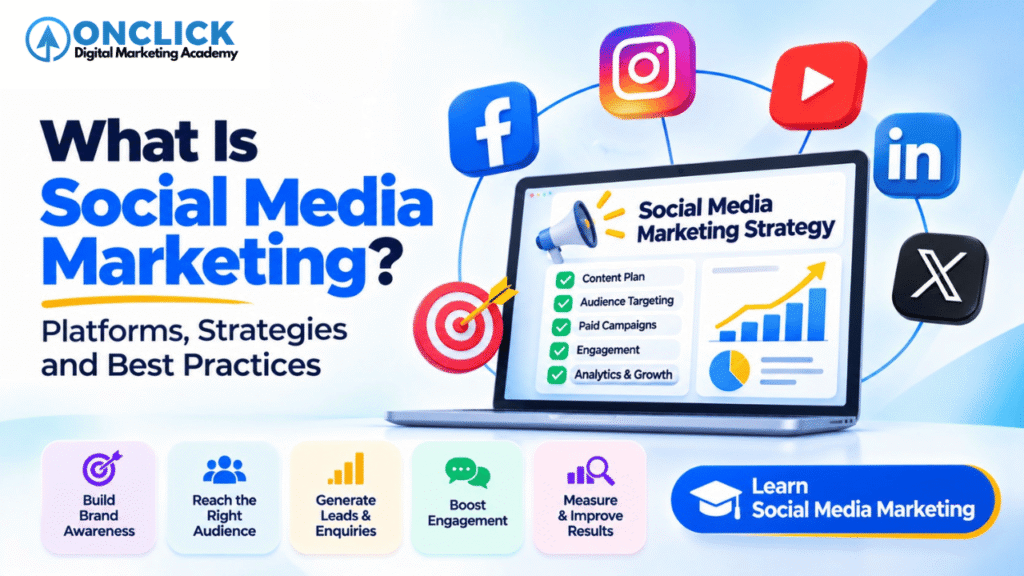
Social media has become an important part of how people communicate, discover brands, research products and make purchasing decisions. Businesses are no longer using social media only to share updates or photographs. They use it to connect with potential customers, build brand awareness, generate leads, promote products and develop long-term customer relationships.
This approach is known as Social Media Marketing (SMM). It involves using social media platforms such as Instagram, Facebook, LinkedIn, YouTube and Pinterest to promote a business, communicate with audiences and achieve marketing objectives.
Whether you are a student planning to enter the digital marketing industry, a business owner looking to promote your products, or a working professional interested in improving your marketing skills, understanding social media marketing can help you make better marketing decisions.
In this guide, we will explore what social media marketing is, how different platforms work, the strategies businesses use, important tools, best practices and the skills required to build a career in this field.
Social Media Marketing is the process of creating, publishing, managing and promoting content through social media platforms to reach a specific audience and achieve business goals.
It includes both organic marketing and paid advertising.
Organic social media marketing focuses on building an audience naturally through regular posts, reels, stories, videos, discussions and community engagement.
Paid social media marketing involves running advertisements on platforms such as Instagram, Facebook and LinkedIn to reach selected audiences based on factors such as interests, demographics, location and online behaviour.
For example, imagine a training institute in Hyderabad offering courses in digital marketing, graphic design and web development. It can use Instagram to publish educational reels, Facebook to promote upcoming batches, LinkedIn to share career-related information and YouTube to upload detailed course videos.
These activities help the institute reach potential students and encourage them to enquire about its courses.
The main objective of social media marketing is not simply to collect likes and followers. It is to build meaningful relationships with the right audience and support measurable business results.
Social media marketing has become an essential part of digital marketing because it allows businesses to communicate directly with their audiences.
Here are some important benefits.
Brand awareness means helping people recognise and remember a business.
Regularly publishing useful and engaging content helps businesses introduce their products, services and brand identity to potential customers.
For example, a clothing brand can publish product photographs, styling tips, customer experiences and seasonal collections to improve brand visibility.
Social media platforms provide audience-targeting features that help businesses reach people based on different characteristics.
Businesses can create campaigns for specific age groups, interests, professions, locations and behaviours.
For example, a company offering professional training programmes may target college students, graduates and job seekers who are interested in developing new skills.
Social media can become an effective source of business enquiries.
Businesses can use lead-generation advertisements, enquiry forms, direct messages, WhatsApp links and website landing pages to encourage interested users to contact them.
A well-planned campaign can turn social media engagement into genuine business opportunities.
Social media gives businesses an opportunity to interact with customers through comments, messages, polls, stories and live sessions.
Responding to questions, addressing concerns and sharing useful information can help develop trust and improve customer relationships.
Businesses can share website articles, service pages, product pages and landing pages through social media.
When users find the content relevant, they may visit the website to learn more, explore products or submit an enquiry.
Social media platforms provide analytics that help marketers understand how their content and campaigns are performing.
Metrics such as reach, impressions, engagement, video views, clicks and conversions help businesses identify successful activities and improve future campaigns.
Every social media platform has its own audience, content format and marketing opportunities. Choosing the right platform depends on the business type, target audience and marketing objective.
Instagram is one of the most widely used platforms for visual content and brand communication.
Businesses use Instagram to publish photographs, reels, stories, carousels and promotional content.
Important Instagram marketing features:
Instagram Reels for short-form video content.
Stories for daily updates, polls and interactive content.
Carousel posts for educational information and step-by-step guides.
Instagram Insights for analysing account performance.
Direct Messages for customer communication.
Instagram advertising for paid audience targeting.
Example: A digital marketing training institute can publish reels explaining SEO concepts, Instagram marketing tips, Google Ads basics and student learning experiences.
Instagram works particularly well for brands that can communicate their products or services through visual storytelling.
Facebook provides businesses with opportunities to build communities, publish updates and run targeted advertisements.
It is useful for local businesses, educational institutions, service providers, retail brands and many other industries.
Important Facebook marketing features:
Business Pages for professional brand representation.
Facebook Groups for building communities.
Facebook Reels for short-form videos.
Meta Ads Manager for advertising campaigns.
Messenger for customer communication.
Facebook Insights for performance measurement.
Example: A local business can create a Facebook Page, publish service information, share customer feedback and run advertisements to reach potential customers in its target area.
LinkedIn is a professional networking platform mainly used for business communication, recruitment, professional branding and B2B marketing.
Companies use LinkedIn to reach decision-makers, industry professionals, job seekers and potential business partners.
Important LinkedIn marketing activities:
Publishing professional articles and industry updates.
Sharing company achievements and announcements.
Building a professional company page.
Promoting webinars and industry events.
Connecting with relevant professionals.
Running LinkedIn advertising campaigns.
Example: A software training company can use LinkedIn to share industry insights, course information, career guidance and professional development content.
LinkedIn marketing is especially valuable for businesses targeting other businesses and professionals.
YouTube is a video-sharing platform that supports educational content, entertainment, product demonstrations and brand storytelling.
Businesses can use YouTube to develop long-term content libraries and reach audiences through searchable videos.
Important YouTube marketing activities:
Educational videos and tutorials.
Product demonstrations.
Customer testimonials.
Shorts for short-form video marketing.
Search-friendly video titles and descriptions.
Playlists for organising content.
YouTube Analytics for performance tracking.
Example: A digital marketing institute can publish tutorials about SEO, Google Ads, social media strategy and digital marketing career opportunities.
Pinterest is a visual discovery platform where users search for ideas, inspiration and products.
It is particularly useful for industries such as fashion, interior design, food, travel, beauty and creative services.
Businesses can publish attractive pins that direct users to their websites, blogs or product pages.
X, formerly known as Twitter, is useful for real-time communication, discussions, industry updates and brand announcements.
Businesses can participate in relevant conversations, share quick updates and communicate with their audiences.
The most suitable platform depends on where a business’s target audience spends time and what kind of content the business can consistently produce.
Successful social media marketing requires planning. Simply publishing posts every day without a clear objective may not produce meaningful results.
A structured marketing process helps businesses organise their activities.
Start by deciding what you want to achieve.
Common social media marketing objectives include:
Increasing brand awareness.
Generating website traffic.
Increasing product enquiries.
Improving audience engagement.
Generating qualified leads.
Promoting new products or services.
Building an online community.
Your objectives should be clear enough to measure.
For example, instead of saying “increase Instagram engagement”, define a measurable objective such as improving the average engagement rate over a specific campaign period.
Understanding your audience is essential before creating content or advertisements.
Consider the following factors:
Age group.
Location.
Profession.
Interests.
Education level.
Customer requirements.
Online behaviour.
Problems your product or service can solve.
For example, a professional training institute may target graduates, final-year students, job seekers and working professionals interested in upgrading their skills.
The better you understand your audience, the easier it becomes to create relevant content.
Not every business needs to maintain an active presence on every social media platform.
Choose platforms based on your audience and business objectives.
For example:
Instagram: Visual branding, reels and audience engagement.
Facebook: Communities, local promotion and advertising.
LinkedIn: Professional networking and B2B marketing.
YouTube: Tutorials, educational videos and brand storytelling.
Pinterest: Visual discovery and creative inspiration.
Focus on the platforms where your audience is most active.
A content strategy defines what you will publish, who you are targeting and why the content matters.
A good strategy includes different types of content instead of repeatedly publishing advertisements.
Common content categories include:
Educational Content: Tips, tutorials, guides and industry information.
Promotional Content: Product details, service announcements, offers and campaign information.
Engagement Content: Questions, polls, quizzes and interactive posts.
Trust-Building Content: Customer reviews, testimonials, case studies and success stories.
Behind-the-Scenes Content: Team activities, work processes and company culture.
A balanced content strategy helps businesses communicate consistently without making every post look like a sales advertisement.
Once your strategy is ready, prepare the content.
This may include:
Designing social media posters.
Creating short-form videos.
Writing captions.
Preparing hashtags where relevant.
Editing images and videos.
Adding appropriate calls to action.
Scheduling posts.
Content should match the platform and audience. A detailed educational carousel may work well on Instagram, while an industry-focused professional update may be more suitable for LinkedIn.
Publishing content is only one part of social media marketing.
Marketers should also respond to comments, answer messages, participate in relevant conversations and understand audience feedback.
Consistent communication can help brands build stronger relationships with their followers.
After publishing content or launching a campaign, analyse its performance.
Review reach, impressions, engagement, clicks, video views, leads and conversions.
Identify which content formats work well, which topics attract attention and where users stop interacting.
Use these insights to improve the next campaign.
A strong social media strategy combines content planning, audience research, platform selection and performance analysis.
Here are some strategies businesses can use.
Content marketing focuses on providing useful and relevant information to an audience.
Instead of promoting products in every post, businesses can educate their followers through tutorials, industry updates, tips and practical guides.
For example, a digital marketing brand can publish:
SEO tips for beginners.
Instagram content creation guides.
Social media advertising explanations.
Website traffic improvement tips.
Digital marketing career guidance.
Useful content can help a brand become a valuable source of information in its industry.
Short-form videos have become an important content format across Instagram Reels, YouTube Shorts and Facebook Reels.
Businesses can use short videos to explain concepts, demonstrate products, answer questions and communicate brand messages.
An effective short video generally needs:
A strong opening hook.
A clear topic.
Useful information.
Good visual presentation.
A relevant call to action.
For example, a 30-second video explaining three Instagram marketing mistakes can attract users who want to improve their social media skills.
Influencer marketing involves collaborating with content creators who have an established audience.
Businesses may work with influencers to introduce products, demonstrate services or communicate brand messages.
Before choosing an influencer, marketers should consider audience relevance, engagement quality, content style and campaign objectives.
A large follower count alone does not guarantee campaign success.
Paid social media advertising allows businesses to promote content beyond their existing followers.
Platforms such as Facebook and Instagram provide advertising tools through Meta Ads Manager.
Businesses can create campaigns for different objectives, including awareness, traffic, engagement, leads and sales, depending on available platform options.
A successful advertising campaign requires:
Clear campaign objectives.
Relevant audience targeting.
Strong creative content.
Appropriate landing pages.
Budget planning.
Conversion tracking.
Continuous performance optimisation.
Community building focuses on developing meaningful connections between a brand and its audience.
Businesses can create conversations through social media groups, interactive stories, live sessions, discussions and useful content.
An active community can support customer relationships and encourage people to engage with a brand over time.
User-generated content refers to content created by customers or users about a brand, product or service.
Examples include customer photographs, product reviews, testimonials and experience videos.
With appropriate permission, businesses can share this content to demonstrate real customer experiences and build trust.
A social media content calendar is a schedule that organises what content will be published, on which platform and when.
It helps marketing teams plan their work and maintain consistency.
A basic content calendar should include:
Publishing date.
Social media platform.
Content category.
Post topic.
Content format.
Caption.
Creative status.
Publishing status.
Example: One-Week Social Media Content Calendar
| Day | Platform | Content Topic | Format |
|---|---|---|---|
| Monday | Social Media Marketing Tips | Carousel | |
| Tuesday | Industry Insights | Professional Post | |
| Wednesday | Marketing Mistakes | Reel | |
| Thursday | Service Information | Creative Post | |
| Friday | YouTube | Digital Marketing Tutorial | Video |
| Saturday | Frequently Asked Questions | Stories | |
| Sunday | Weekly Industry Summary | Text Post |
This is only a sample schedule. Businesses should adjust their publishing frequency based on available resources, audience preferences and campaign requirements.
Social media marketers use different tools to create content, manage accounts, schedule posts and analyse campaign performance.
Some commonly used tools include:
Canva is a graphic design platform used to create social media posts, presentations, advertisements, carousels and other marketing creatives.
It is useful for marketers who need to prepare professional-looking designs without starting every creative from scratch.
Meta Business Suite helps businesses manage their Facebook and Instagram presence.
Depending on account eligibility and available features, users can manage content, review messages, schedule posts and access performance insights.
Meta Ads Manager is used to create, manage and analyse advertising campaigns across Meta platforms.
It provides tools for campaign setup, audience selection, budget management, creative testing and performance reporting.
Buffer is a social media management platform that supports content planning, scheduling and performance review for supported social channels.
Hootsuite provides social media management features that help teams organise publishing activities, monitor accounts and review performance.
Google Analytics 4 helps marketers understand how visitors interact with a website.
It can be useful for measuring website traffic and analysing how users arriving from social media interact with important pages and events.
CapCut is a video editing application used to create short-form videos, add captions, edit clips and prepare social media content.
The right tools depend on your workflow, budget and marketing requirements. Learning how to use tools is important, but understanding marketing strategy is even more valuable.
Measuring performance is necessary to understand whether a social media strategy is working.
Here are some important metrics.
Reach: The number of unique accounts that have seen your content.
Impressions: The total number of times your content has been displayed.
Engagement: Interactions such as likes, comments, shares and saves.
Engagement Rate: A measure of audience interaction relative to a selected base, such as reach or followers. The calculation should be defined consistently when comparing campaigns.
Click-Through Rate (CTR): The percentage of people who clicked a link after seeing an advertisement or content placement.
Cost Per Click (CPC): The average amount spent for each click in a paid campaign.
Cost Per Lead (CPL): The average advertising cost required to generate a lead.
Conversions: Desired actions completed by users, such as submitting an enquiry form, registering for a programme or purchasing a product.
Video Views and Watch Time: Measures that help marketers understand video visibility and how long people watch content.
The most important metric depends on the campaign objective. For example, an awareness campaign may focus on reach, while a lead-generation campaign should focus on qualified leads and conversion performance.
To build an effective social media presence, businesses should follow a few important practices.
Use consistent brand colours, typography, tone of voice and visual presentation.
This helps audiences recognise your business across different platforms.
Create content that answers audience questions, solves problems or provides useful information.
Avoid making every post a direct advertisement.
Different platforms have different audience expectations.
Prepare content that suits the platform instead of copying the same post everywhere without modification.
A practical publishing schedule helps businesses stay active and maintain audience interest.
Consistency should be realistic and sustainable.
Timely responses demonstrate that a business values its audience.
Businesses should monitor enquiries and provide accurate information.
Read the advertising policies and community guidelines of each platform.
Avoid misleading claims, unauthorised content and practices that violate platform rules.
Experiment with different creative formats, captions, audiences and campaign approaches.
Use actual performance data to identify improvements instead of relying only on assumptions.
Use original or properly licensed images, videos and music.
Obtain appropriate permission before sharing customer content, testimonials or personal information.
Ameerpet is a well-known training and education area in Hyderabad, and many learners search specifically for email marketing classes in Ameerpet when looking for digital marketing skills.
For beginners, classroom or practical training can provide a structured learning environment.
When evaluating classes, learners should look at whether the training includes hands-on activities rather than only theoretical explanations.
Practicing campaign planning, newsletter creation, audience segmentation, automation, and analy
Even businesses with active social media accounts may struggle to achieve their objectives because of common mistakes.
Posting Without a Strategy: Publishing random content without defined objectives makes it difficult to measure results.
Focusing Only on Followers: A large follower count does not automatically generate leads, sales or meaningful engagement.
Ignoring Audience Feedback: Not responding to comments and messages can negatively affect customer experience.
Using the Same Content Everywhere: Content should be adapted to the audience and format of each platform.
Over-Promoting Products: Constant promotional posts can make an account less useful or engaging.
Ignoring Analytics: Without reviewing performance, marketers may continue investing time and money in ineffective activities.
Using Irrelevant Hashtags: Hashtags should be relevant to the content and platform. Adding large numbers of unrelated hashtags does not guarantee better reach.
Avoiding these mistakes can help businesses develop a more organised and effective social media marketing approach.
Social media marketing is an important skill area within the digital marketing industry. Businesses need professionals who can plan content, manage social media accounts, create campaigns and understand performance data.
People who develop practical social media marketing skills may explore different career roles.
A Social Media Executive supports daily account management, content publishing, community engagement and basic performance reporting.
A Social Media Manager plans social media activities, coordinates content production, manages campaigns and monitors performance.
A Social Media Strategist develops marketing plans based on business objectives, audience research, platform selection and campaign insights.
A Content Creator develops photographs, graphics, videos, reels and other digital content for social media platforms.
A Social Media Advertising Specialist plans, launches and optimises paid campaigns using advertising platforms such as Meta Ads Manager.
A Digital Marketing Executive may work across social media, SEO, paid advertising, email marketing, website content and analytics.
The skills required for these roles vary depending on the employer, experience level and responsibilities.
To build a career in social media marketing, learners should develop a combination of creative, technical and analytical skills.
Important skills include:
Social media platform management.
Content planning and calendar preparation.
Caption writing and copywriting.
Basic graphic design.
Short-form video editing.
Instagram and LinkedIn marketing.
Meta Business Suite.
Meta Ads Manager.
Audience research.
Campaign planning.
Social media analytics.
Reporting and communication.
Practical experience is especially important. Learners should practise creating content calendars, designing posts, preparing campaign strategies and analysing sample campaign results.
A portfolio containing practical projects can also help demonstrate skills during job applications.
If you want to build a career in digital marketing, learning social media marketing through structured training and practical projects can help you understand how businesses manage their online presence.
When searching for a Social Media Marketing Training Institute in Hyderabad, compare institutes based on the quality of their curriculum, practical learning opportunities, trainer experience and exposure to real marketing tools.
Here are some factors to consider before selecting a training programme.
Look for a programme that includes practical activities such as creating Instagram posts, preparing content calendars, managing social media pages and analysing performance.
A useful curriculum should cover relevant platforms such as Instagram, Facebook, LinkedIn and YouTube.
Understand how paid advertising works, including campaign objectives, audience targeting, budgets, creative testing and performance analysis.
Social media marketers should understand how to prepare captions, graphics, carousels, reels and other content formats.
Look for training that explains important metrics and how to prepare meaningful performance reports.
Practical assignments can help learners build a portfolio that demonstrates their ability to plan and execute social media marketing activities.
Choosing the right Social Media Marketing Course in Hyderabad should involve more than comparing course fees or certificates. Focus on the practical skills you will gain and how the programme supports your career goals.
A structured social media marketing programme may cover the following topics:
Introduction to social media marketing.
Social media platforms and their audiences.
Social media strategy development.
Instagram account management.
Facebook Page management.
LinkedIn marketing.
YouTube marketing fundamentals.
Social media content planning.
Graphic design for social media.
Reels and short-form video creation.
Meta Business Suite.
Meta Ads Manager.
Audience targeting and campaign planning.
Social media analytics.
Campaign reporting and optimisation.
The exact syllabus varies by institute. Before enrolling, check whether the programme includes practical exercises and opportunities to work with relevant tools.
Social media marketing continues to evolve as platforms introduce new content formats, advertising capabilities and artificial intelligence features.
Marketers are increasingly using AI-assisted tools for content ideas, caption drafts, creative planning and workflow support.
Short-form video, creator collaborations, social commerce, community engagement and data-driven advertising are important areas to understand.
However, technology alone does not make a successful marketer. Audience understanding, creativity, communication, strategic thinking and the ability to analyse results remain important skills.
Professionals who continue learning and adapting to platform changes can develop stronger career opportunities in the digital marketing industry.

Why Should You Learn Digital Marketing in 2027? Introduction: The way businesses promote their products and services has changed significantly. Today, customers search on Google,
How to Find Low-Competition Keywords for a New Website Introduction Starting a new website is exciting, but getting it noticed on Google can be challenging.
Why Choose OnClick Digital Marketing Academy for Practical Digital Marketing Training? Digital marketing has become an important part of how businesses attract customers, promote products
10 AI Tools Digital Marketers Can Use for Content, SEO and Campaigns Artificial Intelligence (AI) is changing the way businesses plan, create and manage their
What Is Social Media Marketing? Platforms, Strategies and Best Practices Social media has become an important part of how people communicate, discover brands, research products
Digital Marketing Career Opportunities in 2026: Roles, Skills and Growth Areas Digital marketing has become an important part of how businesses attract customers, promote products,
What Is Google Ads and How Does PPC Advertising Work? Businesses today use digital marketing to reach potential customers, promote their products, and generate enquiries
SEO vs Google Ads: Which Digital Marketing Skill Should You Learn First? Digital marketing has become an essential part of how businesses attract customers, build
How to Choose the Right Digital Marketing Course in Hyderabad Choosing the right digital marketing course can be an important step toward building a successful
How Does SEO Work? A Step-by-Step Guide for Beginners Have you ever searched for something on Google and wondered why certain websites appear at the
What Is Digital Marketing? A Complete Guide for Beginners Digital marketing has become one of the most important ways for businesses to reach customers, build