Digital Marketing Career Opportunities in 2026: Roles, Skills and Growth Areas

Digital marketing has become an important part of how businesses attract customers, promote products, build brand awareness, and generate sales. As more organisations invest in their online presence, digital marketing skills are useful across industries such as education, e-commerce, healthcare, technology, real estate, and professional services.

For students, fresh graduates, working professionals, and career changers, digital marketing offers several potential career paths. These include Search Engine Optimisation (SEO), Google Ads, social media marketing, content marketing, email marketing, web analytics, and performance marketing.

If you are exploring a digital marketing career in Hyderabad, understanding the available job roles, required skills, learning options, and industry expectations can help you plan your next steps. Hyderabad has businesses across technology, education, retail, healthcare, and other sectors that use digital channels to reach customers. Opportunities vary by employer, experience, and current hiring requirements, so developing practical skills is essential.

This guide explains digital marketing career opportunities in 2026, the skills employers may look for, the difference between beginner and specialist roles, and how to build a practical portfolio. It also explains how to prepare for digital marketing jobs in Hyderabad and develop a long-term career in digital marketing.

What Is Email Marketing?

Email marketing is a digital marketing method that involves sending targeted messages to people through email. These messages can include newsletters, promotional offers, product updates, educational content, event invitations, welcome messages, and follow-up communications.

Unlike communication channels where businesses depend entirely on algorithms or changing platform rules, email allows brands to communicate directly with people who have chosen to receive their messages.

A successful email marketing strategy is not simply about sending large numbers of emails. It involves understanding the audience, creating relevant content, segmenting subscribers, choosing appropriate sending times, and measuring campaign performance.

For this reason, email marketing training generally covers both the creative and technical aspects of campaign management.

What Is Digital Marketing?

Digital marketing is the promotion of products, services, brands, or ideas through online channels. It includes activities that help businesses connect with audiences through search engines, websites, social media, email, online advertising, and other digital platforms.

Unlike traditional marketing methods alone, digital marketing allows organisations to measure many online interactions and evaluate how their campaigns perform.

For example, a training institute can publish useful blog articles to attract organic search traffic, run Google Ads to promote its courses, share educational content on social media, and use analytics to measure enquiries.

Digital marketing professionals help plan, execute, measure, and improve these activities according to business goals.

Main Areas of Digital Marketing

1. Search Engine Optimisation (SEO)

SEO focuses on improving a website’s visibility in organic search results. It involves keyword research, content optimisation, technical website checks, internal linking, and performance analysis.

2. Search Engine Marketing and Google Ads

Paid search advertising allows businesses to display advertisements for relevant search queries. Specialists manage campaigns, budgets, bidding, ad copy, and conversion tracking.

3. Social Media Marketing

Social media marketers plan and publish content, manage brand communication, analyse engagement, and support campaigns on relevant platforms.

4. Content Marketing

Content marketers create and organise useful content, such as blogs, landing pages, videos, guides, and educational resources, to attract and inform audiences.

5. Email Marketing

Email marketers develop campaigns to communicate with subscribers, share updates, nurture leads, and encourage relevant actions while respecting consent and privacy requirements.

6. Web Analytics

Analytics professionals interpret website and campaign data to understand user behaviour, measure conversions, and identify opportunities for improvement.

7. Performance Marketing

Performance marketing focuses on measurable outcomes from paid and other trackable marketing activities. It often involves campaign optimisation, conversion tracking, testing, and reporting.

Understanding these areas can help you choose a specialisation that matches your interests and career goals.

Why Consider a Digital Marketing Career in Hyderabad?

Hyderabad has a varied business environment that includes technology companies, educational institutions, healthcare providers, retailers, start-ups, agencies, and service businesses. Many of these organisations use digital channels to communicate with customers and promote their offerings.

This creates a range of possible settings in which digital marketing professionals can work. However, the availability of specific roles depends on hiring activity, company requirements, experience, and the candidate’s skills.

1. Opportunities Across Different Industries

Digital marketing is not limited to one sector. A professional may work for an educational institution, e-commerce company, digital agency, software business, healthcare organisation, or local service provider.

This variety can help professionals explore industries that match their interests.

2. Different Career Paths

Digital marketing includes generalist and specialist positions. Beginners may start with an executive or assistant role and later specialise in SEO, paid advertising, social media, content strategy, analytics, or performance marketing.

3. Practical Skills Can Demonstrate Your Ability

Employers may assess candidates through practical assignments, portfolio reviews, interviews, and questions about campaign results. Demonstrable skills can help you explain what you know beyond course completion alone.

4. Opportunities to Work With Different Types of Businesses

Digital marketers may work in-house for one company, support several clients through an agency, or provide freelance services after gaining relevant experience.

Each work environment has different responsibilities, deadlines, and expectations.

5. Continued Learning

Digital marketing platforms, search systems, and measurement tools change over time. Professionals who keep learning can adapt their skills to new requirements and explore additional areas of specialisation.

Digital Marketing Career Opportunities in 2026

There is no single digital marketing career path. The right role depends on your strengths, interests, and experience.

1. Digital Marketing Executive

A Digital Marketing Executive may support several marketing activities, including social media content, SEO tasks, email campaigns, website updates, advertising coordination, and reporting.

This role can be suitable for beginners who want to understand how different digital marketing channels work together.

Useful skills include:

  • Digital marketing fundamentals

  • Basic SEO and keyword research

  • Social media content planning

  • Website and landing page basics

  • Analytics and reporting

  • Communication and organisation

2. SEO Executive

An SEO Executive helps improve a website’s organic search visibility. Responsibilities may include keyword research, on-page optimisation, content planning, internal linking, technical checks, and reporting.

This role may suit people who enjoy research, website improvement, and content analysis.

Useful skills include:

  • Keyword research and search intent

  • Title tags and meta descriptions

  • On-page SEO

  • Technical SEO fundamentals

  • Google Search Console

  • Google Analytics

  • Content optimisation

3. Google Ads or PPC Executive

A Google Ads or PPC Executive helps plan and manage paid advertising campaigns. Tasks can include keyword research, campaign setup, ad copywriting, budget monitoring, search-term reviews, and conversion tracking.

This role may appeal to people who enjoy working with data, testing ideas, and measuring campaign performance.

Useful skills include:

  • Google Ads campaign structure

  • Keyword match types

  • Negative keyword research

  • Ad copywriting

  • Bidding and budget management

  • Conversion tracking

  • Performance reporting

4. Social Media Marketing Executive

A Social Media Marketing Executive helps a brand communicate with its audience across relevant social platforms. Responsibilities may include content calendars, caption writing, publishing, community engagement, and performance analysis.

Useful skills include:

  • Social media strategy

  • Content planning

  • Copywriting

  • Basic graphic and video content knowledge

  • Community management

  • Engagement and performance metrics

5. Content Marketing Executive

  • Content marketers plan and create content that answers audience questions, explains products or services, and supports business goals.

    Their work may include blog writing, content briefs, website copy, editorial calendars, and content performance analysis.

    Useful skills include:

    • Writing and editing

    • Search intentresearch

  • Content strategy

  • SEO fundamentals

  • Audience research

  • Content performance measurement

6. Performance Marketing Executive

Performance marketing professionals focus on measurable campaign outcomes. They may manage paid advertising, analyse conversion data, test campaign variations, and work with landing pages to improve results.

Useful skills include:

  • Paid media fundamentals

  • Campaign measurement

  • Conversion tracking

  • Budget management

  • A/B testing concepts

  • Data analysis

  • Reporting and optimisation

7. Digital Marketing Analyst

A Digital Marketing Analyst works with marketing data to understand campaign performance and user behaviour. Depending on the employer, the role may involve dashboards, conversion reports, traffic analysis, and recommendations for campaign improvement.

Useful skills include:

  • Google Analytics

  • Spreadsheet analysis

  • Reporting and dashboards

  • Data interpretation

  • Understanding of marketing metrics

  • Clear communication

8. Email Marketing Specialist

Email marketing specialists develop campaigns for subscribers and customers. Their responsibilities may include audience segmentation, campaign planning, email copywriting, automation workflows, and performance reporting.

Useful skills include:

  • Email copywriting

  • Audience segmentation

  • Campaign scheduling

  • Email automation fundamentals

  • Consent and privacy awareness

  • Open, click, and conversion reporting

9. Digital Marketing Strategist

A Digital Marketing Strategist plans how multiple channels can work together to meet business objectives. This position typically requires experience, analytical thinking, and an understanding of how marketing activities contribute to business outcomes.

Useful skills include:

  • Marketing planning

  • Audience and competitor research

  • Channel strategy

  • Budget allocation

  • Performance analysis

  • Communication and presentation

10. Freelance Digital Marketer

Freelance digital marketers provide services directly to clients. Depending on their expertise, they may offer SEO, paid advertising, social media management, content marketing, website optimisation, or reporting.

Freelancing requires more than technical knowledge. Client communication, project management, pricing, expectation setting, and reliable delivery are also important.

How to Create an Effective Email Newsletter

A newsletter should provide a clear reason for people to continue reading.

Start by identifying your audience and deciding what information would be useful to them.

A simple newsletter structure can be:

Subject Line → Introduction → Main Content → Useful Information → Call-to-Action

For example, a digital marketing newsletter might contain:

  • One SEO tip
  • One social media update
  • One useful marketing resource
  • One blog article
  • A relevant course or service update

The content should be organized so readers can quickly understand the important information.

Essential Digital Marketing Skills to Learn in 2026

To prepare for a career in digital marketing, build a combination of technical, analytical, creative, and communication skills.

1. SEO and Keyword Research

Learn how search engines discover pages, how users search for information, and how to optimise content for relevant search intent.

Practise identifying keywords, mapping them to pages, writing page titles, improving headings, and reviewing website performance.

2. Google Ads and Paid Advertising

Understand campaign objectives, keywords, ad copy, bidding, budget management, and conversion tracking. Learn how to evaluate results instead of focusing only on clicks.

3. Social Media Strategy

Learn to plan content around audience needs and business objectives. Practise creating a content calendar and evaluating relevant engagement and conversion metrics.

4. Content Creation and Copywriting

Digital marketers often write captions, blog articles, landing page content, ad copy, and email messages. Clear writing helps communicate value and guide users toward useful actions.

5. Analytics and Reporting

Learn how to interpret data from tools such as Google Analytics and Google Search Console. Understand metrics such as traffic, impressions, clicks, conversions, and conversion rate.

The aim is to explain what the numbers mean and identify practical next steps.

6. Website and Landing Page Fundamentals

A digital marketer should understand how websites work and how landing pages support campaigns. Familiarity with content management systems such as WordPress can be useful for website updates, publishing content, and coordinating landing page improvements.

7. Design and Video Content Basics

Visual communication is important for many marketing activities. Familiarity with design and video editing tools can help you prepare social media creatives, advertisements, presentations, and short-form content.

8. AI-Assisted Marketing

AI tools can support brainstorming, content outlines, research organisation, reporting assistance, and creative workflows. However, marketers should verify information, protect confidential data, check content quality, and ensure that final work meets business and audience needs.

9. Communication and Problem-Solving

Digital marketers often work with designers, developers, sales teams, clients, and managers. The ability to explain findings, ask relevant questions, manage tasks, and solve problems is important.

10. Adaptability and Continuous Learning

Marketing tools and platform features change. Developing a habit of reviewing reliable documentation, practising new techniques, and analysing results can help you remain effective.

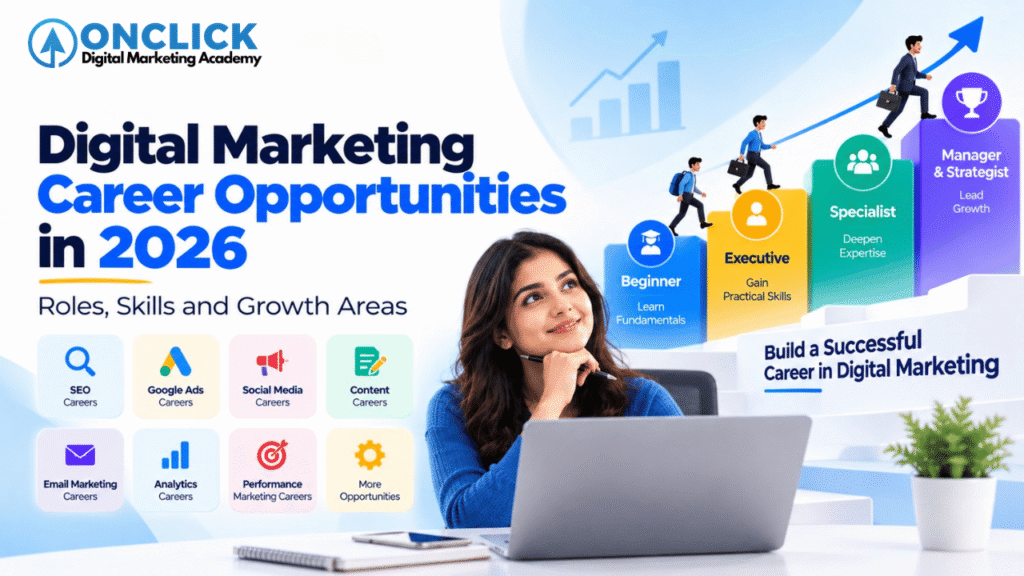
Beginner vs Specialist: How Digital Marketing Careers Grow

A digital marketing career often develops through practical experience rather than a fixed timeline. Job titles and responsibilities vary between organisations.

Career StageTypical ResponsibilitiesSkills to Develop
Beginner / InternResearch, content support, basic reporting, assisted campaign tasksFundamentals, accuracy, communication
ExecutiveManage assigned tasks or channels, update reports, implement campaignsIndependent execution, tools, optimisation
SpecialistOwn a channel or function, troubleshoot issues, improve performanceDeep technical knowledge, analysis, strategy
Senior Specialist / ManagerPlan campaigns, coordinate teams, manage budgets and performanceLeadership, planning, stakeholder communication
Strategist / LeadAlign channels with business goals, guide strategy and measurementBusiness understanding, forecasting, decision-making

You may progress faster in some areas than others depending on the opportunities available, your performance, and the complexity of the work.

How to Build a Digital Marketing Portfolio

A portfolio can help demonstrate your skills when applying for digital marketing jobs in Hyderabad or elsewhere. It does not need to contain confidential client information or impressive claims. It should show how you approach a task and what you learned.

Project 1: SEO Audit

Select a website you are permitted to review. Prepare a report covering page titles, meta descriptions, heading structure, internal links, mobile experience, and technical issues you can verify.

Include recommendations and explain why each one matters.

Project 2: Keyword Research and Content Plan

Research a topic, group related keywords by search intent, and create a content calendar. Explain how each article supports a particular audience need.

Project 3: Google Ads Campaign Plan

Create a sample campaign structure with campaign objectives, keyword groups, negative keyword ideas, ad copy, budget assumptions, and a relevant landing page plan.

Label it as a sample project if it has not run as a live campaign.

Project 4: Social Media Content Calendar

Prepare a calendar with post topics, content formats, captions, intended audience, and objectives. Include examples of how you would measure performance.

Project 5: Analytics Report

Use authorised data or a sample dataset to create a report showing relevant metrics, trends, and recommendations. Never present sample figures as actual business results.

Project 6: Landing Page Improvement

Review a landing page and recommend improvements to its content hierarchy, call to action, mobile layout, readability, and form experience.

A well-organised portfolio can help you explain your process during interviews and show that you can connect marketing tasks to business goals.

How to Prepare for Digital Marketing Jobs in Hyderabad

If you are searching for digital marketing jobs in Hyderabad, take a structured approach to your job search.

1. Choose a Starting Role

Decide whether you want to begin as a Digital Marketing Executive, SEO Executive, PPC Executive, Social Media Executive, or Content Marketing Executive.

Review current job descriptions to understand the skills employers request most often for the roles you prefer.

2. Learn the Relevant Tools

Choose tools that match the role. For example, SEO learners may start with Google Search Console and Google Analytics, while paid advertising learners can study Google Ads fundamentals and conversion measurement.

Do not try to master every tool at once. Focus on the tools required for your target position.

3. Complete Practical Projects

Prepare two or three relevant projects and document your process. Employers may ask how you approached a problem, why you selected a particular strategy, and how you would measure success.

4. Prepare Your Resume

Keep your resume clear and relevant. Include your skills, tools, practical projects, training, internships, and previous work experience where applicable.

Avoid listing a tool as an advanced skill unless you can explain how you have used it.

5. Practise Interview Questions

Prepare to explain basic SEO concepts, Google Ads campaign structure, social media metrics, conversion tracking, and common marketing reports.

Use project examples to demonstrate how you think through problems.

6. Research Employers

Look at the services, industries, and marketing channels used by the organisations you apply to. This can help you prepare more relevant applications and questions.

7. Keep Improving Your Portfolio

Update your projects as you learn. Include clear explanations of your contribution and any genuine outcomes that you can support with evidence.

How to Choose a Digital Marketing Course in Hyderabad

A suitable training programme can help organise your learning and provide guided practice. When comparing a digital marketing course in Hyderabad, evaluate the course based on your career goals rather than choosing only by advertising claims.

1. Check the Course Syllabus

Look for relevant coverage of SEO, Google Ads, social media marketing, content marketing, analytics, and campaign measurement. If you already have a target role, check whether the course covers the specialised skills required for that role.

2. Ask About Practical Training

Find out whether the course includes assignments, case studies, campaign planning, website exercises, and reporting practice.

Practical exercises help you connect theory to real marketing tasks.

3. Understand the Trainers’ Experience

Ask about the trainers’ relevant experience and how they teach practical concepts. A useful course should explain the reasoning behind marketing decisions, not just the steps to click through a tool.

4. Check Tools and Learning Resources

Ask which tools are demonstrated, whether access is included, and whether additional subscriptions or advertising spend are required.

5. Review Portfolio Support

A programme that helps you complete practical projects can make it easier to demonstrate your learning to employers.

6. Understand Career Support

Ask what interview preparation, resume guidance, or placement assistance is provided. Treat career support as a service to evaluate, not a guarantee of employment.

7. Compare Course Format and Cost

Consider class schedules, course duration, learning format, fees, support, and your available time. Choose a programme you can realistically complete and practise alongside.

Digital Marketing Career Growth Areas in 2026

Digital marketing continues to involve several areas of development. The relevance of each area depends on industry needs and the individual role.

1. Data-Driven Marketing

Businesses need to understand which activities contribute to meaningful outcomes. Skills in analytics, reporting, conversion measurement, and interpreting campaign data can help marketers make better decisions.

2. Automation and AI-Assisted Workflows

Automation and AI tools can help with repetitive tasks and support research, content workflows, and reporting. Human judgement remains important for accuracy, strategy, originality, privacy, and quality control.

3. Performance Marketing

Organisations that invest in paid campaigns need professionals who understand targeting, budgets, conversion tracking, and optimisation. Strong measurement skills can help connect advertising activities to business objectives.

4. Search and Content Quality

SEO continues to require useful content, technical accessibility, and an understanding of user intent. Content should solve genuine audience problems rather than exist only to include keywords.

5. Conversion Rate Optimisation

Conversion rate optimisation focuses on improving the percentage of users who complete a desired action. It can involve landing page structure, form design, messaging, usability, and controlled testing.

6. Integrated Digital Marketing

Businesses may use several channels together, including SEO, paid advertising, social media, email, and content marketing. Professionals who understand how these channels contribute to a shared goal can help coordinate more effective campaigns.

7. Privacy-Aware Measurement

Digital marketers need to understand consent, data protection, tracking limitations, and the responsible use of customer information. Measurement practices should respect applicable laws, platform policies, and user expectations.

Common Mistakes to Avoid When Starting a Digital Marketing Career

Trying to learn every tool at once: Start with the fundamentals and develop depth in a few relevant tools before expanding.

Relying only on certificates: Certificates can support your profile, but practical knowledge and the ability to explain your work are also important.

Ignoring analytics: Learn how to interpret results and connect marketing activities to business objectives.

Making unsupported claims: Never invent campaign results, client projects, or placement outcomes in a resume or portfolio.

Copying content without understanding it: Learn why a strategy works and adapt it to the audience, industry, and business goal.

Expecting instant results: Digital marketing requires testing, analysis, improvement, and consistent practice. Results vary by channel and circumstances.

Neglecting communication skills: Clear reporting and professional communication are important in nearly every digital marketing role.

Frequently Asked Questions

1. Is digital marketing a good career option in 2026?

Digital marketing can be a suitable career for people interested in online communication, analytics, content, advertising, and customer behaviour. Opportunities and career growth depend on skills, experience, employer needs, and the ability to deliver useful work.

2. What are the main digital marketing jobs in Hyderabad?

Possible roles include Digital Marketing Executive, SEO Executive, Google Ads Executive, Social Media Marketing Executive, Content Marketing Executive, Performance Marketing Executive, and Digital Marketing Analyst. Actual openings vary over time.

3. What skills should a beginner learn first?

Start with digital marketing fundamentals, keyword research, SEO basics, content creation, social media, analytics, and paid advertising concepts. Then focus on the skills relevant to your preferred role.

4. Can freshers apply for digital marketing jobs?

Yes. Some employers recruit freshers for internships, trainee roles, and entry-level positions. A relevant portfolio, clear communication, and practical understanding can help demonstrate readiness.

5. Do I need coding skills for digital marketing?

Coding is not required for many entry-level digital marketing tasks. However, basic HTML, website knowledge, and technical troubleshooting can be useful for SEO, analytics implementation, and website-related work.

6. How do I get digital marketing jobs in Hyderabad?

Choose a target role, learn its required skills, complete practical projects, prepare a relevant resume, and apply for suitable openings. Review job descriptions and prepare to discuss your work during interviews.

7. Which digital marketing specialisation should I choose?

Choose based on your interests. SEO may suit people who enjoy research and website optimisation, Google Ads may suit people who like campaign analysis, and social media or content marketing may suit people who enjoy communication and creative work.

8. Is a digital marketing course necessary?

A course can provide structure and guided practice, but it is not the only way to learn. You can also study reliable resources and build projects independently. Evaluate a course by its syllabus, practical work, trainer experience, and support.

9. What should I include in a digital marketing portfolio?

Include relevant projects such as an SEO audit, keyword research plan, sample Google Ads campaign, social media calendar, analytics report, or landing page review. Explain your process and clearly distinguish sample work from live results.

10. Can I work as a freelance digital marketer?

Freelancing is a possible path after you develop skills that clients need. You will also need to manage client expectations, project scope, communication, pricing, reporting, and delivery.

11. What is the difference between a digital marketing executive and a specialist?

An executive may handle assigned tasks across one or more channels, while a specialist usually develops deeper expertise in a particular area. Responsibilities differ between organisations.

12. How can I keep my digital marketing skills updated?

Practise regularly, review official platform documentation, study relevant case studies, learn from campaign data, and adapt your knowledge as tools and industry requirements change.