๐ŸŽ„ Christmas & New Year Special Offer! Get 20% OFF on Our Digital Marketing Course. Enroll Now & Boost Your Career! ๐ŸŽ

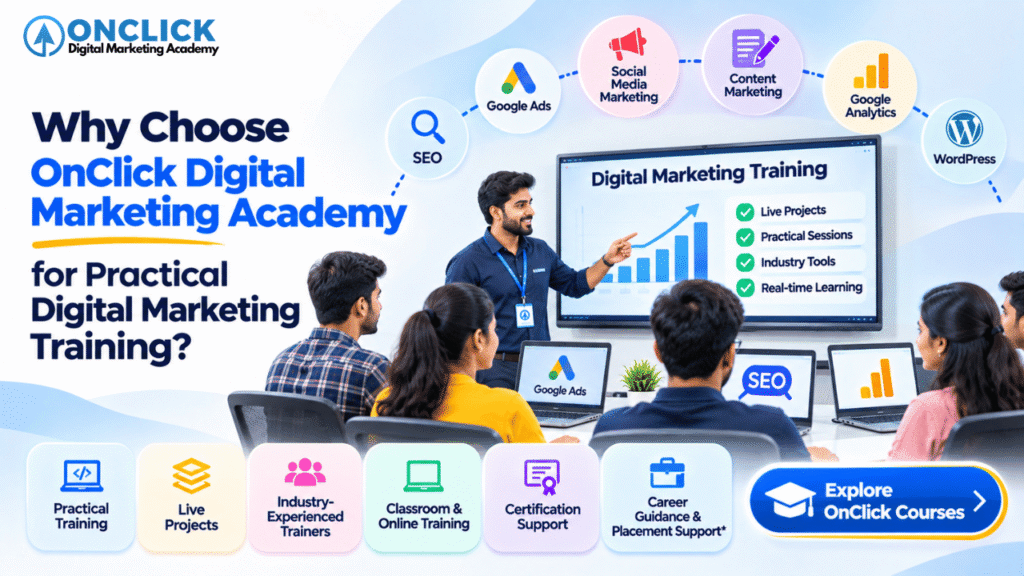
Why Choose OnClick Digital Marketing Academy for Practical Digital Marketing Training?

Digital marketing has become an important part of how businesses attract customers, promote products and build their online presence. Companies across different industries use search engines, social media platforms, websites, online advertisements and email marketing to connect with their target audiences.

As businesses continue investing in online marketing, the demand for professionals with practical digital marketing skills is growing. Students, fresh graduates, working professionals, entrepreneurs and business owners are increasingly interested in learning digital marketing to develop their careers or promote their businesses.

However, learning digital marketing involves more than understanding definitions and watching tutorials. Students need to understand how marketing platforms work, create campaigns, perform keyword research, manage social media accounts, analyse website performance and work with real marketing tools.

This is where choosing the right training institute becomes important.

OnClick Digital Marketing Academy focuses on practical digital marketing education, covering important areas such as Search Engine Optimisation (SEO), Google Ads, Social Media Marketing, content marketing, website development, analytics and AI-powered marketing tools.

If you are searching for a digital marketing institute in Hyderabad, this article explains why practical training matters, what you can learn at OnClick Digital Marketing Academy and how the right learning approach can help you prepare for digital marketing opportunities.

1. Why Is Practical Digital Marketing Training Important?

Digital marketing is a skill-based field. Understanding concepts is necessary, but students also need opportunities to apply what they learn.

For example, reading about Google Ads can help you understand paid advertising. However, creating a campaign, selecting keywords, setting a budget, writing advertisements and analysing campaign performance require practical experience.

Similarly, learning SEO involves more than understanding search engine algorithms. Students should practise keyword research, website optimisation, content planning and performance analysis.

Practical training helps students connect theoretical knowledge with real marketing activities.

Some important benefits include:

  • Understanding how digital marketing platforms work.

  • Developing confidence in using marketing tools.

  • Learning how to plan and execute campaigns.

  • Practising website and content optimisation.

  • Understanding marketing analytics and reporting.

  • Building projects that demonstrate practical skills.

  • Preparing for real workplace responsibilities.

At OnClick Digital Marketing Academy, the learning approach includes practical sessions, assignments, live projects and business case studies to help students understand how digital marketing concepts are applied.

2. Learn Multiple Digital Marketing Modules Under One Programme

Digital marketing includes several interconnected areas. A professional should understand how these channels work individually and how they support an overall marketing strategy.

OnClick Digital Marketing Academy offers training across different digital marketing subjects.

Search Engine Optimisation (SEO)

SEO is the process of improving a website’s visibility in organic search engine results.

It helps businesses attract relevant visitors through search engines without depending entirely on paid advertisements.

Students can develop knowledge of:

  • Introduction to SEO.

  • Keyword research.

  • Search intent.

  • On-page SEO.

  • Off-page SEO.

  • Technical SEO fundamentals.

  • Website structure and optimisation.

  • Content optimisation.

  • Link-building concepts.

  • SEO performance monitoring.

Practical SEO exercises can help students understand how to research keywords, optimise website pages and evaluate organic search performance.

Google Ads and Pay-Per-Click Advertising

Google Ads is an online advertising platform that helps businesses promote products and services through paid campaigns.

Learning Google Ads gives students an understanding of how businesses reach potential customers through search and other advertising formats.

Important learning areas include:

  • Google Ads account setup.

  • Campaign structure.

  • Keyword research.

  • Keyword match types.

  • Search advertising.

  • Display advertising.

  • Ad copywriting.

  • Bidding strategies.

  • Budget management.

  • Conversion tracking.

  • Campaign reporting.

Practical campaign exercises help learners understand the relationship between advertising budgets, keywords, clicks, leads and conversions.

Social Media Marketing

Social Media Marketing involves using platforms such as Instagram, Facebook, LinkedIn and YouTube to promote brands, communicate with audiences and generate business opportunities.

Students can learn:

  • Social media platform management.

  • Instagram marketing.

  • Facebook marketing.

  • LinkedIn marketing.

  • Social media content planning.

  • Reels and creative content.

  • Social media advertising.

  • Audience engagement.

  • Campaign management.

  • Performance analytics.

These skills can support careers in social media management, content marketing and digital advertising.

Content Marketing

Content marketing focuses on creating valuable information that attracts and engages a target audience.

Businesses use blogs, articles, videos, guides, social media posts and other content formats to educate customers and communicate their brand message.

Students can learn how to:

  • Research content topics.

  • Understand audience requirements.

  • Prepare blog outlines.

  • Write website content.

  • Create social media captions.

  • Develop content calendars.

  • Optimise articles for SEO.

  • Plan content distribution.

Content marketing knowledge is useful for businesses that want to improve brand visibility and attract organic website traffic.

Google Analytics and Marketing Performance

Marketing campaigns need to be measured to understand whether they are achieving their objectives.

Analytics helps businesses understand website visitors, traffic sources, user behaviour and important conversion activities.

Students can develop an understanding of:

  • Website performance measurement.

  • Traffic source analysis.

  • User behaviour.

  • Event and conversion tracking.

  • Campaign performance.

  • Marketing reports.

  • Data-driven decision-making.

Understanding analytics helps marketers identify what is working and where improvements are required.

WordPress and Website Development

A website is an important part of a business’s digital presence.

Learning WordPress helps students understand how to create and manage websites without needing to develop everything from scratch.

Important topics may include:

  • WordPress installation and setup.

  • Website structure.

  • Pages and posts.

  • Themes and plugins.

  • Website design.

  • Responsive layouts.

  • Landing page creation.

  • Basic website optimisation.

  • Blogging and content management.

Website knowledge is particularly useful for digital marketers because SEO, paid advertising and content marketing often depend on well-designed landing pages and websites.

Graphic Design and Video Editing

Digital marketing requires attractive visual content for websites, advertisements and social media platforms.

Graphic design and video editing skills help marketers create engaging marketing materials.

Students can explore:

  • Social media creative design.

  • Canva.

  • Promotional posters.

  • Instagram carousels.

  • YouTube thumbnails.

  • Short-form video editing.

  • Reels and promotional videos.

  • Visual content planning.

These skills are useful for content creators, social media executives and digital marketing professionals.

AI Tools in Digital Marketing

Artificial Intelligence is becoming an important part of modern marketing workflows.

AI tools can support content planning, creative development, keyword research, campaign analysis and repetitive marketing activities.

Students can explore how AI-powered tools such as ChatGPT and Canva AI can support marketing tasks.

The goal is to understand how to use these tools responsibly while maintaining content quality, originality and marketing accuracy.

3. Focus on Practical Sessions and Live Projects

One of the important factors to consider when selecting a digital marketing institute in Hyderabad is whether the training includes practical activities.

Students should have opportunities to apply the concepts they learn instead of depending entirely on classroom explanations.

At OnClick Digital Marketing Academy, the training approach includes practical sessions, live projects, assignments and real-world business case studies.

Here are examples of activities that help develop practical understanding.

SEO Practice

Students can practise keyword research, analyse website pages, improve headings and content, and understand basic SEO performance.

Google Ads Practice

Learners can understand campaign setup, keyword selection, advertising copy, budget planning and conversion tracking.

Social Media Marketing Practice

Students can prepare content calendars, create social media posts, develop captions and understand campaign performance.

Website Development Practice

Learners can practise creating website pages, organising website content and understanding responsive design.

Marketing Case Studies

Business case studies help students examine marketing activities, understand business requirements and think about suitable digital marketing strategies.

Working on these activities helps learners connect different marketing concepts and develop practical confidence.

4. Learn From Industry-Experienced Trainers

Digital marketing platforms and strategies continue to evolve. Search engine updates, advertising features, social media formats and AI tools can change how marketing activities are performed.

Learning from trainers with industry experience can help students understand how marketing concepts are applied in professional environments.

OnClick Digital Marketing Academy highlights trainers with 9+ years of industry experience on its website.

Learning with experienced trainers can help students:

  • Understand important digital marketing concepts.

  • Learn practical approaches to marketing tasks.

  • Clarify doubts during training.

  • Understand how businesses use marketing channels.

  • Develop knowledge of industry tools.

  • Receive guidance while completing assignments and projects.

Students should also actively participate in sessions, ask questions and practise independently to make the most of their training.

5. Classroom and Online Digital Marketing Training

Different students have different learning requirements.

Some prefer attending classroom sessions, while others need the flexibility of online learning because of work, education or personal schedules.

OnClick Digital Marketing Academy lists both classroom training and online live training options.

Classroom Training

Classroom learning provides an opportunity to interact directly with trainers and other students.

It can be useful for learners who prefer face-to-face explanations, practical demonstrations and in-person doubt clarification.

Online Live Training

Online live sessions provide an alternative for students who prefer learning remotely.

They can participate in interactive sessions without needing to travel to the training centre.

Before enrolling, students should confirm the available batch timings, learning mode, course duration and practical support for their selected programme.

6. Industry-Focused Digital Marketing Curriculum

Digital marketing training should cover the skills that businesses commonly use to promote their products and services.

A useful curriculum connects multiple marketing channels rather than teaching every subject as an isolated topic.

For example, a business may use SEO to attract organic visitors, Google Ads to generate immediate enquiries, social media marketing to build awareness and analytics to measure campaign performance.

Understanding how these activities work together helps students develop a broader marketing perspective.

The courses listed by OnClick Digital Marketing Academy include subjects such as:

  • Search Engine Optimisation.

  • Google Ads.

  • Google Analytics.

  • Social Media Marketing.

  • Content Marketing.

  • WordPress.

  • Digital Marketing with AI.

  • Graphic Design.

  • Video Editing.

Students can explore the available programmes and select a course based on their interests and career objectives.

7. Build a Portfolio Through Practical Assignments

A portfolio is a collection of projects that demonstrates what a person can do.

For students entering the digital marketing industry, a portfolio can help explain their practical knowledge during interviews and client discussions.

Instead of only mentioning that you know SEO or social media marketing, you can demonstrate your skills through completed projects.

Examples of portfolio projects include:

SEO Project

Prepare a sample website SEO audit, keyword research document and on-page optimisation plan.

Social Media Project

Create a one-month content calendar with sample Instagram posts, captions and campaign ideas.

Google Ads Project

Prepare a sample campaign structure with keywords, advertisements, audience considerations and budget planning.

Website Project

Build a sample WordPress website with important pages, responsive layouts and SEO-friendly content.

Content Marketing Project

Write a blog article with a keyword strategy, meta title, meta description and internal linking suggestions.

Analytics Project

Prepare a sample marketing report explaining website traffic, engagement and conversion performance.

OnClick’s website also highlights placement training and portfolio-building support as part of its career preparation activities.

8. Career Guidance and Placement Assistance

Learning digital marketing is one part of preparing for a career. Students also need to understand how to present their skills to potential employers.

A professional resume, a well-organised portfolio and good interview preparation can help candidates communicate their abilities more effectively.

OnClick Digital Marketing Academy lists career support activities such as:

  • Resume preparation.

  • LinkedIn profile optimisation.

  • Mock interviews.

  • Placement training.

  • Career guidance.

  • Portfolio-building support.

  • Internship opportunities, subject to programme requirements.

These activities are intended to help students prepare for job applications and understand workplace expectations.

Placement assistance should be understood as career support, not a guarantee of employment. Final recruitment decisions depend on employer requirements, candidate performance and available opportunities.

How to Choose an Email Marketing Course in Hyderabad

If you are searching for an email marketing course in Hyderabad, look beyond the course title.

Consider whether the training covers practical areas such as:

  • Campaign creation
  • Newsletter development
  • Lead nurturing
  • Automation
  • Audience segmentation
  • Email analytics
  • Practical assignments
  • Real-world examples
  • Marketing strategy

It can also be useful to understand how email marketing connects with other digital marketing channels.

For example, an email campaign can work alongside SEO, social media, paid advertising, content marketing, landing pages, and analytics.

This broader understanding can help learners approach email marketing as part of a complete digital marketing strategy.

9. Digital Marketing Career Opportunities

Digital marketing offers opportunities across different industries because businesses need professionals who understand online customer acquisition and brand communication.

After developing relevant skills and practical experience, learners may explore roles such as the following.

Digital Marketing Executive

A Digital Marketing Executive supports marketing activities across SEO, social media, paid advertising, content and campaign management.

SEO Executive

An SEO Executive works on keyword research, website optimisation, content improvements and organic search performance.

Social Media Executive

A Social Media Executive manages social media accounts, plans content, creates posts and monitors engagement.

Google Ads Specialist

A Google Ads Specialist works on paid advertising campaigns, keyword targeting, budget management and conversion tracking.

Content Marketing Executive

A Content Marketing Executive creates website articles, blogs, social media content and other marketing materials.

Performance Marketing Executive

A Performance Marketing Executive focuses on advertising campaigns, campaign metrics, lead generation and conversion optimisation.

Website Designer

A Website Designer creates and manages websites, landing pages and other online experiences using website development tools.

Graphic Designer and Video Editor

These professionals create visual content, advertisements, promotional designs and marketing videos.

The specific role you can pursue depends on your skills, practical experience, portfolio and employer requirements.

10. Who Can Join a Digital Marketing Course?

Digital marketing is relevant to people from different educational and professional backgrounds.

Students and Fresh Graduates

Students can learn digital marketing fundamentals and develop practical skills that may support their entry into the industry.

Working Professionals

Professionals interested in changing careers or adding digital marketing knowledge to their existing skill set can explore structured training.

Business Owners

Entrepreneurs can learn how SEO, social media and online advertising support business growth.

Freelancers

Freelancers can develop skills that help them offer services such as website management, social media marketing, content creation and SEO.

Job Seekers

Candidates interested in marketing roles can build their knowledge through training, assignments and practical projects.

Previous digital marketing experience is not necessarily required for a beginner-level programme. Students should check the eligibility and course requirements before enrolling.

11. Why Choose OnClick Digital Marketing Academy in Hyderabad?

When comparing training institutes, it is important to look beyond course names and promotional claims.

Consider the learning environment, practical curriculum, trainers, tools, projects and career support.

Here are some features highlighted by OnClick Digital Marketing Academy:

Practical Learning Approach: The academy highlights hands-on sessions, live projects, assignments and business case studies.

Experienced Trainers: Its website mentions trainers with 9+ years of industry experience.

Multiple Digital Marketing Modules: Students can explore SEO, Google Ads, social media marketing, analytics, content marketing, WordPress and other related subjects.

Classroom and Online Options: Both classroom training and online live training are listed.

Career Preparation: Resume guidance, LinkedIn profile optimisation, mock interviews and portfolio-building support are highlighted.

Internship Opportunities: The academy lists internship opportunities for students, subject to its programme requirements.

Certification Support: The academy mentions course completion certificates and support for relevant industry certifications.

Multiple Training Locations: Students can explore the academy’s training centres in Hyderabad and enquire about the most suitable branch.

These features can help prospective students evaluate whether the programme matches their learning requirements.

12. How to Choose the Right Digital Marketing Course

Before enrolling in any digital marketing programme, take time to compare the important details.

Here is a checklist that can help.

Check the Course Syllabus

Make sure the course covers the subjects you want to learn.

A comprehensive programme may include SEO, Google Ads, social media marketing, analytics, content marketing and website development.

Understand the Practical Training

Ask how practical sessions are conducted and whether students work on projects, assignments and campaign exercises.

Review the Trainers’ Experience

Understand the trainers’ professional background and their experience with digital marketing tools and platforms.

Ask About Learning Tools

Find out which tools and platforms are included in the training.

Understand the Career Support

Ask what support is provided for resumes, interviews, portfolios and internship opportunities.

Confirm Course Duration and Fees

Check the course duration, batch schedule, fee structure and any additional charges before enrolling.

Attend a Demo or Counselling Session

A demo session can help you understand the teaching approach, course structure and learning environment before making a decision.

13. Explore Digital Marketing Courses at OnClick

OnClick Digital Marketing Academy provides different training programmes for students and professionals interested in developing digital marketing skills.

Depending on your interests, you can explore programmes covering:

  • Digital Marketing.

  • Search Engine Optimisation.

  • Google Ads.

  • Social Media Marketing.

  • Google Analytics.

  • Content Marketing.

  • WordPress.

  • Digital Marketing with AI.

  • Graphic Design.

  • Video Editing.

The academy offers course information through its official website.

You can explore the available programmes here:

OnClick Courses: https://onclickdigitalmarketing.com/courses/

For students who are still deciding which programme to select, a counselling or demo session can help clarify the syllabus, learning mode and course requirements.

14. Frequently Asked Questions About OnClick Digital Marketing Academy

1. Why should I choose OnClick Digital Marketing Academy?

OnClick Digital Marketing Academy highlights practical training, live projects, industry-experienced trainers, multiple digital marketing modules and career preparation support.

2. Is OnClick suitable for beginners?

The academy’s website describes its digital marketing course as suitable for beginners, starting with fundamentals and progressing into advanced topics.

3. Does OnClick provide practical digital marketing training?

Yes. The academy highlights practical sessions, live projects, assignments, business case studies and real-time marketing activities.

4. Which subjects are covered in the digital marketing course?

The available programmes include SEO, Google Ads, Social Media Marketing, Google Analytics, content marketing, WordPress, AI-powered digital marketing, graphic design and video editing.

5. Are online and classroom training available?

The academy lists both classroom training and online live training. Confirm current batch availability before enrolling.

6. Does OnClick provide placement assistance?

Yes. The academy lists placement assistance, resume preparation, LinkedIn profile optimisation, mock interviews and career guidance. Placement assistance does not guarantee a job.

7. Are internship opportunities available?

The academy lists internship opportunities for students. Eligibility, duration and availability should be confirmed with the academy before enrolment.

8. Can business owners learn digital marketing?

Yes. Business owners can explore digital marketing training to understand website promotion, SEO, social media marketing, online advertising and customer acquisition.

9. How can I explore OnClick courses?

Visit the official courses page at https://onclickdigitalmarketing.com/courses/ to review available programmes and submit an enquiry.

10. Where can I find OnClick Digital Marketing Academy?

OnClick lists training centres in Hyderabad, including Ameerpet, Dilsukhnagar, Abids and Kukatpally. Check the official branches page for current contact information and addresses.