
SEO vs Google Ads: Which Digital Marketing Skill Should You Learn First?
SEO vs Google Ads: Which Digital Marketing Skill Should You Learn First? Digital marketing has become an essential part of how businesses attract customers, build
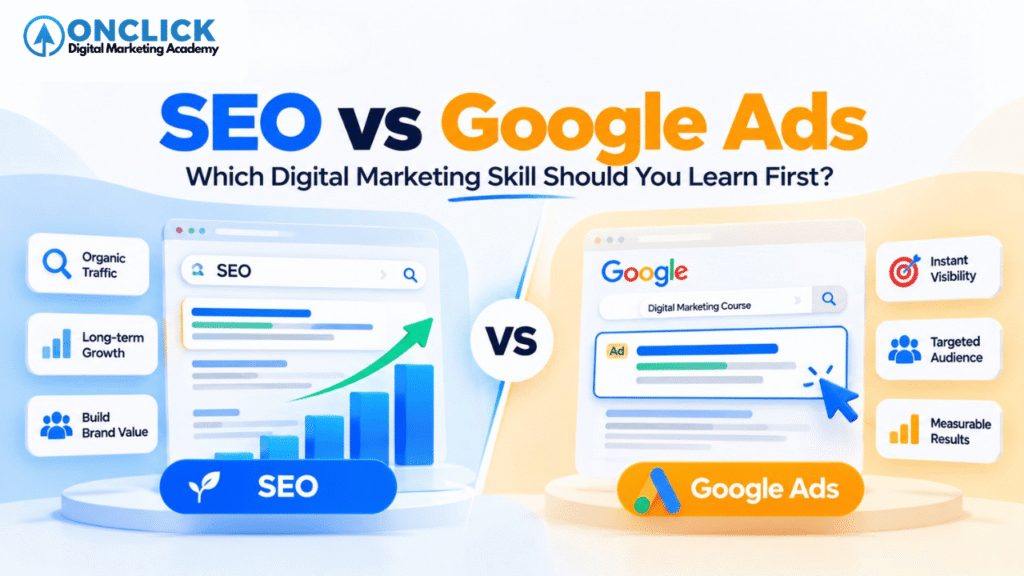
Digital marketing has become an essential part of how businesses attract customers, build brand awareness, and increase sales. From small local businesses to large companies, organisations use online marketing strategies to reach people who are actively searching for products and services. Among the most popular digital marketing skills are Search Engine Optimisation (SEO) and Google Ads.
Both SEO and Google Ads help businesses appear on Google Search, but they work in different ways. SEO focuses on improving a website’s visibility in organic search results, while Google Ads allows businesses to display paid advertisements for relevant search queries. Understanding these differences can help students, job seekers, business owners, and aspiring marketers choose the right skill to learn first.
If you are exploring digital marketing as a career, you may wonder whether to start with SEO or Google Ads. Should you learn how to rank websites organically, or should you focus on paid campaigns that can generate traffic quickly? The answer depends on your career goals, interests, learning preferences, and the type of work you want to do.
For students looking for an SEO Training Institute in Hyderabad or a Google Ads Training Institute in Hyderabad, understanding both skills is an important first step. This guide compares SEO and Google Ads, explains their benefits and limitations, explores career opportunities, and helps you decide which skill to learn first.
Search Engine Optimisation, commonly known as SEO, is the process of improving a website so that it can appear more prominently in organic search engine results. Organic results are the unpaid listings displayed by search engines when users search for information, products, services, or solutions.
For example, someone might search for “best digital marketing course in Hyderabad.” SEO helps a relevant website improve its chances of appearing in those search results by providing useful content, a technically sound website, and a good user experience.
SEO does not guarantee a particular ranking. Search engines consider many factors, including content relevance, page quality, website accessibility, competition, and user intent.
1. Keyword research
Keyword research involves identifying the search terms people use when looking for information or services. Marketers study search intent, competition, and keyword relevance before selecting terms to target.
For example, a training academy may target keywords such as:
Digital Marketing Course in Hyderabad
SEO Course for Beginners
Google Ads Training Institute in Hyderabad
The goal is to match relevant keywords with useful pages rather than inserting keywords unnaturally into content.
2. On-page SEO
On-page SEO focuses on improving individual website pages. It includes writing relevant title tags, creating useful meta descriptions, structuring headings, optimising images, improving internal links, and making content easy to understand.
A well-optimised page should answer the visitor’s question clearly and help them take the next step.
3. Technical SEO
Technical SEO helps search engines discover, crawl, and understand a website. It includes checking website speed, mobile usability, indexing, XML sitemaps, canonical tags, redirects, and other technical elements.
4. Content optimisation
Search engines aim to provide useful results for users. SEO professionals create and improve blog articles, landing pages, service pages, FAQs, and other resources that meet a specific search intent.
5. Off-page SEO
Off-page SEO includes activities that help build a website’s authority and reputation outside its own pages. Relevant backlinks, digital PR, and genuine industry mentions can contribute to a website’s overall credibility.
6. SEO analytics
SEO professionals use tools such as Google Search Console and Google Analytics to evaluate organic performance. They monitor impressions, clicks, click-through rate, traffic, conversions, and page-level results to identify opportunities for improvement.
Google Ads is Google’s online advertising platform. It allows businesses to create paid campaigns that can appear in Google Search and other eligible placements, depending on the campaign type and settings.
Unlike organic SEO, Google Ads can provide visibility soon after a campaign is approved and becomes eligible to serve. Advertisers choose campaign objectives, audiences, keywords or targeting options, budgets, bidding strategies, and ad creatives.
For example, a training institute may run a search campaign targeting people looking for a digital marketing course. When a user’s search matches the campaign’s targeting and the ad wins the relevant auction, the advertisement may appear in the results.
Ad placement is not determined by budget alone. Google Ads considers factors such as bid, ad quality, expected impact of assets, and other auction-time signals.
1. Campaign setup
Campaign setup involves selecting an objective, choosing an appropriate campaign type, defining location and language settings, and configuring budget and bidding.
2. Keyword research and search intent
For Search campaigns, advertisers identify relevant search terms and organise them into logical ad groups. Negative keywords can help reduce irrelevant traffic.
3. Ad copywriting
Google Ads specialists write clear, relevant ad headlines and descriptions. Effective ads communicate the offer, highlight a benefit, and guide users toward a useful next step.
4. Bidding and budget management
Advertisers choose bidding strategies based on their goals, such as clicks, conversions, or conversion value. Budgets and bids should be managed according to campaign performance and business objectives.
5. Landing page optimisation
A paid campaign should lead users to a page that matches the advertisement. A relevant landing page, clear call to action, fast loading experience, and simple enquiry form can improve the visitor experience.
6. Conversion tracking and reporting
Conversion tracking helps measure valuable actions, such as form submissions, phone calls, purchases, or registrations. Accurate measurement is important for understanding whether advertising is generating business results.
7. Campaign optimisation
Google Ads professionals analyse search terms, cost per click, conversion rate, cost per conversion, and other relevant metrics. They use this information to improve targeting, ads, landing pages, and bidding decisions.
The biggest difference is how visibility is obtained. SEO aims to improve organic visibility over time, whereas Google Ads uses paid advertising to reach eligible audiences.
| Comparison Factor | SEO | Google Ads |
|---|---|---|
| Traffic type | Organic search traffic | Paid advertising traffic |
| Cost model | Requires time, expertise, and resources; no payment per organic click to Google | Usually involves advertising spend, with costs depending on campaign and bidding model |
| Speed | Generally takes time to build visibility | Can generate visibility relatively quickly after approval and eligibility |
| Sustainability | Strong rankings can continue to attract traffic, but require ongoing work | Traffic from ads generally reduces or stops when campaigns stop serving |
| Main skills | Content, keyword research, technical optimisation, analytics | Campaign setup, ad copy, bidding, targeting, conversion tracking |
| Measurement | Impressions, clicks, rankings, organic conversions | Spend, clicks, conversions, cost per conversion, return on ad spend where applicable |
| Best suited for | Long-term organic visibility and content-led growth | Time-sensitive offers, targeted campaigns, lead generation, and measurable paid promotion |
| Main challenge | Competition, algorithm changes, and delayed results | Advertising costs, auction competition, and campaign efficiency |
Neither channel is universally better. The right choice depends on the organisation’s goals, budget, competition, timeline, and available resources.
SEO is a valuable skill for people who enjoy research, writing, website improvement, and long-term strategy.
SEO teaches you to understand search behaviour, identify content opportunities, improve websites, and measure organic performance. These skills can be applied across many industries.
SEO professionals may work on educational websites, e-commerce stores, local businesses, service companies, blogs, and corporate websites. Each project presents different search challenges.
SEO involves both analytical and creative tasks. You might research keywords in the morning, improve page titles in the afternoon, and review technical issues or analytics later.
Local SEO helps eligible businesses improve their visibility for location-relevant searches. For example, a training academy can create helpful course pages, maintain accurate business information, and publish locally relevant content.
Beginners can practise by auditing a website, researching keywords, improving a sample page, preparing a content plan, and analysing available performance data. These projects can help demonstrate practical knowledge to potential employers.
SEO teaches marketers to consider the questions, problems, and needs behind a search query. This understanding is useful for content marketing, website planning, and broader digital strategy.
Google Ads is particularly useful for learners who enjoy numbers, experimentation, campaign planning, and performance analysis.
You learn how to organise campaigns, define objectives, allocate budgets, create advertisements, and evaluate results.
Paid campaigns can help businesses test different headlines, offers, and landing pages. Results must be interpreted carefully, but structured testing can reveal which messages are more effective.
Google Ads provides performance data that helps marketers understand how advertising spend relates to clicks and conversions. Accurate conversion tracking is essential for meaningful analysis.
Depending on the campaign type and business requirements, Google Ads can support search visibility, lead generation, sales, app promotion, and other advertising objectives.
Campaign management is not simply about launching an advertisement. Professionals must analyse results, identify wasted spend, review search terms, improve landing pages, and make informed changes.
A learner can build sample campaign structures, create mock advertisements, practise keyword grouping, and prepare reporting dashboards without necessarily spending money on a live campaign. Real campaign experience is useful when it can be obtained responsibly within an approved budget.
Neither SEO nor Google Ads is automatically easier for everyone. The learning experience depends on your interests and how you prefer to solve problems.
SEO may feel more comfortable if you enjoy writing, researching topics, improving website pages, and working toward gradual results. It requires patience because search visibility can take time to develop, and outcomes are not guaranteed.
Google Ads may appeal to you if you like structured campaign settings, data analysis, testing, and working with budgets. Although ads can begin serving relatively quickly, managing campaigns effectively requires careful measurement and ongoing optimisation.
Both skills require analytical thinking, an understanding of customer behaviour, and the ability to communicate marketing results.
A good beginner approach is to understand digital marketing fundamentals first, then learn SEO and Google Ads through practical exercises. This helps you see how the channels differ and where they complement each other.
Both skills can support a digital marketing career. Opportunities depend on your practical ability, communication skills, portfolio, location, experience, and the requirements of individual employers.
Possible roles include:
SEO Executive
SEO Analyst
Technical SEO Specialist
SEO Content Strategist
Local SEO Specialist
SEO Specialist
Organic Growth Specialist
Typical responsibilities may include keyword research, website audits, content optimisation, technical checks, competitor research, and performance reporting.
Possible roles include:
Google Ads Executive
PPC Executive
Paid Search Specialist
Performance Marketing Executive
Digital Advertising Analyst
Search Campaign Manager
Performance Marketing Specialist
Responsibilities may include campaign planning, keyword targeting, ad copywriting, budget management, conversion tracking, and performance reporting.
If you prefer organic growth, content strategy, and website optimisation, SEO may be a suitable starting point. If you prefer paid campaigns, structured experiments, and performance measurement, Google Ads may be a better initial fit.
You do not need to commit to only one skill for your entire career. Many marketers develop expertise in both and later specialise in SEO, paid media, analytics, content strategy, or a broader digital marketing role.
Although SEO and Google Ads use different methods, they can support the same business objectives. Learning both gives you a more complete understanding of how customers discover businesses online.
A user searching for “what is SEO” may be looking for information, while someone searching for “SEO training institute in Hyderabad” may be comparing training options. SEO and Google Ads can help businesses reach relevant audiences at different stages of the customer journey.
SEO teaches you to identify what people want from a search. Google Ads teaches you to create targeted messages that respond to relevant searches. Combining these skills can improve your understanding of customer needs.
SEO encourages useful content, logical page structure, and a positive user experience. Google Ads highlights the importance of matching ad messages to landing pages and measuring conversions. Both disciplines benefit from relevant, user-friendly pages.
A business may use SEO to build organic visibility while running Google Ads to promote a new service or reach potential customers for a time-sensitive offer. The right mix depends on budget, competition, conversion goals, and available resources.
A portfolio containing a keyword research report, an SEO audit, a content plan, a sample Google Ads campaign structure, and a performance report can demonstrate a broader range of digital marketing skills.
Use the following recommendations to choose a starting point based on your interests and goals.
Choose SEO first if:
You enjoy writing, research, and content planning.
You want to understand how websites attract organic traffic.
You are interested in technical website optimisation.
You prefer building long-term visibility rather than relying only on paid promotion.
You want to practise keyword research, on-page SEO, and website audits.
Choose Google Ads first if:
You enjoy working with numbers and performance reports.
You want to understand paid search campaigns.
You are interested in budget allocation, targeting, and bidding strategies.
You like testing advertisements and comparing results.
You want to learn how to measure advertising conversions.
Learn both if:
You want a broad foundation in digital marketing.
You are interested in managing campaigns across multiple channels.
You want to understand both organic and paid search.
You plan to work with agencies, businesses, or clients who need integrated marketing support.
For most beginners who are still exploring their interests, starting with digital marketing fundamentals and then learning the basics of SEO and Google Ads is a practical approach. You can specialise after completing introductory projects in both areas.
If you want to specialise in organic search, selecting the right training programme is an important step. A good course should explain concepts clearly and provide opportunities to apply them.
When comparing an SEO Training Institute in Hyderabad, consider these factors.
The course should cover keyword research, search intent, on-page SEO, technical SEO, content optimisation, off-page SEO, local SEO, and analytics.
It should also explain how to evaluate SEO performance using relevant tools and reports.
Practical learning helps you understand how SEO concepts work in real situations. Look for exercises involving page optimisation, keyword mapping, website audits, internal linking, and content planning.
SEO professionals need to interpret performance data. A useful course should introduce Google Search Console, Google Analytics, and reporting methods where appropriate.
Search engines change their systems over time. Ask how the course addresses search intent, content quality, technical accessibility, and changes in SEO practices.
Check the trainer’s relevant experience, teaching approach, and ability to explain practical examples. Student reviews can be helpful, but consider multiple sources rather than relying on a single testimonial.
Find out whether you will complete practical assignments that you can discuss during interviews. A portfolio should show your process, the work completed, and the results when genuine results are available.
If paid advertising interests you, compare courses based on the quality of their campaign training and measurement practices.
When evaluating a Google Ads Training Institute in Hyderabad, look for the following.
The syllabus should cover campaign objectives, account structure, keyword targeting, ad creation, bidding strategies, budget management, and campaign optimisation.
It should also explain when different campaign types are suitable.
For search campaigns, learners should understand how to select relevant keywords, organise ad groups, review search terms, and use negative keywords to limit irrelevant traffic.
Conversion tracking is essential for evaluating campaign performance. Ask whether the course explains how to measure actions such as enquiry submissions, phone calls, registrations, and purchases.
A practical programme should give you opportunities to write ad headlines and descriptions, understand ad relevance, and connect advertising messages to suitable landing pages.
You should understand key metrics such as impressions, clicks, click-through rate, cost per click, conversions, cost per conversion, and return on ad spend when applicable.
Ask how campaign budgets are handled during training. Live advertising can involve real costs, so clarify whether the course uses demonstrations, simulations, or approved live campaigns.
Understanding the main performance metrics helps you evaluate both channels more accurately.
Metric | SEO | Google Ads |
|---|---|---|
Impressions | How often organic listings appear in search results, as reported by relevant tools | How often ads are shown |
Clicks | Clicks on organic search listings | Clicks on advertisements |
Click-through rate | Percentage of impressions that result in clicks | Percentage of ad impressions that result in clicks |
Rankings | Position of pages for relevant search queries | Ad position may vary by auction and context |
Conversions | Valuable actions attributed to organic traffic | Valuable actions attributed to paid traffic |
Cost | Requires resources for content, expertise, tools, and website work | Includes advertising spend and management resources |
Cost per conversion | Can be estimated by allocating SEO costs across measured conversions | Can be measured from campaign costs and conversions |
Return on investment | Evaluated against SEO costs and business outcomes | Evaluated against advertising and management costs and business outcomes |
These metrics should be interpreted in context. A large number of clicks does not necessarily mean a campaign is successful. The quality of visitors, relevance of the landing page, conversion rate, and business value of the outcome also matter.
For example, an SEO page may attract many visitors but generate few enquiries because its content does not match the visitor’s needs. A Google Ads campaign may generate clicks but produce poor results if its targeting is too broad or its landing page is unclear.
The objective is not simply to increase traffic. It is to attract relevant visitors and help them complete meaningful actions.
Yes. Both channels can help local businesses reach people who are searching for relevant products, services, or training opportunities.
For example, a student searching for “SEO Training Institute in Hyderabad” may be exploring courses, comparing syllabuses, or looking for practical training. A business searching for “Google Ads Training Institute in Hyderabad” may want to develop paid advertising skills for a new career or existing business.
A training institute can use SEO to build relevant course pages, publish helpful educational blogs, and improve its local online presence. It can also use Google Ads to promote specific courses to relevant audiences, subject to campaign settings and advertising policies.
Businesses should select keywords carefully, create useful landing pages, and measure enquiries rather than judging success by traffic alone.
Local SEO and paid search can complement each other, but they serve different purposes. SEO supports organic discovery over time, while Google Ads can provide paid visibility when campaigns are eligible to serve.
If you are unsure where to begin, follow this roadmap to develop your skills progressively.
Understand how customers discover businesses online, how search engines work, and how digital marketing channels support business goals. Learn the basics of customer journeys, search intent, landing pages, and conversion tracking.
Practise keyword research, on-page optimisation, title tags, meta descriptions, internal linking, and content planning. Explore technical SEO concepts and learn how to use Google Search Console.
Practice project: Select a sample website and prepare a keyword map, page optimisation checklist, and blog content plan.
Understand campaign objectives, search keywords, ad groups, ad copy, bidding, budgets, and negative keywords. Study how campaign settings influence the audience an advertisement can reach.
Practice project: Create a sample Search campaign structure with relevant keywords, negative keywords, advertisements, and a proposed landing page. You can practise planning without launching a paid campaign.
Learn to interpret impressions, clicks, click-through rate, conversions, and other relevant performance metrics. Practise preparing reports that explain what happened, why it may have happened, and what should be tested next.
Document your projects clearly. Include the original objective, your research, the steps you completed, the reasoning behind your decisions, and the results if real performance data is available.
Never invent campaign results or claim improvements that you have not measured.
After learning the fundamentals, decide whether you prefer SEO, paid advertising, or a combination of both. You can then deepen your knowledge through more advanced projects and relevant certifications.
It depends on your interests. SEO may suit learners who enjoy content, research, and website optimisation. Google Ads may suit learners who prefer campaign management, budgets, and performance analysis. Learning the fundamentals of both can help you make a more informed choice.
SEO can support long-term organic visibility, but rankings and traffic are never guaranteed. Google Ads can deliver paid visibility while campaigns are eligible to serve. Many businesses use both channels based on their objectives and resources.
You can learn the fundamentals over a period of weeks with consistent study and practice. Developing the ability to handle complex websites, technical issues, and competitive search markets generally requires more experience.
The basics of campaign structure, targeting, and ad creation can be learned through guided practice. Becoming proficient in optimisation, conversion measurement, and budget management takes additional experience.
No. Beginners can start with keyword research, content optimisation, and basic website audits without coding. Some technical SEO tasks benefit from familiarity with HTML, website structure, and troubleshooting.
No. Most standard campaign management tasks can be completed through the Google Ads interface. Knowledge of tracking implementation, website analytics, or tag management can be helpful for more advanced work.
Look for a relevant syllabus, practical website exercises, experienced trainers, analytics training, updated learning materials, and portfolio support. Ask how assignments are evaluated and what you will be able to demonstrate after completing the course.
Check whether the course covers campaign setup, keyword targeting, ad copywriting, bidding, budget management, conversion tracking, and optimisation. Ask about practical exercises and whether live advertising spend is required.
Yes. Learning both can help you understand organic and paid search strategies. Start with the fundamentals, practise each channel separately, and then explore how they can support a shared marketing objective.
Both can support freelance services. SEO freelancers may offer keyword research, website audits, content optimisation, and local SEO. Google Ads freelancers may offer campaign setup, management, tracking, and optimisation. Your success will depend on your skills, client communication, service quality, and ability to demonstrate value.
Certifications can demonstrate structured learning, but they do not guarantee employment. Practical projects, analytical thinking, communication skills, and the ability to explain your work are also important.
Not necessarily. Beginners can start with demonstrations, sample campaign structures, and guided exercises. If you later run a live campaign, use an approved budget, configure tracking carefully, and understand the financial risk before spending.

SEO vs Google Ads: Which Digital Marketing Skill Should You Learn First? Digital marketing has become an essential part of how businesses attract customers, build
How to Choose the Right Digital Marketing Course in Hyderabad Choosing the right digital marketing course can be an important step toward building a successful
How Does SEO Work? A Step-by-Step Guide for Beginners Have you ever searched for something on Google and wondered why certain websites appear at the
What Is Digital Marketing? A Complete Guide for Beginners Digital marketing has become one of the most important ways for businesses to reach customers, build
How to Choose the Best Digital Marketing Training Institute in Hyderabad Choosing a digital marketing training institute is an important decision, particularly if your goal
Digital Marketing Course After Graduation: Career Guide for Freshers, Career Gap Learners and Homemakers Graduation is often seen as the point where a student should
Digital Marketing for Business Owners in Hyderabad: How to Get Leads from SEO, Google Ads and GBP A practical digital marketing strategy can combine SEO,
Google AdSense Course: Blogging, Website Monetization and Approval Learning Path Building a blog or website can be more than an exercise in publishing content. With
Affiliate Marketing Course for Beginners: How It Works, Skills Needed and Mistakes to Avoid Affiliate marketing has become an important part of the digital marketing
Email Marketing Course: Learn Campaigns, Newsletters, Lead Nurturing and Automation Email marketing continues to be an important part of digital marketing because it gives businesses
Google Analytics 4 Reporting: A Practical Beginner Workflow Google Analytics 4 Reporting: A Practical Beginner Workflow Google Analytics 4 reporting means turning website activity into