
How Does SEO Work? A Step-by-Step Guide for Beginners
How Does SEO Work? A Step-by-Step Guide for Beginners Have you ever searched for something on Google and wondered why certain websites appear at the
Have you ever searched for something on Google and wondered why certain websites appear at the top while others appear much lower in the search results?
Whether you search for a product, service, course, restaurant, tutorial, or answer to a question, search engines such as Google have to process an enormous amount of information before displaying the results.
For example, if someone searches for “SEO Course in Hyderabad”, Google needs to identify webpages that are relevant to that search, understand what those pages offer, evaluate different signals, and then display the most useful results.
This entire process is connected to Search Engine Optimization, commonly known as SEO.
SEO is one of the most important areas of digital marketing because it helps websites become more visible in organic search results. When implemented correctly, SEO can help businesses attract relevant visitors, generate leads, increase brand visibility, and build long-term online presence.
However, SEO is not simply about adding keywords to a webpage.
It involves understanding how search engines discover webpages, how they process and store information, how they understand search queries, and how they determine which pages should appear in search results.
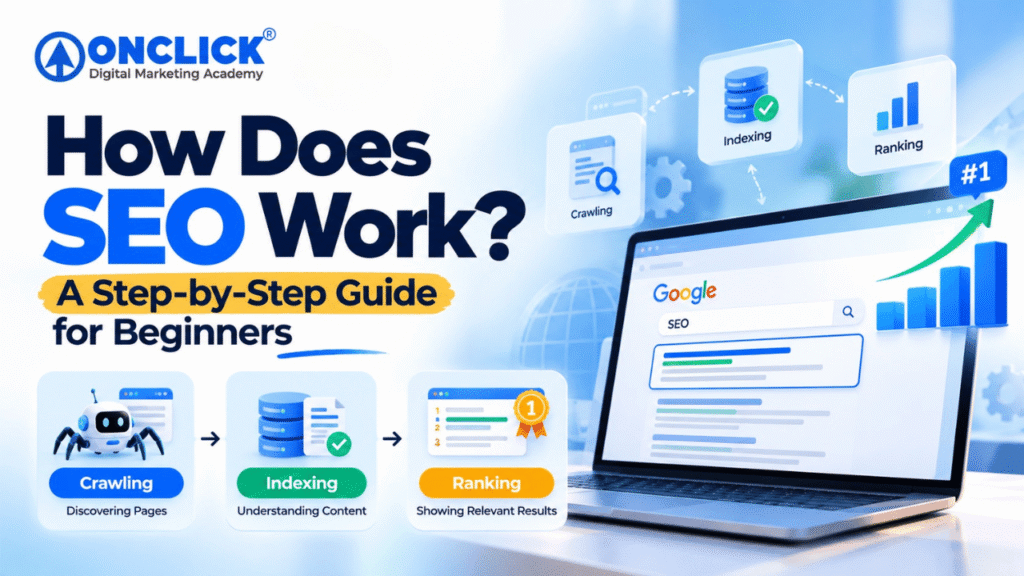
For beginners, the easiest way to understand the basic SEO process is through three important stages:
Crawling → Indexing → Ranking
In this complete guide, we will explain how SEO works, how Google discovers websites, what indexing means, how ranking works, the major areas of SEO, common mistakes beginners make, and how you can start learning SEO professionally.
SEO stands for Search Engine Optimization.
It is the process of improving a website, its content, and its technical structure to help search engines understand the website and improve its visibility for relevant organic searches.
Suppose you have a website that offers digital marketing training.
You may want people searching for terms such as:
Digital Marketing Course in Hyderabad
SEO classes for beginners
Best SEO course
Learn SEO
Search Engine Optimization course
to discover your website.
SEO helps you create and optimize pages that are relevant to these types of searches.
However, the objective of SEO is not simply to rank for keywords.
The larger objective is to:
Help the right users find the right information at the right time.
Good SEO combines:
Useful content
Keyword research
Search intent
Website structure
Technical optimization
Internal linking
Content optimization
Authority
User experience
Analytics
Continuous improvement
Search engines are one of the major ways people discover information online.
Before purchasing a product or service, users may search Google to:
Compare different options
Read reviews
Find prices
Understand a topic
Find a nearby business
Research courses
Learn about a company
Solve a problem
This creates an opportunity for businesses and websites.
If your website appears when someone searches for a topic related to your business, you can potentially attract visitors who are already interested in what you offer.
For example, a person searching for:
“SEO Training in Hyderabad”
may already have an interest in learning SEO.
A relevant webpage can provide that user with:
Course information
Curriculum
Training details
Practical learning information
Career information
Frequently asked questions
SEO therefore helps connect searchers with relevant websites.
The basic SEO process can be explained through three stages:
1. Crawling
Search engines discover webpages and access their content.
2. Indexing
Search engines process and store information about webpages that they determine are eligible for inclusion in their search index.
3. Ranking
When someone searches for something, search engines evaluate relevant indexed pages and determine the order in which results should appear.
The simplified process looks like this:
Website → Crawling → Understanding → Indexing → Search Query → Ranking → Search Results
Let’s understand each stage in detail.
Crawling is the process through which search engines discover and access webpages.
Search engines use automated programs called crawlers, bots, or spiders.
Google’s crawler is commonly known as Googlebot.
Think of a crawler as a digital explorer.
It visits webpages, accesses their content, follows links, and discovers other URLs.
For example, imagine a website has this structure:
Homepage
↓
Digital Marketing Course
↓
SEO Course
↓
SEO Blog
If the SEO course page contains a link to an SEO blog article, search engines can follow that link and discover the article.
This is one reason internal linking is important.
A search engine can discover URLs through different sources.
These may include:
Internal links
External links
XML sitemaps
Previously discovered URLs
Other discovery mechanisms
Suppose you publish a new blog called:
“How Does SEO Work? A Step-by-Step Guide for Beginners”
If another page on your website links to this article, search engines can potentially discover the new page through that internal link.
An XML sitemap can also help search engines understand the URLs that a website considers important.
However, submitting a sitemap does not guarantee that every URL will automatically be indexed.
Internal links are links that connect one page on your website to another page on the same website.
For example:
SEO Blog → SEO Course
or:
Digital Marketing Course → SEO Course → SEO Blog
Internal links can help:
Search engines discover webpages
Users navigate your website
Connect related topics
Establish a logical website structure
Distribute internal signals between pages
For example, if you publish an article explaining SEO basics, you could naturally link to your dedicated SEO course page using relevant anchor text.
This creates a useful journey:
Informational Blog → Course Information → Enquiry
For an education website, this type of internal linking can be particularly useful
Search engines need to be able to access important pages.
Potential crawling problems can include:
Broken links
Server errors
Incorrect robots.txt configuration
Poor website architecture
Excessive redirects
Difficult-to-discover pages
Technical configuration problems
Poor internal linking
Technical SEO helps website owners identify and address these types of problems.
After a search engine discovers a webpage, the next major stage is indexing.
You can think of a search engine’s index as a massive digital library.
When Google discovers a webpage, it analyzes the page and attempts to understand what the page is about.
It can process information such as:
Text
Images
Page title
Headings
Links
Content structure
Main topic
Other relevant information
If the page is eligible for indexing, it can become part of Google’s search index.
An indexed page is a page that has been processed and stored in a search engine’s index.
But beginners often misunderstand one important point:
Indexed does not mean ranked #1.
A page can be:
Crawled → Indexed → Ranking on Page 5
or:
Crawled → Indexed → Ranking on Page 1
Indexing is therefore only one part of the SEO process.
For example, suppose you publish a page targeting:
SEO Course in Hyderabad
Google may crawl the page and index it.
However, there may be many other webpages targeting the same topic.
Google has to determine which pages are most useful and relevant for the particular search.
That brings us to ranking.
Not every webpage that exists on the internet necessarily appears in a search engine’s index.
Possible reasons can include:
Technical problems
Noindex directives
Duplicate content
Low-value content
Canonicalization issues
Crawling problems
Poor website structure
Pages that provide little unique value
This is why SEO professionals use tools such as Google Search Console to monitor indexing and search performance.
Ranking is the stage where search engines determine the order in which relevant search results should appear.
Imagine someone searches:
“How does SEO work?”
Google may have access to thousands or millions of webpages related to the subject.
It needs to determine which pages are most useful for that particular search.
Search engines use complex systems and many signals to evaluate pages.
SEO professionals therefore work on several areas of a website to improve its relevance, quality, accessibility, authority, and usefulness.
The important thing to remember is:
There is no single SEO factor that guarantees a #1 ranking.
SEO is a combination of many elements.
A search query is the word or phrase that a user enters into a search engine.
Examples include:
“What is SEO?”
“SEO course in Hyderabad”
“How to learn SEO?”
“Best SEO tools for beginners”
Every search query can have a different purpose.
Understanding the purpose behind a search is called understanding search intent.
Search intent is the reason why a person performs a particular search.
There are several common types of search intent.
The user wants information.
Examples:
What is SEO?
How does SEO work?
What is keyword research?
How do search engines work?
This blog is primarily targeting informational intent.
The user is researching options before making a decision.
Examples:
Best SEO course in Hyderabad
Best SEO training institute
SEO course fees
SEO course comparison
The user is ready to take an action.
Examples:
Join SEO course
Enroll in SEO training
Buy SEO course
Book SEO demo
The user is looking for a specific website or brand.
Examples:
OnClick Digital Marketing
OnClick SEO course
OnClick Digital Marketing website
Understanding search intent helps you create content that actually matches what users want.
SEO is a broad field.
It can be divided into several major areas.
Keyword research is the process of identifying search terms that users enter into search engines.
For example, someone interested in SEO training may search for:
SEO Training in Hyderabad
SEO classes
SEO course for beginners
Search Engine Optimization course
Learn SEO
Keyword research helps marketers understand what their audience is looking for.
It can help identify:
Search topics
User needs
Search intent
Related queries
Long-tail keywords
Content opportunities
Competitive topics
However, keyword research should not be treated as simply finding the keyword with the highest search volume.
The keyword should be relevant to your audience and business.
Long-tail keywords are usually more specific search phrases.
For example:
SEO
is a broad keyword.
While:
SEO course for beginners in Hyderabad
is more specific.
Long-tail keywords can help businesses target more specific user needs.
For informational content, examples could include:
How does SEO work for beginners?
How long does SEO take?
What is technical SEO?
How does Google ranking work?
Creating content around relevant long-tail queries can help a website address specific questions.
On-page SEO refers to optimization performed on individual webpages.
Important elements include:
Page title
Meta description
Headings
Content
Keywords
URLs
Images
Internal links
Content structure
For example, an article about SEO should have a clear title and logical headings.
Instead of creating one huge block of text, break the article into sections such as:
What is SEO?
How does crawling work?
What is indexing?
How does ranking work?
What are SEO types?
How can beginners learn SEO?
This improves readability and makes the content easier to understand.
Technical SEO focuses on the technical foundation of a website.
It can include:
Website speed
Mobile usability
HTTPS
XML sitemap
Robots.txt
Canonical URLs
Redirects
Crawlability
Indexability
Website architecture
Structured data
Core Web Vitals
Imagine you have excellent content but search engines cannot properly access important pages.
That technical problem can limit the potential visibility of your content.
Technical SEO helps ensure that the website is technically accessible and structured properly.
Off-page SEO refers to activities and signals outside your website that can contribute to search visibility and authority.
One major area is backlinks.
A backlink occurs when another website links to your website.
For example:
Website A → Your Website
Backlinks can help search engines understand relationships between websites and can contribute to authority.
However, SEO is not simply about getting hundreds of links.
Quality and relevance are important.
A relevant, trustworthy link can be much more valuable than a large number of low-quality links.
Local SEO focuses on improving visibility for location-based searches.
For example:
SEO Course in Hyderabad
has a clear local intent.
Businesses targeting local customers can work on:
Google Business Profile
Local keywords
Location pages
Reviews
Business information
Local citations
Relevant local content
For a training institute, local SEO can help connect people searching for training programs with relevant course information.
OnClick Digital Marketing currently provides SEO training and lists SEO, local SEO, Google Ads, WordPress, and other digital marketing services and courses.
Content SEO focuses on creating useful, relevant, search-friendly content.
Good content should answer the user’s question.
For example, if someone searches:
“How does SEO work?”
an article should explain the actual process rather than simply repeating the phrase “SEO course in Hyderabad” throughout the page.
A strong SEO article can include:
Clear explanations
Examples
Step-by-step processes
Relevant statistics when appropriate
Related questions
Practical tips
Helpful visuals
Internal links
The objective should be to satisfy the user.
A common beginner mistake is repeating the same keyword again and again.
For example:
SEO Course in Hyderabad is the best SEO Course in Hyderabad for anyone looking for an SEO Course in Hyderabad…
This creates unnatural content.
Instead, use the primary keyword naturally.
You can also use related terms such as:
SEO training
Search Engine Optimization
SEO classes
Learn SEO
SEO course
Search optimization
The article should remain natural and useful.
SEO should not stop after publishing content.
You need to measure performance.
Important SEO metrics can include:
Organic clicks
Organic impressions
Average position
Click-through rate
Organic traffic
Indexed pages
Keyword visibility
Leads
Conversions
Tools such as Google Search Console can help website owners understand how their webpages perform in Google Search.
Analytics tools can provide additional information about what users do after reaching a website.
Google ranking is much more complex than simply counting keywords.
When someone performs a search, search engines attempt to return results that are relevant and useful for the query.
Different factors and systems can influence how results are displayed.
For SEO professionals, this means there is no single shortcut to ranking.
Instead, websites should focus on:
Relevant content
Good website structure
Technical accessibility
Search intent
Quality information
Helpful user experience
Relevant authority
Strong internal linking
Continuous improvement
SEO should therefore be treated as a long-term process rather than a one-time task.
Let’s take a practical example.
Suppose an institute offers an SEO course.
The institute creates a page:
The page includes:
Course overview
SEO curriculum
Keyword research module
On-page SEO
Technical SEO
Off-page SEO
Local SEO
Tools
Practical projects
FAQs
The institute then creates supporting blog content such as:
What Is SEO?
How Does SEO Work?
What Is Keyword Research?
On-Page SEO vs Off-Page SEO
How Long Does SEO Take?
These pages can be connected using internal links.
The overall structure could look like:
SEO Course Page
↕
SEO Beginner Guide
↕
Keyword Research Guide
↕
Technical SEO Guide
↕
Local SEO Guide
This creates a topic-focused content structure.
Imagine a website has 100 pages but none of them are connected properly.
Search engines and users may have difficulty discovering important content.
Internal links help create relationships between pages.
For example:
Digital Marketing Course
can link to:
SEO Course
Google Ads Course
Social Media Marketing Course
Content Marketing Course
Google Analytics Course
OnClick’s current course catalog includes SEO, Google Ads, Google Analytics, Social Media Marketing, WordPress, Content Marketing, and advanced digital marketing programs.
A blog can therefore become an entry point for users who later explore relevant course pages.
One of the most common questions beginners ask is:
“How many days does SEO take?”
There is no fixed answer.
SEO performance can depend on:
Website age
Competition
Industry
Keyword difficulty
Content quality
Website authority
Technical SEO
Existing traffic
Backlinks
Search intent
Consistency
SEO is generally a long-term process.
Instead of expecting instant results, businesses should follow a continuous cycle:
Research → Create → Optimize → Publish → Measure → Improve
This approach helps build sustainable search visibility.
Do not repeatedly insert the same keyword just to increase keyword frequency.
Focus on natural language and useful content.
A page may target the right keyword but fail to answer what the user actually wants.
Always understand the purpose behind the search.
Do not create pages simply to target keywords.
Each page should provide genuine value.
Even great content can face problems if search engines cannot properly access or process the website.
Connect relevant pages together to improve navigation and content discovery.
Rankings are important, but they are not the only measure of success.
Also consider:
Traffic
Engagement
Leads
Conversions
Business outcomes
SEO requires patience and continuous improvement.
Focus on relevant, trustworthy, natural link opportunities rather than manipulating rankings through low-quality links.
If you are completely new to SEO, follow this learning path.
Learn:
What search engines are
How Google works
Crawling
Indexing
Ranking
SERPs
Understand:
Keywords
Search volume
Search intent
Long-tail keywords
Competitor keywords
Practice:
Page titles
Meta descriptions
Headings
URLs
Content optimization
Internal linking
Image optimization
Understand:
XML sitemaps
Robots.txt
Canonicals
Redirects
Crawlability
Indexability
Website speed
Mobile optimization
Understand:
Backlinks
Link relevance
Outreach
Digital PR
Authority
Practice:
Google Business Profile
Local keywords
Reviews
Location pages
Local citations
Get familiar with tools such as:
Google Search Console
Google Analytics
Google Keyword Planner
SEMrush
Ahrefs
Moz
Screaming Frog
This is one of the most important steps.
Create or work on an actual website.
Perform keyword research.
Optimize pages.
Write content.
Build internal links.
Monitor search performance.
Identify technical problems.
Measure results.
Real implementation helps convert theoretical knowledge into practical SEO skills.
If you are searching for an SEO Course in Hyderabad, look beyond just the course title.
Check whether the curriculum covers the major areas required for practical SEO.
A useful SEO program should ideally include:
SEO fundamentals
Search engine working process
Keyword research
Search intent
Competitor research
On-page SEO
Technical SEO
Off-page SEO
Local SEO
Content optimization
Internal linking
Website audits
Search Console
Analytics
SEO tools
Practical projects
OnClick Digital Marketing’s dedicated SEO course currently describes training across keyword research, on-page SEO, off-page SEO, technical SEO, local SEO, link building, content optimization, website structure, and SEO tools including Google Search Console and Google Analytics.
Reading about SEO can help you understand the concepts.
But SEO is a practical skill.
For example, knowing what keyword research means is different from actually performing keyword research.
Knowing what technical SEO means is different from conducting a website audit.
Knowing what on-page SEO means is different from optimizing a real webpage.
Practical training can help learners work with:
Real websites
SEO tools
Keyword research
Content
Website audits
Search Console
Analytics
Internal links
SEO reports
OnClick Digital Marketing describes its SEO training as practical and includes live-project and real-time learning elements.
SEO can be used as an individual specialization or as part of a broader digital marketing career.
Possible roles include:
Works on day-to-day SEO activities.
Handles broader SEO strategies and optimization.
Analyzes search performance and identifies opportunities.
Works across multiple digital marketing channels.
Focuses on creating and optimizing search-friendly content.
Works on local search visibility.
Provides SEO strategy and recommendations to businesses.
Works with multiple clients and businesses.
SEO can also be useful for:
Bloggers
Website owners
Entrepreneurs
Content creators
Marketing professionals
SEO and Google Ads are often confused by beginners.
Although both can help businesses gain visibility in search engines, they work differently.
SEO focuses on organic visibility.
It involves:
Content
Technical optimization
Keywords
Website structure
Internal linking
Authority
Google Ads is a paid advertising platform.
It involves:
Campaigns
Keywords
Budgets
Bidding
Advertisements
Landing pages
Conversion tracking
Many businesses use both SEO and paid advertising as part of their broader digital marketing strategy.
OnClick also provides Google Ads training alongside SEO and other digital marketing courses.
SEO is the process of improving a website so that search engines can understand it and users can discover it through relevant organic search results.
Google can discover webpages through links, sitemaps, previously known URLs, and other discovery mechanisms.
Crawling is the process of discovering and accessing webpages.
Indexing involves processing and storing information about webpages.
Ranking is the process of determining the order of relevant search results for a particular query.
No. A webpage can be indexed without ranking highly.
Yes. Keyword research helps you understand what your audience searches for and what topics you should create content around.
Organic search traffic does not require paying a search engine for every click, but SEO requires investment in time, content, tools, technical work, and expertise.
There is no fixed timeline. Results depend on the website, industry, competition, content quality, technical factors, authority, and consistency.
Yes. Beginners can start with search engine fundamentals and gradually learn keyword research, on-page SEO, technical SEO, off-page SEO, local SEO, and analytics.
SEO can be a valuable career skill for people interested in websites, content, marketing, analytics, and search engines.
Look for a course that covers SEO fundamentals, keyword research, on-page SEO, technical SEO, off-page SEO, local SEO, tools, analytics, practical projects, and real-world implementation.

How Does SEO Work? A Step-by-Step Guide for Beginners Have you ever searched for something on Google and wondered why certain websites appear at the
What Is Digital Marketing? A Complete Guide for Beginners Digital marketing has become one of the most important ways for businesses to reach customers, build
How to Choose the Best Digital Marketing Training Institute in Hyderabad Choosing a digital marketing training institute is an important decision, particularly if your goal
Digital Marketing Course After Graduation: Career Guide for Freshers, Career Gap Learners and Homemakers Graduation is often seen as the point where a student should
Digital Marketing for Business Owners in Hyderabad: How to Get Leads from SEO, Google Ads and GBP A practical digital marketing strategy can combine SEO,
Google AdSense Course: Blogging, Website Monetization and Approval Learning Path Building a blog or website can be more than an exercise in publishing content. With
Affiliate Marketing Course for Beginners: How It Works, Skills Needed and Mistakes to Avoid Affiliate marketing has become an important part of the digital marketing
Email Marketing Course: Learn Campaigns, Newsletters, Lead Nurturing and Automation Email marketing continues to be an important part of digital marketing because it gives businesses
Google Analytics 4 Reporting: A Practical Beginner Workflow Google Analytics 4 Reporting: A Practical Beginner Workflow Google Analytics 4 reporting means turning website activity into
Email Marketing Guide: Tools, Automation and Jobs Email marketing continues to be one of the most effective ways for businesses to communicate with customers, nurture
Top 100 Digital Marketing Interview Questions 2026 The digital marketing industry continues to grow rapidly, creating thousands of career opportunities for fresh graduates and job