
10 AI Tools Digital Marketers Can Use for Content, SEO and Campaigns
10 AI Tools Digital Marketers Can Use for Content, SEO and Campaigns Artificial Intelligence (AI) is changing the way businesses plan, create and manage their
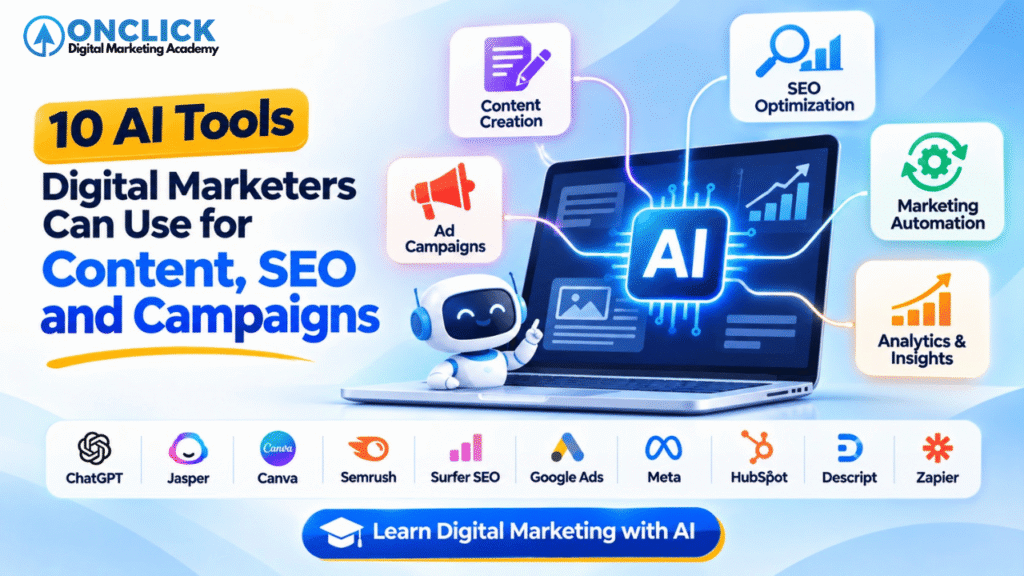
Artificial Intelligence (AI) is changing the way businesses plan, create and manage their digital marketing activities. From writing blog articles and designing social media posts to improving website SEO and analysing advertising campaigns, AI tools help marketers complete many tasks more efficiently.
Earlier, digital marketers often spent hours researching keywords, preparing content, designing creatives, writing advertisements and analysing campaign performance. Today, AI-powered tools can assist with these activities, reduce repetitive work and provide useful insights.
However, AI is not a replacement for marketing knowledge or creativity. Digital marketers still need to understand their target audience, develop marketing strategies, check information and make decisions based on business objectives.
In this article, we will explore 10 AI tools that digital marketers can use for content creation, SEO, social media marketing, advertising, video editing and marketing automation. We will also understand their applications, benefits, limitations and how beginners can start using them.
AI tools in digital marketing are software applications that use artificial intelligence to support marketing activities such as content creation, keyword research, advertising, customer communication, data analysis and campaign management.
These tools can understand instructions, analyse information, generate content, identify patterns and automate certain tasks.
For example, a digital marketer can use an AI writing assistant to prepare a blog outline, an SEO tool to identify keyword opportunities, a graphic design platform to create promotional creatives and an analytics platform to understand campaign performance.
AI tools are commonly used for:
Blog writing and content planning.
Social media captions and post ideas.
SEO research and content optimisation.
Graphic design and image creation.
Video editing and content repurposing.
Advertising copy and creative variations.
Email marketing and automation.
Customer support and chatbot workflows.
Marketing analytics and reporting.
The main purpose is to improve productivity while helping marketers focus on strategy, creativity and performance.
AI tools have become useful in digital marketing because businesses need to create more content, manage multiple platforms and understand customer behaviour.
Here are some important advantages.
AI tools can help marketers prepare first drafts, generate ideas, summarise information and complete repetitive activities.
Instead of starting every task from scratch, marketers can use AI-generated suggestions as a starting point and refine the results.
Creating regular content for websites, blogs, Instagram, Facebook, LinkedIn and YouTube requires planning and effort.
AI writing tools can assist with blog outlines, captions, video scripts, email drafts, advertising headlines and content calendars.
AI-powered SEO features can help marketers understand search queries, identify keyword opportunities, analyse competitors and improve website content.
These insights can support better SEO planning when combined with reliable search data and human analysis.
AI can support advertising activities by generating creative ideas, suggesting audience segments and helping marketers analyse campaign performance.
Advertising platforms also provide automated optimisation features that can assist with campaign delivery.
Digital marketing campaigns generate large amounts of data.
AI-assisted analysis can help marketers identify trends, summarise reports and understand patterns in website traffic, engagement and conversions.
When repetitive tasks are handled more efficiently, marketers can spend more time on campaign strategy, creative planning, customer research and optimisation.
The following tools cover different areas of digital marketing. Some are general-purpose AI assistants, while others focus on specialised marketing activities.
ChatGPT is a general-purpose AI assistant that can support many digital marketing activities.
Marketers can use it to brainstorm content ideas, prepare blog outlines, write social media captions, develop email drafts, generate video scripts and organise campaign plans.
How digital marketers can use ChatGPT:
Generate blog topics based on target keywords.
Prepare SEO-friendly article outlines.
Write Instagram and LinkedIn captions.
Create YouTube video scripts.
Generate Google Ads headline ideas.
Develop email marketing drafts.
Prepare content calendars.
Summarise research and marketing reports.
Brainstorm campaign concepts.
Practical example:
Suppose a digital marketing institute wants to publish an Instagram carousel about SEO.
A marketer can provide the topic, target audience and key points to ChatGPT and request a seven-slide content outline. The marketer can then verify the information, improve the messaging and create the final design.
Best for: Content planning, brainstorming, research assistance and marketing copy drafts.
Important consideration: ChatGPT-generated information should always be reviewed. Check facts, statistics, keyword intent and brand messaging before publishing.
Jasper is an AI-powered content platform designed for marketing and business communication.
It can assist marketing teams with creating content for different channels while maintaining a consistent brand voice.
How digital marketers can use Jasper:
Create marketing copy.
Draft product descriptions.
Prepare advertising headlines.
Generate email marketing content.
Develop website copy.
Create social media content.
Adapt messaging for different marketing channels.
Practical example:
An e-commerce company wants to promote a new product across its website, Instagram and email newsletter.
Jasper can help generate different versions of the promotional message for each channel. The marketing team can then edit the content to match the brand’s tone and campaign objectives.
Best for: Marketing teams, brand messaging and multi-channel content production.
Important consideration: Review generated content for originality, factual accuracy and consistency with your brand guidelines.
Canva is a graphic design platform that includes AI-powered features through its Magic Studio tools.
It helps marketers create social media creatives, presentations, promotional graphics and other marketing materials.
How digital marketers can use Canva:
Design Instagram posts and carousels.
Prepare Facebook advertisements.
Create YouTube thumbnails.
Design promotional posters.
Generate design ideas.
Edit and resize creative assets.
Prepare presentations.
Maintain consistent brand designs.
Practical example:
A training institute wants to promote a new digital marketing Training Instiute In Hyderabad batch.
The marketer can use Canva templates and AI-assisted design features to create a promotional poster, course announcement and Instagram carousel. The final designs can be customised with the institute’s branding, course details and approved images.
Best for: Social media design, promotional creatives and marketing presentations.
Important consideration: AI-generated designs may require manual adjustments to improve typography, spacing, alignment and brand consistency.
Semrush is a digital marketing platform widely used for SEO research, keyword analysis, competitor research and website performance activities.
Its AI-related features can assist marketers with content workflows and search visibility insights.
How digital marketers can use Semrush:
Discover keyword opportunities.
Analyse competitor websites.
Research organic search performance.
Identify content gaps.
Review backlink profiles.
Monitor keyword rankings.
Audit website SEO issues.
Explore search visibility insights.
Practical example:
A company wants to rank for the keyword “Digital Marketing Course in Hyderabad“.
A marketer can use SEO research tools to explore related keywords, understand competing websites, review search intent and identify topics that should be covered on the course page.
The marketer can then prepare a content strategy based on the research.
Best for: SEO research, competitor analysis and organic search planning.
Important consideration: Do not choose keywords only because a tool shows high search volume. Consider search intent, competition, relevance and the actual needs of your audience.
Surfer SEO is a content optimisation platform that helps marketers improve website content using search-related insights.
It can assist with content planning, topic coverage and on-page optimisation.
How digital marketers can use Surfer SEO:
Prepare content briefs.
Identify related topics and terms.
Review article structure.
Improve topical coverage.
Evaluate content optimisation.
Support SEO content workflows.
Practical example:
A digital marketing website has an article about social media marketing.
The marketer can use content optimisation insights to identify related subjects that may be missing, such as Instagram marketing, LinkedIn marketing, content calendars, social media analytics and paid advertising.
The article can then be improved to provide more complete information to readers.
Best for: Blog optimisation, SEO content planning and on-page content improvement.
Important consideration: Do not add unnecessary keywords just to achieve a higher content score. Content should remain natural, accurate and useful.
Google Ads includes AI-powered capabilities that help advertisers create and optimise advertising campaigns.
Depending on the campaign type and available features, advertisers can use automated bidding, audience signals, creative assistance and campaign optimisation capabilities.
How digital marketers can use Google Ads AI features:
Support automated bidding strategies.
Develop advertising creative variations.
Optimise campaign delivery.
Reach relevant audiences.
Analyse advertising performance.
Improve campaign efficiency.
Practical example:
A training institute wants to generate enquiries for a digital marketing course.
The marketer can create a Google Ads campaign with relevant keywords, suitable landing pages and conversion tracking. Automated bidding features may help optimise campaign delivery towards the selected objective.
The marketer should still monitor search terms, lead quality, spending and conversion performance.
Best for: Paid search advertising and automated campaign optimisation.
Important consideration: Automated campaign settings do not guarantee successful results. Conversion tracking, landing page quality, campaign structure and budget management remain important.
Meta provides AI-powered advertising capabilities through its advertising ecosystem, including Advantage+ features.
These capabilities help advertisers automate parts of campaign setup, audience selection, creative delivery and optimisation, depending on the campaign objective and available options.
How digital marketers can use Meta Advantage+:
Support audience targeting.
Automate selected campaign settings.
Test creative variations.
Optimise advertising delivery.
Reach potential customers.
Analyse campaign results.
Practical example:
A clothing business wants to promote its latest collection through Facebook and Instagram.
The marketer can prepare suitable images, videos, advertising copy and conversion tracking, then use available Advantage+ campaign features to support campaign delivery and optimisation.
Best for: Facebook and Instagram advertising campaigns.
Important consideration: Monitor cost per result, lead quality, purchases and actual business outcomes instead of judging a campaign only by impressions or clicks.
HubSpot is a customer relationship management and marketing platform that provides tools for managing contacts, campaigns, sales activities and customer communication.
Its Breeze AI capabilities support different business and marketing workflows.
How digital marketers can use HubSpot:
Organise customer information.
Manage marketing contacts.
Support email marketing activities.
Assist with content creation.
Manage lead workflows.
Support customer engagement.
Review marketing performance.
Connect marketing and sales activities.
Practical example:
A company receives enquiries through its website, social media advertisements and landing pages.
Using a suitable CRM workflow, the marketing team can organise these enquiries, track their status and coordinate follow-ups with the sales team.
AI-assisted features may support content and workflow activities depending on the selected HubSpot products and subscription.
Best for: CRM-based marketing, lead management and marketing automation.
Important consideration: Configure contact permissions, data access and follow-up processes carefully. Customer information should be handled responsibly.
Descript is an AI-assisted audio and video editing platform.
It is useful for marketers who create tutorials, interviews, podcasts, educational videos and promotional content.
How digital marketers can use Descript:
Edit videos using transcript-based workflows.
Generate and edit captions.
Remove unwanted sections.
Improve audio quality using available features.
Prepare podcast content.
Repurpose long videos into shorter content.
Create marketing video assets.
Practical example:
A digital marketing trainer records a 15-minute video explaining keyword research.
The marketing team can use Descript to edit the recording, prepare captions and create shorter clips for social media platforms.
This helps repurpose one educational video into multiple content formats.
Best for: Video editing, educational content and marketing video production.
Important consideration: Always review edited videos, captions and audio before publishing to ensure the meaning and presentation are correct.
Zapier is an automation platform that connects different applications and helps users create workflows between them.
It can reduce repetitive manual work by automatically transferring information between supported applications.
How digital marketers can use Zapier:
Connect website forms with CRM systems.
Send notifications when new leads arrive.
Transfer information between applications.
Automate selected marketing workflows.
Organise campaign data.
Trigger follow-up tasks.
Connect AI services with other applications.
Practical example:
A business receives enquiries through a website contact form.
A suitable Zapier workflow can transfer the submitted information to a connected CRM and notify the sales team. Depending on the setup, additional actions can be triggered automatically.
Best for: Marketing automation, application integration and repetitive workflow management.
Important consideration: Test automation workflows before using them in real campaigns. Check permissions, data accuracy and possible duplicate records.
The following table summarises the main purpose of each tool.
| AI Tool | Main Marketing Use | Category |
|---|---|---|
| ChatGPT | Content ideas, drafts and research | Content |
| Jasper AI | Marketing copy and brand messaging | Content |
| Canva Magic Studio | Social media graphics and creatives | Design |
| Semrush | Keyword and competitor research | SEO |
| Surfer SEO | Content optimisation | SEO |
| Google Ads AI Features | Advertising optimisation | Ads |
| Meta Advantage+ | Facebook and Instagram campaigns | Ads |
| HubSpot Breeze | CRM and marketing workflows | Automation |
| Descript | Video editing and repurposing | Video |
| Zapier | Connecting apps and automating tasks | Automation |
These tools serve different purposes. Digital marketers do not need to purchase or use all ten tools. The right s
Understanding individual tools is useful, but knowing how to combine them in a campaign is even more important.
Let’s consider an example of a digital marketing training institute In Hyderabad promoting a new course.
Use an SEO research platform such as Semrush to explore relevant search terms and competitor content.
Identify what potential students are searching for and understand their questions.
Use ChatGPT to brainstorm blog topics, social media content ideas, video scripts and campaign messaging.
Review the suggestions and create a practical content plan.
Use Canva to design Instagram carousels, Facebook creatives, course announcements and promotional graphics.
Make sure all designs follow the institute’s brand guidelines.
Use SEO research and content optimisation tools to improve course page structure, headings, keyword coverage and relevant information.
Use Google Ads or Meta Ads Manager to promote the course to relevant audiences.
Apply suitable automated campaign features where appropriate and configure conversion tracking.
Use a CRM such as HubSpot to organise enquiries and support follow-up activities.
Use Zapier to connect supported applications and automate suitable lead notifications or data-transfer activities.
Analyse leads, conversions, website traffic, advertising costs and customer enquiries.
Use the results to improve the next campaign.
This example demonstrates how AI tools can support different stages of a digital marketing workflow.
AI tools can improve productivity, but marketers should use them responsibly.
AI-generated content may contain incorrect facts, outdated information or misleading statements.
Check important information before publishing, especially statistics, product details, technical explanations and business claims.
The quality of AI output often depends on the instructions provided.
Instead of asking for a generic social media caption, include the topic, target audience, platform, objective and desired tone.
Clear instructions help produce more relevant results.
AI-generated content should match the business’s communication style.
Review the tone, language, terminology and messaging before publishing.
Do not depend entirely on automatically generated articles or social media posts.
Add practical examples, original insights, experience and useful information that genuinely helps readers.
Do not upload confidential customer information, passwords, financial records or sensitive business documents into AI tools without proper authorisation and an approved data-handling process.
Understand each platform’s privacy and data settings.
Using AI to create content does not automatically improve search rankings.
Focus on helpful information, search intent, original value, accuracy, website quality and a good user experience.
Evaluate whether AI is helping achieve business objectives.
Measure improvements in content production time, qualified leads, campaign performance, conversions and customer engagement.
Many beginners make mistakes when they start using AI in digital marketing.
Using Too Many Tools: Trying every available AI platform can create confusion. Start with tools that solve specific problems.
Copying AI Content Directly: Publishing generated content without editing may lead to generic, inaccurate or repetitive information.
Ignoring Target Audience Requirements: AI content should be adapted to the interests and needs of the actual audience.
Depending Only on AI for SEO: Keyword research, competitor analysis, technical SEO and content quality still require human judgement.
Not Checking Advertising Results: Automated campaign features need regular monitoring and optimisation.
Ignoring Brand Guidelines: All content and creative assets should maintain a consistent brand identity.
Automating Without Testing: Incorrect automation settings can cause duplicate leads, missing information or unwanted messages.
The best approach is to combine AI assistance with practical marketing knowledge.
If you are new to digital marketing, you do not need to learn every AI platform at once.
Start with basic marketing concepts and gradually explore tools according to your learning goals.
Here is a simple learning path.
Learn the basics of:
Search Engine Optimisation.
Social Media Marketing.
Google Ads.
Content Marketing.
Email Marketing.
Website Management.
Digital Marketing Analytics.
These subjects provide the foundation needed to understand how AI tools support marketing activities.
Start with ChatGPT and learn how to prepare effective prompts for:
Blog outlines.
Social media captions.
Email drafts.
Video scripts.
Advertising headlines.
Content calendars.
Practise editing and improving AI-generated output.
Explore Canva and practise creating:
Instagram posts.
Social media carousels.
Promotional posters.
YouTube thumbnails.
Advertising creatives.
Focus on design fundamentals such as alignment, typography, colour and visual hierarchy.
Explore Semrush and Surfer SEO to understand keyword research, competitor analysis and content optimisation.
Practise researching keywords and improving a sample blog article.
Understand Google Ads and Meta advertising fundamentals.
Then explore HubSpot and Zapier to learn how businesses manage enquiries and connect marketing workflows.
Create a small portfolio containing:
One SEO-optimised blog article.
One social media content calendar.
Five social media creatives.
One short-form marketing video.
One sample advertising campaign plan.
One basic lead-management automation workflow.
One marketing performance report.
Practical projects help demonstrate your skills to potential employers and clients.
AI knowledge can complement several digital marketing career paths.
Works across SEO, social media, paid advertising, content and campaign management.
Works on keyword research, on-page optimisation, competitor analysis and website search performance.
Plans content, manages social media accounts, prepares creatives and analyses engagement.
Creates and manages blog articles, website content, email content and other marketing materials.
Works on paid advertising campaigns, audience targeting, conversion tracking and campaign optimisation.
Supports CRM workflows, lead management, email automation and application integrations.
Reviews marketing data and prepares reports to help businesses understand campaign performance.
The opportunities available depend on practical skills, experience, communication and the specific requirements of employers.
AI is expected to remain an important part of digital marketing as businesses continue adopting automation, data analysis and AI-assisted content production.
Some important areas to understand include:
AI-Powered Content Creation: Marketers can use AI to support content research, drafting, editing and creative development.
Personalised Marketing: Businesses can use customer and behavioural data to develop more relevant marketing communication, subject to privacy and consent requirements.
Marketing Automation: AI and automation platforms can support repetitive activities across lead management, customer communication and campaign workflows.
AI-Assisted SEO: Marketers can use AI to support content research, search visibility analysis and topic planning.
Conversational Marketing: Chatbots and AI assistants can support customer enquiries and provide information through digital channels.
Predictive Analytics: AI-powered analytical capabilities can help businesses identify patterns and support planning.
However, marketing professionals will continue to need strategic thinking, creativity, communication skills and the ability to understand customer requirements.
AI is a tool that supports marketing work. The ability to use it effectively will depend on understanding the marketing principles behind each task.

10 AI Tools Digital Marketers Can Use for Content, SEO and Campaigns Artificial Intelligence (AI) is changing the way businesses plan, create and manage their
What Is Social Media Marketing? Platforms, Strategies and Best Practices Social media has become an important part of how people communicate, discover brands, research products
Digital Marketing Career Opportunities in 2026: Roles, Skills and Growth Areas Digital marketing has become an important part of how businesses attract customers, promote products,
What Is Google Ads and How Does PPC Advertising Work? Businesses today use digital marketing to reach potential customers, promote their products, and generate enquiries
SEO vs Google Ads: Which Digital Marketing Skill Should You Learn First? Digital marketing has become an essential part of how businesses attract customers, build
How to Choose the Right Digital Marketing Course in Hyderabad Choosing the right digital marketing course can be an important step toward building a successful
How Does SEO Work? A Step-by-Step Guide for Beginners Have you ever searched for something on Google and wondered why certain websites appear at the
What Is Digital Marketing? A Complete Guide for Beginners Digital marketing has become one of the most important ways for businesses to reach customers, build
How to Choose the Best Digital Marketing Training Institute in Hyderabad Choosing a digital marketing training institute is an important decision, particularly if your goal
Digital Marketing Course After Graduation: Career Guide for Freshers, Career Gap Learners and Homemakers Graduation is often seen as the point where a student should
Digital Marketing for Business Owners in Hyderabad: How to Get Leads from SEO, Google Ads and GBP A practical digital marketing strategy can combine SEO,