
What Is Google Ads and How Does PPC Advertising Work?
What Is Google Ads and How Does PPC Advertising Work? Businesses today use digital marketing to reach potential customers, promote their products, and generate enquiries
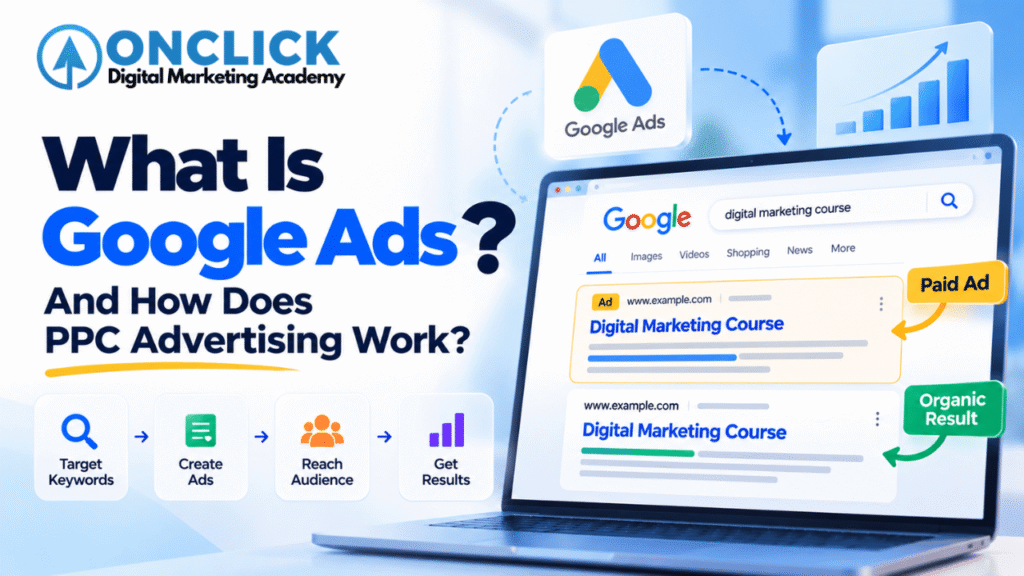
Businesses today use digital marketing to reach potential customers, promote their products, and generate enquiries online. When people search for a product, service, or training programme on Google, they often see a combination of paid advertisements and organic search results. Google Ads helps businesses display paid advertisements to relevant audiences and attract visitors who may be interested in their offerings.
Whether you are a student, job seeker, business owner, freelancer, or aspiring digital marketer, understanding Google Ads can help you develop valuable marketing skills. It is one of the key platforms used for search advertising, lead generation, online sales, and campaign performance measurement.
But what exactly is Google Ads? How does PPC advertising work? How much does it cost, and what skills are required to manage a campaign successfully?
This guide answers these questions in simple terms. It explains Google Ads basics, the PPC advertising model, campaign types, keyword targeting, bidding, conversion tracking, and career opportunities. If you are looking for a Google Ads Course in Hyderabad or comparing a Google Ads Training Institute in Hyderabad, this article will also help you understand what to look for in a practical training programme.
Google Ads is an online advertising platform that allows businesses to promote their products and services across eligible Google advertising placements. Depending on the campaign type and settings, advertisements may appear on Google Search, YouTube, websites and apps within Google’s advertising network, Google Maps, and other eligible placements.
For example, imagine someone searches for “digital marketing course in Hyderabad.” A training academy can use Google Ads to create a relevant search advertisement. If the campaign matches the user’s search and wins the advertising auction, the ad may appear among the search results.
The advertiser can set campaign goals, select relevant targeting options, create ad content, define a budget, and measure performance.
Google Ads is useful because it allows businesses to reach people based on factors such as their search intent, location settings, interests, or other supported targeting signals, depending on the campaign type.
Google Ads can help businesses achieve several marketing objectives:
Generate enquiries: Promote services and encourage users to submit an enquiry form or call.
Increase sales: Direct potential customers to product or service pages.
Promote courses: Reach people searching for relevant training programmes.
Build awareness: Introduce a brand, product, or service to suitable audiences.
Measure results: Track campaign performance and, where configured correctly, conversions.
Test marketing messages: Compare different ad messages, offers, and landing pages.
Google Ads does not guarantee sales or leads. Results depend on campaign quality, competition, budget, offer relevance, website experience, and many other factors.
PPC stands for Pay-Per-Click. It is an advertising model in which an advertiser typically pays when someone clicks on an advertisement. Search advertising on Google commonly uses this model, although Google Ads supports other bidding and charging arrangements depending on the campaign type.
For example, a business might advertise a digital marketing course. When a user searches for a relevant phrase and clicks the advertisement, the advertiser may incur a charge according to the campaign’s auction and pricing rules.
The cost of a click is not fixed for every keyword. It can vary based on competition, the user’s search, the advertising context, the quality and relevance of the ad, and other auction factors.
PPC advertising can be understood through a simple process:
Step 1: Select a marketing goal
Decide what the campaign should achieve. The objective might be to generate course enquiries, sell a product, encourage registrations, or attract relevant website traffic.
Step 2: Identify the target audience
Define the audience you want to reach. For a search campaign, this includes understanding relevant search queries, locations, languages, and other appropriate campaign settings.
Step 3: Research keywords
Identify search terms that potential customers may use. For example, a training academy might research phrases such as “Google Ads course in Hyderabad” and “PPC advertising course.”
Step 4: Create advertisements
Write clear headlines and descriptions that match the search intent and explain the value of the offer.
Step 5: Set a budget and bidding strategy
Choose a budget and a bidding strategy appropriate to your campaign objective. The actual cost and number of clicks depend on campaign performance and auction conditions.
Step 6: Enter the advertising auction
When a relevant search occurs, eligible ads may compete in an auction. Google considers factors including bids, ad quality, expected impact of assets, and other signals.
Step 7: Measure and improve results
Review clicks, costs, conversions, and other relevant metrics. Use the information to refine targeting, advertisements, bidding, and landing pages.
This process helps businesses manage advertising more systematically rather than relying on guesswork.
Google Search advertising allows businesses to show eligible ads to people searching for relevant products, services, or information.
When someone enters a search query, Google evaluates the eligible ads for that search through an auction. The advertisements that appear and their positions depend on several factors, including bid, ad quality, competition, search context, and expected impact of ad assets.
Google Search can display paid advertisements alongside organic listings.
Paid search results are advertisements delivered through an advertising campaign. Businesses pay according to the applicable campaign pricing model.
Organic search results are unpaid listings that appear because search engines consider the pages relevant to the query. Businesses work on SEO to improve their organic visibility.
Both can help users discover businesses, but they use different approaches. Google Ads can provide paid visibility when a campaign is eligible to serve, while SEO generally requires ongoing work to develop organic visibility.
A business may use both strategies to reach potential customers through paid and organic search.
Google Ads offers different campaign types for different business goals. Availability and features can change, so advertisers should review the current campaign options before launching a campaign.
Search campaigns can display text advertisements on Google Search when users search for relevant terms.
For example, a training academy may create a campaign to reach people looking for a Google Ads course. The advertiser can organise keywords into relevant groups, write advertisements, and direct users to a suitable course page.
Search campaigns are particularly useful when businesses want to reach users who are actively searching for relevant offerings.
Display campaigns can show visual advertisements across eligible websites and apps within Google’s advertising network.
These advertisements can help businesses build awareness, reach relevant audiences, or reconnect with eligible previous visitors when suitable targeting and privacy requirements are met.
Video campaigns can promote products and services through eligible video placements, including YouTube. Depending on the campaign setup, they can support awareness, consideration, traffic, or conversion objectives.
Shopping campaigns help eligible retailers promote products using product information such as images, prices, and store details. They are especially relevant to businesses selling physical products online.
App campaigns help promote mobile applications across eligible Google properties. Campaigns can support objectives such as app installs or in-app actions, depending on the configuration.
Performance Max is a goal-based campaign type that can access multiple Google advertising channels from a single campaign. It uses automation to help optimise delivery toward the advertiser’s selected objectives.
Advertisers still need to provide appropriate assets, accurate conversion measurement, suitable budgets, and clear business goals.
Keywords are an important part of many Search campaigns. They help advertisers connect their advertisements with relevant search queries.
Choosing the right keywords can improve campaign relevance, while poorly selected keywords may attract visitors who are unlikely to become customer
Google Ads supports different keyword match options that influence which searches may trigger an advertisement.
Broad match: Can match a wider range of searches related to the keyword’s meaning and intent.
Phrase match: Can match searches that include the meaning of the keyword phrase, subject to Google’s matching rules.
Exact match: Can match searches that have the same meaning or intent as the keyword, rather than requiring an identical character-for-character search.
These match options do not always work as simple literal filters. Advertisers should review actual search terms and use negative keywords where appropriate.
Negative keywords help prevent advertisements from serving for searches that are not relevant to a campaign.
For example, if a business offers paid professional training and does not provide free classes, it might consider whether searches containing “free” should be excluded. The decision should be based on the actual offer and search intent, not on assumptions alone.
Regular search-term reviews help advertisers identify irrelevant traffic and refine targeting.
There is no single fixed price for Google Ads. Costs depend on campaign type, industry competition, bidding strategy, targeting, ad quality, and the results an advertiser wants to achieve.
Some keywords may have relatively low click costs, while highly competitive commercial searches can be more expensive.
1. Keyword competition
Keywords targeted by many advertisers may have higher costs because businesses are competing for the same audience.
2. Ad relevance and quality
Relevant ads and useful landing pages can contribute to better ad quality and may improve auction performance. Strong quality does not guarantee a specific position or cost.
3. Targeting settings
Location, language, audience, device, and other settings can influence which auctions a campaign enters.
4. Bidding strategy
Manual and automated bidding approaches work differently. The right choice depends on the campaign objective, available conversion data, and the advertiser’s requirements.
5. Landing page experience
A landing page should be relevant to the advertisement, easy to navigate, mobile-friendly, and clear about the next action.
Beginners should decide how much they can responsibly spend before launching a live campaign. Start with a clear objective, verify conversion tracking, and monitor costs frequently.
Do not assume that a larger budget automatically produces better results. A campaign can spend money without generating useful enquiries if targeting, ad messaging, or the landing page is poor.
Learners can practise campaign structure, keyword research, and ad writing without running a paid campaign. If live campaigns are part of training, clarify who funds the spend and how the budget is controlled.
Quality Score is a diagnostic metric available for certain Search keywords. It is based on Google’s assessment of expected click-through rate, ad relevance, and landing page experience.
It can help advertisers identify areas that may need improvement, but it is not the same as the real-time auction calculation and does not directly determine every ad position.
Align ad copy with the user’s search intent.
Organise keywords into relevant ad groups.
Write clear, specific headlines and descriptions.
Send users to landing pages that match the advertisement.
Make the landing page useful, accessible, and mobile-friendly.
Review search terms and exclude irrelevant traffic where appropriate.
The aim is to provide a better experience for users while supporting the campaign’s business objective.
Conversion tracking measures valuable actions that users complete after interacting with an advertisement. Depending on the business, a conversion may be an enquiry submission, phone call, purchase, registration, or another meaningful action.
Without accurate conversion tracking, advertisers may know how many clicks they receive but struggle to determine whether those clicks produce useful business outcomes.
Imagine a training academy receives 200 clicks from a Google Ads campaign. That number alone does not tell the business how many people enquired, how many were suitable leads, or how many enrolled.
With properly configured conversion tracking, the academy can evaluate which campaigns and search terms contribute to enquiries and enrolments, subject to the accuracy of its measurement setup.
Impressions: How often an advertisement is shown.
Clicks: How often users click an advertisement.
Click-through rate (CTR): The percentage of impressions that result in clicks.
Cost per click (CPC): The average amount paid per click when this metric applies.
Conversions: The valuable actions defined for the campaign.
Conversion rate: The percentage of relevant interactions that result in a conversion, according to the reporting definition.
Cost per conversion: The cost associated with generating a conversion.
Return on ad spend (ROAS): The conversion value attributed to advertising divided by the advertising spend, when reliable conversion-value data is available.
These metrics should be interpreted together. A low cost per click is not necessarily good if the traffic does not convert, and a high click-through rate does not automatically mean the campaign is profitable.
Google Ads and Search Engine Optimisation both help users discover websites through search, but the methods are different.
| Factor | Google Ads | SEO |
|---|---|---|
| Search visibility | Paid advertising | Organic search listings |
| Traffic costs | Typically involves advertising spend | Requires resources, but there is no payment per organic click to Google |
| Time to visibility | Can be relatively quick once a campaign is approved and eligible | Often takes time to build |
| Control | Offers campaign settings for budgets, targeting, and bidding | Rankings are influenced by search engine systems and competition |
| Sustainability | Paid visibility generally stops when ads stop serving | Organic traffic can continue but requires ongoing maintenance |
| Measurement | Spend, clicks, conversions, and campaign performance | Organic impressions, clicks, rankings, and conversions |
| Main activities | Campaign setup, ads, bidding, targeting, tracking | Content optimisation, technical SEO, keyword research, and authority building |
Neither channel is always better. Google Ads can be useful for targeted promotions and campaigns with clear measurable goals. SEO can support sustained organic discovery. Businesses often use both based on their resources and marketing strategy.
Learning how to avoid common mistakes is an important part of becoming a capable campaign manager.
Broad or poorly researched keywords can attract visitors who are not interested in the offer. Research search intent and review search-term reports regularly.
If irrelevant queries continue to trigger ads, the campaign may waste part of its budget. Use negative keywords carefully and review them as the campaign develops.
A user searching for a specific course should ideally land on a page that explains that course, its syllabus, learning outcomes, and next steps.
Without accurate tracking, it is difficult to evaluate whether a campaign generates meaningful results. Test tracking before relying on conversion data for optimisation.
Campaigns need enough relevant data for performance to be evaluated. Constantly changing multiple settings at once can make it difficult to understand which changes had an impact.
Clicks are useful, but the business objective may be enquiries, purchases, registrations, or qualified leads. Evaluate campaign success using metrics that reflect the actual objective.
Many users access websites through mobile devices. Check mobile loading speed, page layout, readability, and the ease of completing forms or contacting the business.
Google Ads can be useful for a wide range of learners.
Students and fresh graduates: People starting a digital marketing career can learn campaign fundamentals and build sample projects.
Working professionals: Professionals looking to develop additional marketing skills may use Google Ads knowledge to expand their responsibilities.
Business owners: Entrepreneurs can learn how paid search works and make more informed decisions about advertising budgets and agency services.
Freelancers: Freelancers may develop campaign planning, reporting, and optimisation services after gaining sufficient practical experience.
Content creators and website designers: People who already work on websites and landing pages can benefit from understanding how paid traffic is acquired and measured.
No particular academic background is required to begin learning the fundamentals. However, analytical thinking, attention to detail, communication, and consistent practice are helpful.
Google Ads knowledge can support different digital marketing roles. Actual job requirements vary by employer, experience, and market conditions.
A Google Ads Executive may help create campaigns, research keywords, prepare ad copy, monitor performance, and support routine optimisation.
A PPC Specialist focuses on paid advertising campaigns, including keyword targeting, bidding, budgets, search-term analysis, and campaign reporting.
A Performance Marketing Executive works with paid channels and measurable business outcomes. The role may include campaign planning, conversion tracking, performance analysis, and testing.
A Digital Marketing Executive may support several channels, such as SEO, Google Ads, social media, content marketing, email, and analytics.
With sufficient experience, a professional may offer services such as account audits, campaign setup, tracking support, reporting, and ongoing optimisation.
Practical skills matter. Employers and clients may want to see how you plan campaigns, interpret results, identify problems, and explain your recommendations.
If you want to learn Google Ads, comparing training programmes carefully can help you choose one that matches your goals.
When evaluating a Google Ads Course in Hyderabad, consider the following factors.
Look for campaign setup, keyword research, match types, negative keywords, ad copywriting, bidding, budgets, conversion tracking, and reporting.
Training should give you opportunities to practise building campaign structures, creating ads, selecting keywords, reviewing search terms, and preparing reports.
Ask whether the course introduces relevant tools for keyword research, analytics, conversion measurement, and campaign reporting.
Ask about the trainer’s experience managing campaigns and explaining real-world examples. A useful instructor should be able to explain not only what to do but also why a particular decision is appropriate.
Clarify whether you will practise with demonstrations, sample data, or live campaigns. If advertising spend is required, confirm who pays for it and how the budget is controlled.
A practical course should explain how to interpret campaign metrics and make decisions based on the available evidence.
A sample campaign plan, keyword research sheet, ad copy examples, and performance report can help demonstrate your learning during interviews.
Ask what career support is offered, how practical assignments are assessed, and whether you will receive feedback on your work. Do not assume that course completion guarantees employment.
A structured training programme should help learners move from understanding basic concepts to completing practical exercises.
When comparing a Google Ads Training Institute in Hyderabad, look for learning that covers:
Google Ads account and campaign structure
Search campaign setup and targeting
Keyword research and match types
Negative keyword planning
Ad copywriting and ad assets
Bidding strategies and budget management
Landing page relevance
Conversion tracking fundamentals
Campaign performance metrics
Search-term analysis and optimisation
Reporting and practical project work
The best course for you is one that suits your learning needs and helps you build skills you can demonstrate. Ask the training provider for its current syllabus, class format, practical project details, and available support before enrolling.
Google Ads is an online advertising platform that businesses use to promote products and services across eligible Google placements. Advertisers can choose campaign goals, targeting, budgets, and bidding strategies, then measure the results.
PPC stands for Pay-Per-Click. It is an advertising model in which advertisers typically pay when a user clicks an advertisement. The exact charging model depends on the campaign type.
Yes. Beginners can start with basic concepts such as keywords, ad groups, campaign objectives, budgets, and ad copy. Practical exercises and a structured learning plan can help build confidence.
There is no universal fixed price. Costs vary according to competition, targeting, campaign settings, bidding strategy, and other factors. Advertisers should define a manageable budget and monitor performance.
Neither is always better. Google Ads provides paid visibility when campaigns are eligible to serve, while SEO aims to improve organic visibility over time. Businesses can use both to support different goals.
Yes. Many campaign management tasks can be completed without coding. Technical knowledge can be helpful for advanced tracking implementations or website integrations, but it is not required to start learning the fundamentals.
Possible roles include Google Ads Executive, PPC Specialist, Performance Marketing Executive, Digital Marketing Executive, and, with sufficient experience, freelance campaign consultant.
A useful course should cover campaign setup, keyword research, ad writing, bidding, budgets, conversion tracking, performance analysis, and practical assignments.
Compare the syllabus, trainer experience, practical exercises, tools covered, reporting training, live campaign expenses, and career support. Ask for details before enrolling.
You can learn many fundamentals through demonstrations, sample campaign plans, and exercises without launching a paid campaign. Live campaign practice can be useful, but it should use a clearly approved budget and appropriate tracking.
PPC is an advertising model, while CPC means cost per click. CPC is a metric that indicates the average amount paid for each click when the metric applies.
Conversion tracking measures valuable actions, such as form submissions, purchases, calls, or registrations, after users interact with advertising. It helps advertisers evaluate whether campaigns contribute to their goals.

What Is Google Ads and How Does PPC Advertising Work? Businesses today use digital marketing to reach potential customers, promote their products, and generate enquiries
SEO vs Google Ads: Which Digital Marketing Skill Should You Learn First? Digital marketing has become an essential part of how businesses attract customers, build
How to Choose the Right Digital Marketing Course in Hyderabad Choosing the right digital marketing course can be an important step toward building a successful
How Does SEO Work? A Step-by-Step Guide for Beginners Have you ever searched for something on Google and wondered why certain websites appear at the
What Is Digital Marketing? A Complete Guide for Beginners Digital marketing has become one of the most important ways for businesses to reach customers, build
How to Choose the Best Digital Marketing Training Institute in Hyderabad Choosing a digital marketing training institute is an important decision, particularly if your goal
Digital Marketing Course After Graduation: Career Guide for Freshers, Career Gap Learners and Homemakers Graduation is often seen as the point where a student should
Digital Marketing for Business Owners in Hyderabad: How to Get Leads from SEO, Google Ads and GBP A practical digital marketing strategy can combine SEO,
Google AdSense Course: Blogging, Website Monetization and Approval Learning Path Building a blog or website can be more than an exercise in publishing content. With
Affiliate Marketing Course for Beginners: How It Works, Skills Needed and Mistakes to Avoid Affiliate marketing has become an important part of the digital marketing
Email Marketing Course: Learn Campaigns, Newsletters, Lead Nurturing and Automation Email marketing continues to be an important part of digital marketing because it gives businesses