
New Batches
Upcoming Batches Why Choose Onclick Digital Marketing Academy Onclick Digital Marketing Is Best Digital Marketing Training Institute In Hyderabad With 100% Placement Assistance 9+ Years
Digital marketing is entering another major transformation in 2026. Artificial intelligence, AI powered search, automation, short-form video, social commerce, personalization and privacy focused data strategies are changing how businesses attract, engage and convert customers.The biggest change is that digital marketing is no longer limited to getting a website to rank on Google or running advertisements on social media. Consumers now discover brands through search engines, social platforms, AI assistants, videos, communities and conversational interfaces.The latest digital marketing trends 2026 show that successful marketing requires a combination of technology and human creativity. AI can help marketers analyze data, create variations, automate repetitive activities and personalize experiences, but strategy, originality, trust and human understanding remain essential.HubSpot’s 2026 State of Marketing research identifies AI powered personalization, automation, brand value driven content, adapting SEO to search changes and content repurposing among the leading trends marketers are focusing on. So, what should marketers and businesses focus on in 2026?
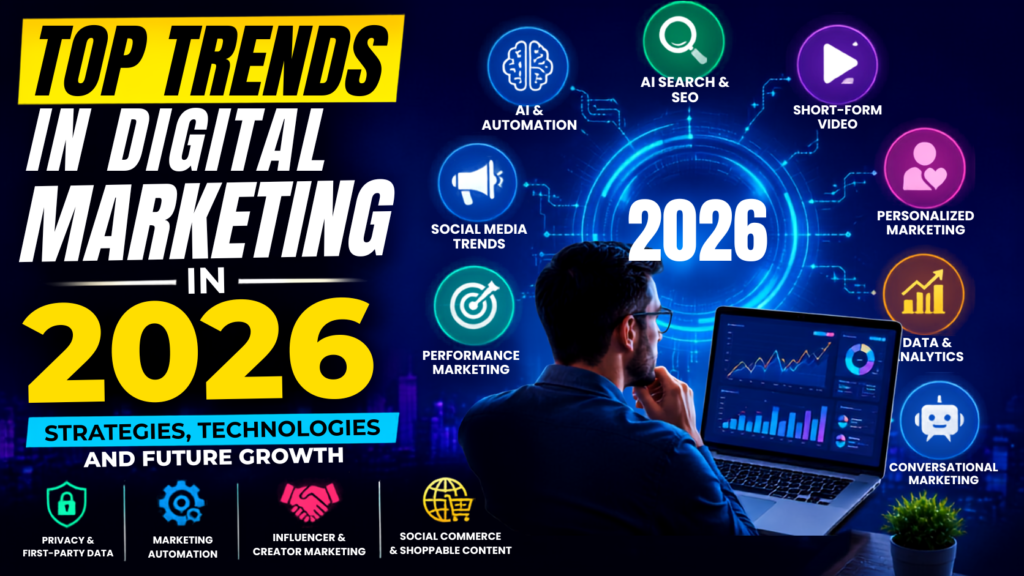
Digital marketing changes because consumer behavior changes.People are using multiple platforms during the buying journey. Someone may discover a brand through an Instagram Reel, research it on Google, ask an AI assistant for recommendations, watch a YouTube review and finally contact the company through WhatsApp.This creates several challenges for businesses:
The answer is not necessarily to be present on every platform. Businesses need to understand where their customers search, what questions they ask and which channels actually generate business results.
Artificial intelligence has moved from being an experimental technology to becoming part of everyday marketing workflows.Marketers are using AI for:
AI can help a marketing team complete repetitive tasks faster and analyze large amounts of information. However, the strongest approach is not to replace marketers with AI. It is to make marketers more productive with AI. For example, a marketer could use AI to generate ten advertising concepts, analyze campaign performance and identify audience segments, while the marketer makes the final strategic decisions.The emerging direction is toward agentic AI, where AI systems can perform increasingly complex sequences of tasks. Kantar identifies AI agents as an important 2026 marketing development, particularly as consumers increasingly use AI-assisted
One of the biggest changes in search is the growth of AI-generated answers. Users are increasingly asking AI systems questions rather than simply typing keywords into a search engine. Google’s AI Overviews and AI Mode are examples of this evolving search experience.This means brands need to think beyond traditional rankings.They need to create content that is:
Google itself published a 2026 guide explaining how website owners can optimize for generative AI features in Search. Google emphasizes that established SEO best practices remain important and also highlights the importance of unique, valuable content. This has increased interest in GEO Generative Engine Optimization. GEO focuses on improving a brand’s ability to be understood, referenced or surfaced by AI generated search experiences.Importantly, GEO should not be treated as a replacement for SEO. It is better understood as an extension of search visibility in an environment where users may receive answers directly from AI systems.
SEO is still important in 2026, but the definition of search visibility is expanding.Traditional SEO often focused heavily on keywords and rankings. Modern SEO requires a broader approach involving:
A business should not create a page simply because a keyword has search volume.Instead, marketers should ask
What problem is the user trying to solve?
For example, someone searching for “digital marketing course Hyderabad” may want to compare institutes, understand course modules, check fees, evaluate placement support or determine whether digital marketing is a suitable career.A useful page should answer those questions rather than simply repeat the keyword.In 2026, SEO is increasingly becoming a combination of search optimization, content quality, brand authority and information architecture.
Short form video remains one of the most powerful formats for capturing attention.Platforms such as YouTube Shorts, Instagram Reels and similar short-video formats allow businesses to communicate ideas quickly.Businesses can use short form videos for:
For example, a digital marketing institute could create a 30 second video explaining 3 SEO mistakes beginners make.The objective should not always be to make a video go viral. A better goal is to attract the right audience and move interested viewers toward the next step.Short form video is particularly valuable because a single topic can be repurposed into multiple pieces of content.
Social media is increasingly functioning as a discovery and search environment.People don’t use social platforms only to communicate with friends. They also use them to discover restaurants, products, services, tutorials, creators and businesses.social media research highlights the shift toward interest based discovery and reports that social platforms are increasingly serving search, shopping and customer service functions. This means businesses should think about Social SEO.
Optimization can include:
For businesses targeting local customers, location specific content can also help connect social discovery with local search.
Consumers increasingly expect businesses to understand their interests and needs. Personalization can be based on:
For example, an e commerce company could show different recommendations to a first-time visitor and a returning customer.However, personalization must be balanced with privacy.The goal is not to make customers feel that a company knows everything about them. The goal is to provide a more relevant and useful experience. AI is making personalization more scalable by helping marketers process customer data and create different content variations more efficiently.
First party data is becoming increasingly important.First party data is information a business collects directly from its audience through legitimate interactions, such as:
Businesses should develop strategies for collecting and managing this data responsibly.The emphasis is shifting toward consent, transparency and customer trust.Instead of depending entirely on external audience signals, companies can build stronger relationships through their own CRM and customer databases.This is particularly important for businesses running lead generation campaigns because a lead should become part of a measurable customer journey rather than simply a name in an advertising platform.
Marketing automation helps businesses reduce repetitive manual tasks.Common automation workflows include:
Consider a company that receives 100 leads every week.Instead of manually sending the same first response to every lead, automation can send an immediate acknowledgement, assign the lead to the appropriate salesperson and trigger a follow up sequence.The important point is that automation should support human strategy rather than eliminate it.Good automation makes the customer journey faster and more consistent.
Video is no longer only a social media tactic. Businesses can use video throughout the marketing funnel.
Use:
Use:
Use:
For example, a software company can create a short video showing how its product solves a common problem. A longer YouTube video can then provide a complete tutorial.The combination of short and long form video creates a stronger content ecosystem.
Influencer marketing is becoming more focused on relevance and credibility.Brands are increasingly working with:
A creator with 20,000 highly relevant followers may deliver more useful business results than a celebrity with millions of followers but little connection to the target audience. Authenticity is also becoming increasingly important. Audiences are more likely to respond to creators who demonstrate genuine knowledge and experience rather than content that feels like a traditional advertisement.
Customers increasingly expect businesses to provide quick answers. Conversational marketing uses technologies such as:
A conversational system can answer basic questions, collect lead information and route complex requests to a human representative.For example, a training institute could use a chatbot to answer questions about:
The result is a shorter path between customer interest and business response.
The changing marketing environment is also changing the skills professionals need. Important skills include:
Beginners should first develop strong fundamentals in SEO, content, social media, paid advertising and analytics. Experienced marketers can then add AI, automation, CRM integration, GEO and advanced measurement. The most valuable professionals will not simply know how to operate individual tools. They will understand how those tools work together to generate business results.
Businesses do not need to implement every trend simultaneously.
A practical approach is:
The future of digital marketing will likely be more automated, personalized and fragmented across multiple discovery environments.
AI-powered search will continue to influence how people find information. AI agents may increasingly assist users with research, comparisons and purchasing decisions.
At the same time, human creativity will become more valuable.
As AI makes it easier to produce generic content, original ideas, first-hand experience, strong opinions, authentic stories and trusted brands can become important differentiators.
The future is therefore not simply AI versus humans.
It is more accurately:
AI + human creativity + data + strategy + trust.
Businesses that combine these elements will be better positioned to compete
The major digital marketing trends 2026 are not isolated technologies. They represent a broader change in how consumers discover information, evaluate brands and make purchasing decisions.
AI is transforming marketing workflows. GEO and AI search are expanding the definition of search visibility. Social media is becoming more searchable and commerce oriented. Short-form video continues to capture attention, while personalization and first-party data are becoming increasingly important.
At the same time, traditional fundamentals have not disappeared.
Businesses still need:
Google’s own 2026 guidance reinforces this point: optimizing for generative AI search does not mean abandoning established SEO fundamentals.
The marketers who succeed in 2026 will be those who learn to use new technology without losing sight of the customer.
The future of digital marketing belongs to professionals who can combine AI, creativity, data, strategy and human understanding.
If you are planning a career in digital marketing, 2026 is an excellent time to develop a combination of practical skills rather than learning only one platform or tool.
The major trends include AI-powered marketing, generative AI search, GEO, evolving SEO, short-form video, social search, personalization, first-party data, marketing automation, creator marketing, conversational marketing, smarter paid advertising and advanced analytics.
AI is helping marketers with content creation, personalization, customer segmentation, campaign optimization, analytics, lead scoring, automation and customer support. Increasingly, AI is also becoming integrated into search and customer journeys.
Yes. SEO remains important, but it is evolving. Marketers now need to optimize not only for traditional rankings but also for search intent, topical authority, structured content and emerging AI-powered search experiences.
GEO stands for Generative Engine Optimization. It refers broadly to optimizing content and brand information so that AI-powered search and answer systems can understand and potentially reference the brand or content.
Important skills include SEO, GEO, Google Ads, Meta Ads, social media marketing, content marketing, GA4, Google Tag Manager, AI marketing, CRM, marketing automation, analytics and conversion optimization.
Video remains a major marketing format, particularly short-form video. Businesses can use video for awareness, education, product demonstrations, testimonials, tutorials and customer conversion.

Upcoming Batches Why Choose Onclick Digital Marketing Academy Onclick Digital Marketing Is Best Digital Marketing Training Institute In Hyderabad With 100% Placement Assistance 9+ Years
Privacy Policy Welcome to Onclick Digital Marketing Academy. We value your privacy and are committed to protecting the personal information you share with us. This
Terms & Conditions Welcome to Onclick Digital Marketing Academy. By accessing our website, submitting an enquiry, enrolling in any of our training programs, or using
Loading… ISO Certification We Are Providing ISO Certification For Our Students. 15000+ Students We bring the right people together to challenge established thinking Accredited &
Loading… ISO Certification We Are Providing ISO Certification For Our Students. 15000+ Students We bring the right people together to challenge established thinking Accredited &
Master Digital Marketing Learn Industry-Ready Skills. Get Certified. Launch Your Career with Practical Training. Expert Trainers Learn from Industry Experts 100% Placement Assistance Explore Courses
Whatsapp Us Call : 9346775340 Get Brochure 2026 Curriculum AI Powered Become Job Ready with AI Powered Digital Marketing Course Join Hyderabad’s most trusted digital
Whatsapp Us Call : 9985023500 Get Brochure 2026 Curriculum AI Powered Become Job Ready with AI Powered Digital Marketing Course Join Hyderabad’s most trusted digital
Whatsapp Us Call : 9985023500 Enquiry Now #1 Digital Marketing Institute in Hyderabad Launch Your Digital Marketing Career with Performance Marketing, Real-Time Projects & 100%
Whatsapp Us Call : 9985023500 #1 Digital Marketing Institute in Hyderabad Launch Your Digital Career With Real-Time Projects & 100% Placement Assistance Master 15+ in-demand
Enroll Now Master Digital Marketing with AI & Build a Future-Proof Career Learn SEO, Google Ads, Social Media & AI Tools with Real-Time Projects +