
New Batches
Upcoming Batches Why Choose Onclick Digital Marketing Academy Onclick Digital Marketing Is Best Digital Marketing Training Institute In Hyderabad With 100% Placement Assistance 9+ Years
SEO has become one of the most important skills in digital marketing. As businesses increasingly depend on organic search visibility, companies are looking for SEO professionals who understand more than just keywords and backlinks. Candidates are now expected to understand search intent, technical SEO, content optimization, analytics, local SEO, Core Web Vitals, structured data, and AI-powered search.
If you are preparing for an SEO interview in 2026, knowing common questions is only the first step. You should also be able to explain how you would solve real SEO problems.
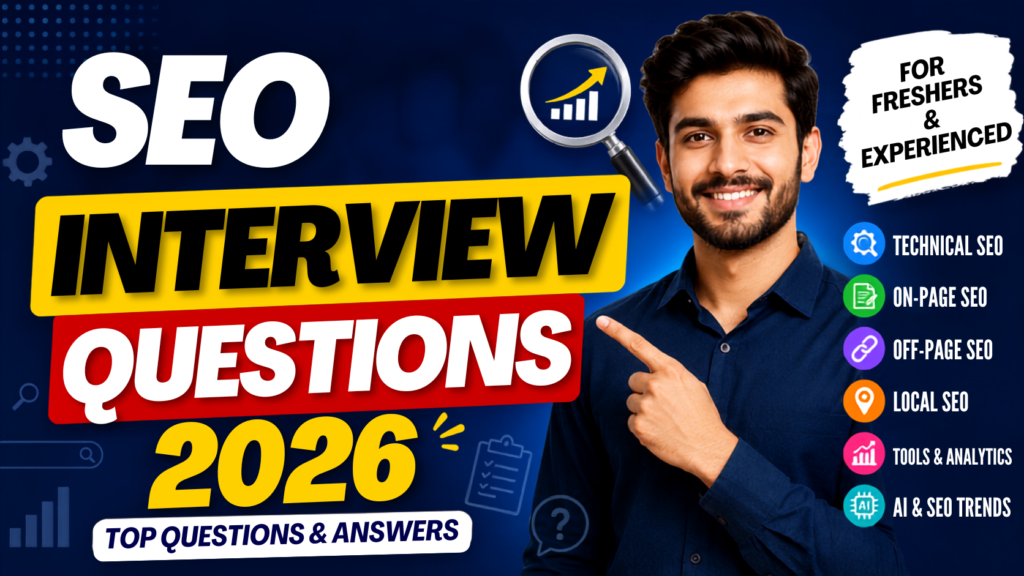
This guide covers important SEO interview questions and answers for freshers, beginners, and experienced professionals, along with technical, on-page, off-page, local, tools, AI, and scenario-based questions.
An SEO interviewer generally evaluates both your theoretical knowledge and your ability to apply SEO concepts practically.
Important skills include:
A strong candidate should be able to explain why a particular SEO action is necessary instead of simply memorizing definitions.
SEO, or Search Engine Optimization, is the process of improving a website’s visibility in organic search engine results.
SEO involves optimizing website content, technical elements, internal links, user experience, and authority so that search engines can better understand and rank relevant pages.
For example, if a digital marketing institute wants to rank for “SEO training in Hyderabad,” it can optimize relevant pages around that search intent.
SEO can help a website attract relevant organic traffic without relying entirely on paid advertising.
A successful SEO strategy can help businesses:
SEO is particularly valuable because users are actively searching for products, services, answers, or information.
The major areas of SEO include:
On-page SEO: Optimizing content and elements on a webpage.
Technical SEO: Improving technical aspects that affect crawling, indexing, and website accessibility.
Off-page SEO: Building authority and reputation through relevant external signals such as quality backlinks and digital PR.
Local SEO: Optimizing a business for location-based searches.
These areas work together rather than operating as completely separate strategies.
A keyword is a word or phrase that represents what a user searches for in a search engine.
Examples include:
Modern SEO should focus not only on exact keywords but also on the meaning, context, and intent behind searches.
Search intent refers to the reason behind a user’s search query.
Common types include:
Understanding intent helps SEO professionals create content that actually satisfies the user’s needs.
Organic traffic refers to visitors who reach a website through unpaid search engine results.
SEO aims to increase relevant organic traffic by improving a website’s visibility for valuable searches.
SERP stands for Search Engine Results Page. It is the page displayed by a search engine after a user enters a query.
A SERP may contain traditional organic results as well as features such as featured snippets, images, videos, local results, shopping results, and other search experiences.
Keyword density refers to how frequently a keyword appears in relation to the total amount of text on a page.
However, SEO professionals should not focus on achieving a particular keyword-density percentage. Content should be natural, useful, relevant, and aligned with search intent.
SEO focuses primarily on improving organic search visibility, while SEM is commonly used to describe search engine marketing activities involving paid search advertising and, depending on the context, broader search marketing.
SEO generally requires time to build sustainable visibility, while paid search can provide immediate advertising exposure.
On-page SEO involves optimizing elements within a webpage to improve its relevance, usability, and ability to be understood by search engines.
Important elements include:
A meta title, commonly represented by the HTML title element, identifies a webpage and is an important signal for helping search engines and users understand the page topic.
A good title should be descriptive, relevant, and compelling rather than unnecessarily stuffed with keywords.
A meta description provides a summary of a webpage. Search engines may use it as the snippet displayed in search results.
A good meta description should clearly communicate what the page offers and encourage relevant users to click.
Header elements such as H1, H2, and H3 help organize webpage content.
For example:
H1: SEO Interview Questions 2026
H2: Basic SEO Interview Questions
H3: What is SEO?
Proper heading structure improves readability and helps communicate content hierarchy.
Internal linking means linking one page on a website to another page on the same website.
Internal links can help users discover related content and help search engines understand relationships between pages.
For example, a blog about SEO interview questions could internally link to an article about keyword research.
Alt text provides a textual description of an image.
It helps communicate the image’s purpose or content when the image cannot be viewed and can also support accessibility.
Alt text should describe the image naturally rather than being used to insert unnecessary keywords.
Technical SEO focuses on improving the technical aspects of a website so that search engines can efficiently crawl, understand, and index its content.
It can include:
Crawling is the process through which search engine crawlers discover and access webpages.
Links, sitemaps, and other discoverability mechanisms can help search engines find URLs.
Indexing refers to the process of analyzing and storing information about webpages so that eligible pages can potentially appear in search results.
A page being crawled does not automatically mean it will be indexed.
Robots.txt is a file that provides instructions to crawlers about which areas of a website they may or may not access.
SEO professionals should understand that robots.txt is primarily a crawling-control mechanism and should not be treated as a universal method for removing URLs from search results.
An XML sitemap provides search engines with information about important URLs on a website.
It can be particularly useful for large websites, websites with complex structures, or sites where some pages may be difficult to discover through normal internal linking.
A canonical URL indicates the preferred version of a page when multiple URLs contain duplicate or substantially similar content.
Canonicalization helps search engines understand which URL should generally be treated as the primary version.
A 301 redirect is generally used when a page has permanently moved to another URL.
A 302 redirect is generally associated with a temporary move.
Choosing the appropriate redirect depends on the actual purpose and duration of the URL change.
A 404 status generally indicates that the requested page could not be found.
SEO professionals should identify important broken URLs, determine whether users or search engines are encountering them, and decide whether the URL should remain unavailable, redirect to a relevant replacement, or be restored.
Core Web Vitals are user-focused performance metrics that assess important aspects of webpage experience.
They include metrics related to:
SEO professionals should understand these metrics as part of broader website performance and user experience optimization.
A backlink is a link from another website to your website.
Relevant, trustworthy backlinks can contribute to a site’s authority and discoverability. However, acquiring large numbers of low-quality links is not a reliable SEO strategy.
“Dofollow” is commonly used to describe ordinary links without a nofollow relationship.
A nofollow link includes a link relationship attribute that tells search engines not to associate the link in the same way as a normal link.
Modern link attributes can also include values such as sponsored and ugc.
Link building is the process of earning or acquiring relevant links from external websites.
Effective approaches can include:
The focus should be on relevance, usefulness, quality, and editorial value, not simply link quantity.
Anchor text is the visible clickable text of a hyperlink.
For example, in the phrase “learn SEO techniques,” the words “learn SEO techniques” are the anchor text.
Anchor text should be natural and relevant to the linked page.
Local SEO focuses on improving a business’s visibility for searches associated with a specific geographic location.
It is particularly important for businesses that serve customers in particular cities or regions.
Google Business Profile is a business listing that helps eligible businesses manage how their information appears across Google’s local experiences.
Businesses should keep information accurate and complete and actively manage customer reviews and other relevant profile information.
NAP stands for:
NAP consistency means keeping important business information accurate and consistent across relevant online listings and platforms.
A local business can focus on:
For example, a business targeting customers in Hyderabad should create useful location-relevant content rather than simply repeating “Hyderabad” throughout every page.
I would begin by understanding the website’s goals and structure.
Then I would investigate:
I would then prioritize issues based on their potential impact, implementation difficulty, and business importance.
First, I would verify whether the traffic drop is genuine or caused by analytics tracking issues.
Next, I would compare:
I would also investigate technical changes, website migrations, indexing problems, content changes, seasonality, algorithmic developments, and competitor activity.
The key is to diagnose the cause before implementing a recovery strategy.
I would use Google Search Console and crawling tools to compare:
I would then inspect representative URLs individually and identify patterns instead of assuming every excluded URL is an SEO problem.
I would first identify whether the decline affects specific pages, keywords, categories, devices, or the entire website.
Then I would analyze:
The recovery plan should address the underlying problem rather than blindly adding keywords or backlinks.
SEO success should be measured against business objectives.
Useful metrics include:
Ranking position alone should not be treated as the only measure of SEO success.
I would:
I would analyze the current search results and determine why competing pages satisfy the query better.
I would review:
The goal would be to make the page more useful and relevant rather than simply increasing keyword frequency.
I would check:
I would also inspect individual URLs to determine whether the issue is isolated or part of a larger pattern.
I would explain that backlink quantity alone is not an appropriate SEO goal.
Instead, I would recommend focusing on earning relevant, high-quality, trustworthy links through useful content, digital PR, partnerships, outreach, and other legitimate strategies.
I would set realistic expectations and connect link-building activity to broader business and SEO objectives.
I would investigate both SEO and conversion factors, including:
High traffic does not automatically mean high business value.
Google Search Console helps website owners and SEO professionals understand how their websites perform in Google Search and identify issues related to search visibility, indexing, and other areas.
Google Analytics helps analyze website and user behavior data, including traffic sources, engagement, conversions, and other measurement dimensions.
Keyword Planner is a Google Ads tool that can help marketers discover keyword ideas and estimate search-related data for advertising planning.
SEO professionals can also use keyword research tools alongside other sources of search-intent and competitor information.
These tools can support different SEO activities.
Screaming Frog: Website crawling and technical SEO analysis.
Semrush: Keyword research, competitor analysis, site auditing, and broader SEO research.
Ahrefs: Backlink analysis, keyword research, competitor research, and content analysis.
SEOquake: Browser-based SEO information and page-level analysis.
A strong candidate should understand what a tool does rather than simply memorizing its name.
AI is changing how users search, discover information, compare answers, and interact with search engines.
SEO professionals therefore need to think beyond traditional keyword ranking and focus on:
AI-generated content is not automatically guaranteed to rank or fail to rank simply because AI was used.
The more important consideration is whether the content provides genuine value, demonstrates appropriate expertise and trustworthiness, satisfies user intent, and meets quality expectations.
AI can assist with research, ideation, analysis, and workflows, but human oversight and quality control remain important.
AI will automate and accelerate many SEO tasks, but SEO professionals still need strategic judgment.
Human expertise remains important for:
The SEO professionals who learn to work effectively with AI are likely to have an advantage.
Avoid these common mistakes:
Interviewers often value clear reasoning and practical thinking more than complicated terminology.
Follow this preparation strategy:
Understand crawling, indexing, keywords, search intent, SERPs, and the basic SEO process.
Use keyword research tools and learn to identify search intent, competition, relevance, and content opportunities.
Practice auditing real websites to identify technical and on-page SEO issues.
Understand performance reports, indexing reports, URL inspection, sitemaps, and common search-related issues.
Learn how to analyze organic traffic, landing pages, conversions, engagement, and other meaningful metrics.
Study robots.txt, XML sitemaps, canonical tags, redirects, structured data, mobile-first indexing, and Core Web Vitals.
Learn Google Business Profile, reviews, citations, NAP, local content, and location-based search.
Search technology continues to evolve. Keep learning about changes in search, AI-assisted experiences, content quality, and technical SEO.
A practical project can demonstrate your skills far better than memorized definitions.
For example, create a website, perform keyword research, optimize pages, configure Search Console, monitor performance, and prepare an SEO report.
Practice explaining what you would do when a website loses traffic, pages are not indexed, rankings decline, or conversions remain low.
Before attending your interview, revise:
Common questions cover SEO fundamentals, keyword research, search intent, on-page SEO, technical SEO, backlinks, local SEO, analytics, Google Search Console, SEO tools, and practical problem-solving.
Freshers are commonly asked basic questions such as what SEO is, types of SEO, keywords, search intent, organic traffic, SERPs, crawling, indexing, meta tags, backlinks, and the difference between SEO and paid search.
Important technical questions include crawling, indexing, robots.txt, XML sitemaps, canonical URLs, redirects, 404 errors, mobile-first indexing, Core Web Vitals, HTTPS, and structured data.
Study SEO fundamentals, practice keyword research, perform website audits, learn Search Console and analytics, understand technical SEO, work on a practical SEO project, and practice scenario-based interview questions.
Candidates should be familiar with tools such as Google Search Console, Google Analytics, Google Keyword Planner, Google Trends, Screaming Frog, Semrush, Ahrefs, and SEOquake.
SEO continues to be an important digital marketing skill because businesses need organic visibility and qualified search traffic. Candidates who combine SEO fundamentals with analytics, technical skills, content strategy, and AI literacy can build strong career opportunities.
Important skills include keyword research, on-page SEO, technical SEO, content optimization, link building, analytics, Search Console, competitor research, local SEO, problem-solving, communication, and continuous learning.
Preparing for an SEO interview in 2026 requires more than memorizing a list of definitions. Employers increasingly want candidates who can analyze problems, understand search intent, interpret data, identify technical issues, optimize content, and develop practical SEO strategies.
Whether you are a fresher attending your first digital marketing interview or an experienced professional applying for an SEO position, focus on understanding the reasoning behind every SEO activity.
Practice real website audits, work with SEO tools, study technical SEO, understand content and search intent, and stay updated with changes in search and AI-powered experiences.
If you want to build practical SEO and digital marketing skills, Onclick Digital Marketing Academy, Ameerpet, Hyderabad, can be considered as a training option for structured learning, practical projects, and career preparation.

Upcoming Batches Why Choose Onclick Digital Marketing Academy Onclick Digital Marketing Is Best Digital Marketing Training Institute In Hyderabad With 100% Placement Assistance 9+ Years
Privacy Policy Welcome to Onclick Digital Marketing Academy. We value your privacy and are committed to protecting the personal information you share with us. This
Terms & Conditions Welcome to Onclick Digital Marketing Academy. By accessing our website, submitting an enquiry, enrolling in any of our training programs, or using
Loading… ISO Certification We Are Providing ISO Certification For Our Students. 15000+ Students We bring the right people together to challenge established thinking Accredited &
Loading… ISO Certification We Are Providing ISO Certification For Our Students. 15000+ Students We bring the right people together to challenge established thinking Accredited &
Master Digital Marketing Learn Industry-Ready Skills. Get Certified. Launch Your Career with Practical Training. Expert Trainers Learn from Industry Experts 100% Placement Assistance Explore Courses
Whatsapp Us Call : 9346775340 Get Brochure 2026 Curriculum AI Powered Become Job Ready with AI Powered Digital Marketing Course Join Hyderabad’s most trusted digital
Whatsapp Us Call : 9985023500 Get Brochure 2026 Curriculum AI Powered Become Job Ready with AI Powered Digital Marketing Course Join Hyderabad’s most trusted digital
Whatsapp Us Call : 9985023500 Enquiry Now #1 Digital Marketing Institute in Hyderabad Launch Your Digital Marketing Career with Performance Marketing, Real-Time Projects & 100%
Whatsapp Us Call : 9985023500 #1 Digital Marketing Institute in Hyderabad Launch Your Digital Career With Real-Time Projects & 100% Placement Assistance Master 15+ in-demand
Enroll Now Master Digital Marketing with AI & Build a Future-Proof Career Learn SEO, Google Ads, Social Media & AI Tools with Real-Time Projects +