
New Batches
Upcoming Batches Why Choose Onclick Digital Marketing Academy Onclick Digital Marketing Is Best Digital Marketing Training Institute In Hyderabad With 100% Placement Assistance 9+ Years
Digital marketing is changing faster than ever. In 2026, businesses are no longer competing only for Google rankings, social media followers, or advertising clicks. They are competing for attention, trust, visibility across AI-powered search, meaningful engagement, and customer loyalty.
Artificial intelligence, generative AI, conversational search, short-form video, personalization, automation, data analytics, and community-driven marketing are reshaping how brands reach their audiences. At the same time, traditional digital marketing foundations such as SEO, content quality, technical optimization, analytics, and customer experience remain essential.
Google’s current guidance confirms that traditional SEO fundamentals continue to matter for AI-powered search experiences such as AI Overviews and AI Mode. Google also emphasizes unique, valuable, people-first content rather than content created simply at scale. For students, marketers, freelancers, entrepreneurs, and business owners, understanding the digital marketing trends for 2026 is therefore essential for staying competitive.
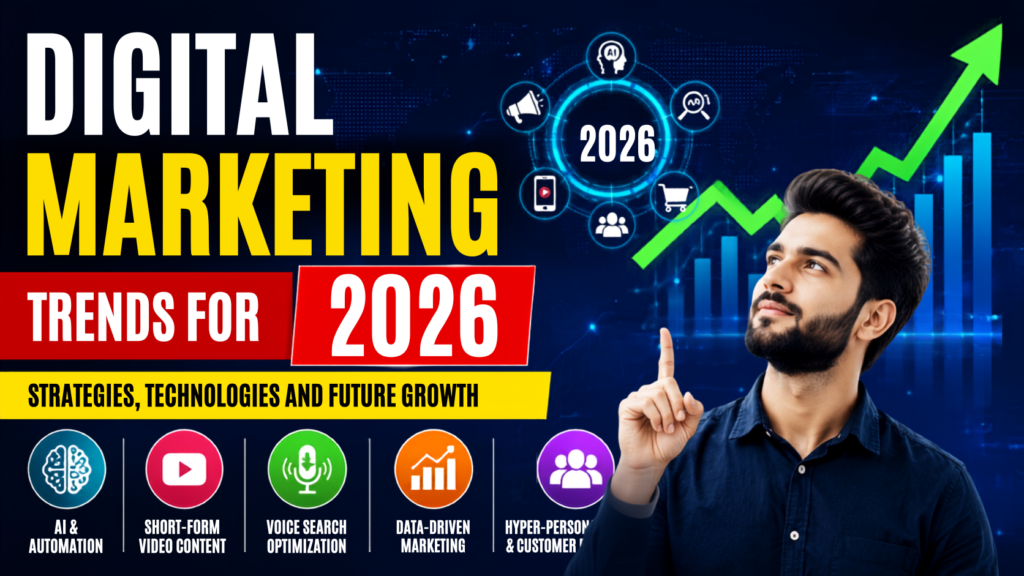
Digital marketing is the process of promoting products, services, brands, or businesses through digital channels and technologies.
Major areas of digital marketing include:
While these fundamentals remain important, the way marketers use them is changing. Modern digital marketing combines technology, creativity, customer psychology, data, and strategic thinking.
Artificial intelligence is one of the most important forces shaping digital marketing in 2026.
AI can help marketers analyze large amounts of data, understand customer behavior, generate ideas, personalize campaigns, automate repetitive activities, and improve marketing workflows.
Common applications include:
However, successful marketers should not treat AI as a complete replacement for human expertise. AI can increase productivity, but marketers still need creativity, strategic judgment, brand understanding, fact-checking, and customer insight.
The strongest approach is AI + human expertise.
Generative AI is changing how marketers create and manage content.
AI tools can assist with:
But creating thousands of pages using AI without adding meaningful value is not a sustainable SEO strategy. Google’s guidance warns that generating many pages primarily to manipulate rankings can fall under its spam policies.
Therefore, marketers should use AI as an assistant rather than an automatic publishing machine.
High-quality content should include:
The future belongs to brands that combine AI efficiency with genuine human value.
SEO remains one of the most important digital marketing skills in 2026, but modern SEO is much broader than inserting keywords into articles.
Effective SEO now involves:
Google’s current documentation states that the same foundational SEO practices remain relevant for AI Overviews and AI Mode. Websites still need to be crawlable, indexable, technically sound, useful, and easy for users to navigate.
This means businesses should not abandon SEO because of AI search. Instead, they should make their SEO strategy more comprehensive.
Generative Engine Optimization, commonly called GEO, refers to efforts aimed at improving a brand’s visibility in AI-generated search experiences.
People increasingly ask complex questions through conversational interfaces rather than relying only on traditional keyword searches.
For example, instead of searching:
“Best digital marketing course Hyderabad”
a user might ask:
“Which digital marketing course in Hyderabad would be suitable for someone who wants practical SEO, Google Ads and AI marketing skills?”
This creates new opportunities for businesses to build authoritative, comprehensive content.
Google’s latest guidance explains that terms such as AEO and GEO are used for work focused on AI search visibility, but Google’s perspective is that optimizing for generative AI search is still fundamentally part of SEO.
To improve visibility, businesses should focus on:
Rather than chasing a secret “GEO trick,” marketers should build websites that are genuinely useful and authoritative.
Short-form video continues to be a powerful content format.
Platforms such as Instagram Reels and YouTube Shorts allow businesses to communicate ideas quickly and visually.
Businesses can use short videos for:
For example, a digital marketing institute can create short videos explaining SEO mistakes, Google Ads tips, keyword research techniques, or interview questions.
The most effective short videos generally have a clear hook, useful information, strong visuals, and a simple call to action.
Social media success is no longer simply about collecting followers.
Brands increasingly need to focus on:
A smaller but highly engaged audience can be more valuable than a large audience that rarely interacts with a brand.
Businesses should therefore create content that encourages people to comment, share, save, discuss, and participate.
Consumers often want to see real experiences before making purchasing decisions.
This is why user-generated content (UGC) and influencer marketing continue to be important digital marketing trends.
UGC can include:
Influencer marketing is also becoming more diversified. Brands do not always need celebrities. Micro-influencers and niche creators can provide access to highly relevant communities.
Authenticity is particularly important. Audiences can quickly recognize content that feels overly scripted or purely promotional.
Customers increasingly expect businesses to understand their needs.
Personalization can include:
AI can help businesses analyze customer behavior and deliver more relevant experiences.
However, personalization should be balanced with privacy. Businesses need to collect and use customer information responsibly and transparently.
Automation allows marketers to spend less time on repetitive tasks and more time on strategy and creativity.
Examples include:
For example, when someone downloads an educational guide, an automated workflow can send a sequence of relevant emails rather than requiring a marketer to contact every person manually.
Automation becomes particularly powerful when combined with customer data and AI.
People increasingly use natural-language questions when interacting with search engines, assistants, and AI systems.
Instead of searching for:
“SEO course Hyderabad”
a person might ask:
“What should I learn in an SEO course if I want to become an SEO professional?”
Marketers should therefore consider conversational search behavior.
Useful optimization techniques include:
The objective should not be to write awkward content for machines. It should be to answer the questions customers actually ask.
Video is no longer limited to entertainment.
Businesses use video for education, sales, demonstrations, customer support, webinars, product launches, and brand storytelling.
Interactive content can make marketing even more engaging.
Examples include:
Interactive experiences encourage audiences to participate rather than passively consume information.
Successful marketers need to understand what is working and what is not.
Data can help businesses measure:
Important tools include Google Analytics, Google Search Console, advertising dashboards, CRM systems, and reporting platforms.
Marketers should learn to answer questions such as:
Data should guide decisions rather than assumptions.
Google also introduced new Search Console reporting for generative-AI visibility in 2026, giving a subset of sites dedicated views into impressions from AI-powered Search features
Privacy is becoming increasingly important as businesses collect more customer information.
First-party data can include information voluntarily provided through:
Businesses should clearly explain how customer information is collected and used.
Responsible data practices can help build trust while supporting useful personalization.
Local SEO remains particularly valuable for businesses that serve specific geographic areas.
Important local SEO activities include:
For example, a training institute targeting Hyderabad can create useful content around searches such as:
However, local SEO should focus on providing useful local information rather than repeatedly inserting city names into every paragraph.
The modern digital marketer needs a combination of technical, creative, analytical, and AI-related skills.
Important skills include:
The strongest professionals will not necessarily be experts in every individual tool. Instead, they will understand how different marketing channels work together.
For example:
SEO + Content + AI + Analytics + Conversion Optimization
can create a much stronger marketing system than relying on one channel alone.
Businesses can take several practical steps to adapt.
Review your website, SEO, social media, advertising, content, analytics, and conversion processes.
Identify customer problems, questions, preferences, search behavior, and buying motivations.
Make sure your website is crawlable, technically sound, mobile-friendly, fast, internally linked, and filled with useful content.
Use AI to improve research, productivity, analysis, personalization, and ideation while maintaining human oversight.
Develop content based on expertise, experience, customer questions, case studies, examples, and original insights.
Create educational, entertaining, and informative videos appropriate to your audience and platform.
Focus on conversations and relationships instead of only follower growth.
Build permission-based relationships through email subscriptions, customer accounts, forms, and direct interactions.
Measure business outcomes rather than vanity metrics alone.
Digital marketing is an ongoing process. Test headlines, advertisements, landing pages, content formats, audiences, and calls to action.
The growth of digital channels and AI-powered marketing is creating opportunities across many roles.
Potential career paths include:
Students and professionals can build careers by developing practical skills rather than focusing only on theoretical knowledge.
A strong digital marketing professional should understand how to research keywords, create content, optimize websites, run campaigns, analyze performance, communicate with customers, and use modern AI tools effectively.
.
For students and professionals looking for digital marketing training in Hyderabad, practical learning can be an important part of career development.
Onclick Digital Marketing Academy can be positioned as a learning environment where students explore important areas of modern digital marketing, including:
The goal of digital marketing education should not simply be learning definitions. Students should understand how different channels work together to solve real marketing problems.
Whether someone wants to pursue a digital marketing career, freelance for clients, promote a business, or build a personal brand, developing practical digital marketing skills can provide a strong foundation.
Major trends include AI powered marketing, generative AI, advanced SEO, AI search, GEO, short-form video, personalization, marketing automation, UGC, social communities, data driven marketing, and privacy focused strategies.
AI is helping marketers with research, content ideation, personalization, customer segmentation, analytics, advertising optimization, automation, and customer support. Human strategy and quality control remain important.
Yes. Google’s current guidance states that foundational SEO practices remain relevant for AI-powered Search experiences, including AI Overviews and AI Mode.
GEO, or Generative Engine Optimization, is a term used for efforts focused on improving visibility in generative AI search experiences. Google describes GEO as essentially part of optimizing for the broader search experience rather than a replacement for SEO
Start with SEO, Google Ads, social media, content marketing, analytics, AI tools, WordPress, copywriting, video marketing, and conversion optimization.
Digital marketing continues to offer diverse career paths across SEO, paid advertising, content, social media, analytics, automation, consulting, freelancing, and entrepreneurship. Success depends on practical skills, adaptability, and continuous learning.

Upcoming Batches Why Choose Onclick Digital Marketing Academy Onclick Digital Marketing Is Best Digital Marketing Training Institute In Hyderabad With 100% Placement Assistance 9+ Years
Privacy Policy Welcome to Onclick Digital Marketing Academy. We value your privacy and are committed to protecting the personal information you share with us. This
Terms & Conditions Welcome to Onclick Digital Marketing Academy. By accessing our website, submitting an enquiry, enrolling in any of our training programs, or using
Loading… ISO Certification We Are Providing ISO Certification For Our Students. 15000+ Students We bring the right people together to challenge established thinking Accredited &
Loading… ISO Certification We Are Providing ISO Certification For Our Students. 15000+ Students We bring the right people together to challenge established thinking Accredited &
Master Digital Marketing Learn Industry-Ready Skills. Get Certified. Launch Your Career with Practical Training. Expert Trainers Learn from Industry Experts 100% Placement Assistance Explore Courses
Whatsapp Us Call : 9346775340 Get Brochure 2026 Curriculum AI Powered Become Job Ready with AI Powered Digital Marketing Course Join Hyderabad’s most trusted digital
Whatsapp Us Call : 9985023500 Get Brochure 2026 Curriculum AI Powered Become Job Ready with AI Powered Digital Marketing Course Join Hyderabad’s most trusted digital
Whatsapp Us Call : 9985023500 Enquiry Now #1 Digital Marketing Institute in Hyderabad Launch Your Digital Marketing Career with Performance Marketing, Real-Time Projects & 100%
Whatsapp Us Call : 9985023500 #1 Digital Marketing Institute in Hyderabad Launch Your Digital Career With Real-Time Projects & 100% Placement Assistance Master 15+ in-demand
Enroll Now Master Digital Marketing with AI & Build a Future-Proof Career Learn SEO, Google Ads, Social Media & AI Tools with Real-Time Projects +