
New Batches
Upcoming Batches Why Choose Onclick Digital Marketing Academy Onclick Digital Marketing Is Best Digital Marketing Training Institute In Hyderabad With 100% Placement Assistance 9+ Years
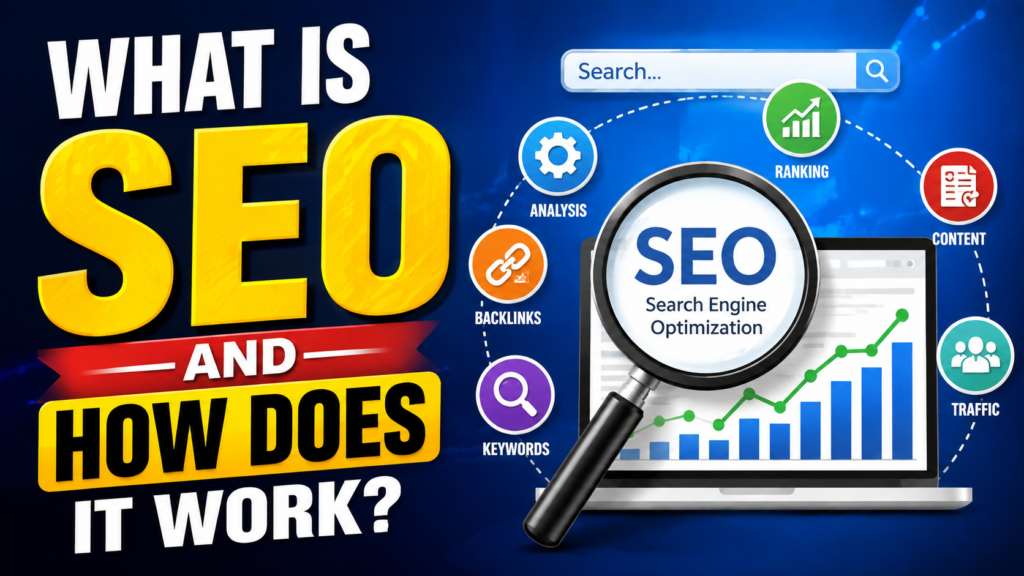
In today’s hyper connected world, having a website is just the beginning. The real challenge is making sure your target audience can actually find you online. That’s where SEO Search Engine Optimization comes in. Whether you’re a business owner, a blogger, a startup founder, or a marketing professional, understanding SEO is no longer optional it’s essential. No prior technical experience is required; our course at Onclick Academy is designed to guide complete beginners through every step. In this comprehensive guide, we will break down everything you need to know about SEO: what it is, how search engines work, the key components of SEO, and how you can leverage it to grow your online presence. Our digital marketing course at Onclick Academy is tailored to demystify SEO, helping you overcome common misconceptions and practical challenges. By the end of this course, you’ll have the skills to implement effective strategies and see tangible results.
SEO, or Search Engine Optimization, is the practice of improving your website’s visibility on search engines like Google, Bing, and Yahoo. When a user types a query into a search engine, the search engine displays a list of results ranked by relevance and authority. Mastering SEO can empower you to attract more visitors and grow your online presence effectively. Unlike paid advertising, SEO focuses on earning traffic naturally through relevant content, technical website improvements, and building authority. It is a long-term strategy that, when done correctly, delivers sustainable and compounding results over time, helping your business grow steadily and reliably.
To understand SEO, you first need to understand how search engines function. Search engines like Google use automated programs called ‘bots’ or ‘spiders’ to crawl the internet. These bots follow links from one page to another, collecting information about each page they visit. This process is called web crawling.
Googlebot and other search engine crawlers constantly scan the web, visiting URLs and following hyperlinks. They discover new pages and updated content, then report back to the search engine’s servers. Having a clean website structure, proper internal linking, and an XML sitemap helps crawlers navigate your site efficiently.
After crawling, search engines store the collected information in a massive database called the index. This index is like a giant library catalog when a user searches for something, the search engine looks through its index to find the most relevant pages. Content that is well-structured, original, and uses relevant keywords is more likely to be indexed properly.
Once indexed, search engines use complex algorithms to determine which pages to display for a given query and in what order. Google’s algorithm considers over 200 ranking factors, including content relevance, page authority, user experience, site speed, mobile-friendliness, and backlinks. The goal of SEO is to satisfy as many of these ranking factors as possible.
Modern SEO is built on three core pillars: On-Page SEO, Off-Page SEO, and Technical SEO. A successful SEO strategy, supported by professional training, can help you develop comprehensive skills and confidently grow your digital marketing career.
On-page SEO refers to all the optimizations you make directly on your web pages to improve their search rankings. This includes:
Off-page SEO involves actions taken outside of your website to improve its authority and trustworthiness in the eyes of search engines. The most important off-page SEO factor is backlinks — links from other websites pointing to yours. Key off-page strategies include:
Influencer Outreach – Collaborating with influencers to reach a wider audience.
Technical SEO focuses on the backend structure of your website — the elements that search engines use to crawl and index your site efficiently. Without a technically sound website, even great content may fail to rank. Technical SEO includes:
SEO is one of the most cost-effective digital marketing strategies available. Unlike paid ads that stop generating traffic the moment you stop spending, SEO builds long-term organic visibility. Here’s why SEO is critical for every business:
LSI (Latent Semantic Indexing) keywords are conceptually related terms and phrases that search engines use to understand the context and depth of your content. They are not just synonyms they are words that naturally co-occur with your primary keyword, helping Google verify that your content is comprehensive and authoritative on a topic.
For example, an article about SEO would naturally include LSI keywords such as:
By incorporating LSI keywords naturally throughout your content, you signal to Google that your article is a thorough, expert-level resource improving your chances of ranking for multiple related search queries simultaneously.
One of the most common questions beginners ask is: “How fast will I see results from SEO?” The honest answer is that SEO is a long-term investment. Most websites begin to see meaningful improvements in rankings and organic traffic between 3 to 6 months of consistent effort though this can vary significantly based on your niche competitiveness, domain authority, content quality, and the resources you dedicate to SEO. The key is consistency. Regularly publishing high-quality content, earning backlinks, fixing technical issues, and monitoring your performance through tools like Google Search Console and Google Analytics will compound your results over time. Many businesses that invest seriously in SEO experience exponential traffic growth after 12 months.
Now that you understand what SEO is and how it works, you might be wondering: “How do I master all of this and apply it to grow a real business or career?” The answer is professional training and that’s exactly what Onclick Digital Marketing Academy offers. At Onclick Digital Marketing Academy in Hyderabad, we offer a comprehensive Digital Marketing Course designed for students, entrepreneurs, freelancers, and working professionals who want to build in-demand skills in the digital economy. Our Digital Marketing Training in Hyderabad is 100% practical, industry-aligned, and mentored by experienced professionals with real-world campaign expertise.
Whether you’re a fresh graduate looking to break into the digital marketing industry, a business owner who wants to market your own brand, or a professional looking to upskill our Digital Marketing Course in Hyderabad is the perfect launchpad for your goals.
SEO is one of the most powerful tools in any digital marketer’s arsenal. By understanding how search engines crawl, index, and rank content and by optimizing your website across all three pillars of on-page, off-page, and technical SEO you can significantly improve your online visibility and drive consistent, high-quality organic traffic. SEO is not a one-time task; it is an ongoing process that rewards consistency, quality, and a genuine commitment to delivering value to your audience. The businesses and individuals who invest in SEO today are the ones who will dominate search results tomorrow. If you’re ready to take your digital marketing skills to the next level, Onclick Digital Marketing Academy in Hyderabad is here to guide you every step of the way. Join our comprehensive Digital Marketing Course and transform your career or business with the power of SEO and beyond.
Bussa Karthik Reddy is an experienced corporate trainer in Hyderabad, entrepreneur, and digital marketing expert with over 10 years in the industry. He focuses on professional training in Primavera P6, Microsoft Project, and BIM training. He helps students and professionals build strong careers in project management and construction technologies.
He founded Onclick Digital Marketing Services, JBK Academy, and Raster FX Studios. At these organizations, he provides job-oriented training in Hyderabad that emphasizes real-world skills, job placement support, and career growth. His skills also include lead generation through digital marketing, SEO strategies, and performance marketing. This makes him a well-rounded trainer in both technical and marketing fields.
As a Digital Marketing Trainer in Hyderabad and HR Manager at MAAC Kukatpally, he has hands-on experience with student placement, recruitment, and career development. This dual role helps him understand what the industry needs and train students with practical skills that are relevant to the job market.
With a strong passion for teaching, he has trained hundreds of students in BIM courses, project management tools, and digital marketing courses in Hyderabad. His aim is to help learners gain in-demand skills, improve their job prospects, and secure high-paying positions in competitive industries.

Upcoming Batches Why Choose Onclick Digital Marketing Academy Onclick Digital Marketing Is Best Digital Marketing Training Institute In Hyderabad With 100% Placement Assistance 9+ Years
Privacy Policy Welcome to Onclick Digital Marketing Academy. We value your privacy and are committed to protecting the personal information you share with us. This
Terms & Conditions Welcome to Onclick Digital Marketing Academy. By accessing our website, submitting an enquiry, enrolling in any of our training programs, or using
Loading… ISO Certification We Are Providing ISO Certification For Our Students. 15000+ Students We bring the right people together to challenge established thinking Accredited &
Loading… ISO Certification We Are Providing ISO Certification For Our Students. 15000+ Students We bring the right people together to challenge established thinking Accredited &
Master Digital Marketing Learn Industry-Ready Skills. Get Certified. Launch Your Career with Practical Training. Expert Trainers Learn from Industry Experts 100% Placement Assistance Explore Courses
Whatsapp Us Call : 9346775340 Get Brochure 2026 Curriculum AI Powered Become Job Ready with AI Powered Digital Marketing Course Join Hyderabad’s most trusted digital
Whatsapp Us Call : 9985023500 Get Brochure 2026 Curriculum AI Powered Become Job Ready with AI Powered Digital Marketing Course Join Hyderabad’s most trusted digital