
New Batches
Upcoming Batches Why Choose Onclick Digital Marketing Academy Onclick Digital Marketing Is Best Digital Marketing Training Institute In Hyderabad With 100% Placement Assistance 9+ Years
Having a website and social media presence is no longer enough to succeed online. Businesses need a well-planned digital marketing strategy that reaches the right audience, communicates the right message, and guides potential customers through the buying journey.
Whether you run a small local business, e-commerce store, startup, educational institute, or established company, digital marketing can help you increase brand awareness, attract qualified visitors, generate leads, improve customer relationships, and support long-term business growth.
However, digital marketing success does not come from simply being active on every platform. It requires a strategic approach based on your audience, business goals, content, marketing channels, and performance data.
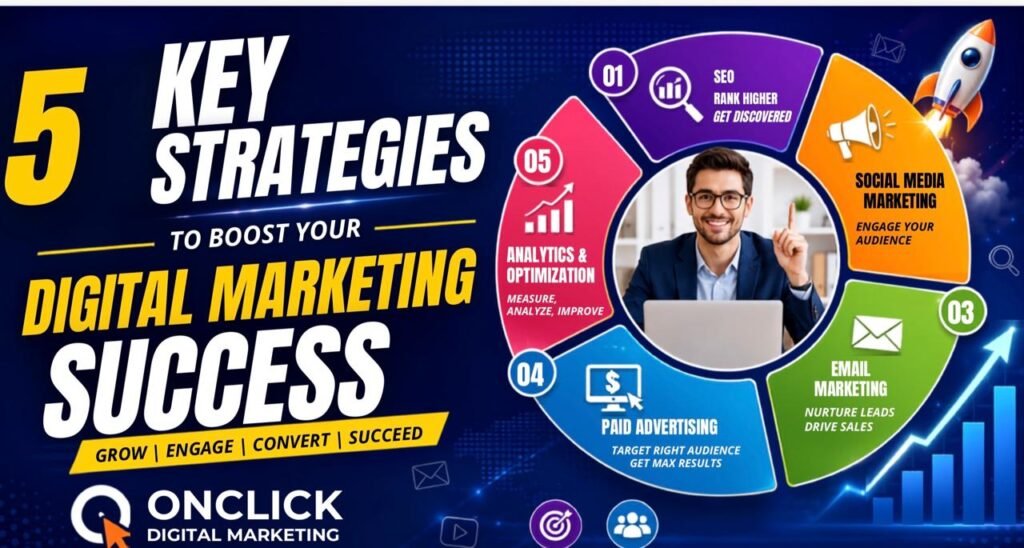
The five key strategies covered in this guide are SEO, social media marketing, email marketing, paid advertising, and data-driven marketing. When these strategies work together, they can create a stronger and more measurable online marketing system.
For businesses and aspiring marketers interested in digital marketing training in Hyderabad, understanding how these channels work together is also an important foundation for developing practical digital marketing skills.
Search Engine Optimization (SEO) is one of the most important components of a successful digital marketing strategy. SEO helps businesses improve their visibility when potential customers search online for products, services, information, or solutions related to their business.
Unlike paid advertising, organic search visibility is not directly dependent on an advertising budget. Instead, it is developed through helpful content, technical improvements, relevant keywords, strong website structure, positive user experience, and website authority.
SEO is a long-term process rather than a quick solution. Consistent optimization, monitoring, and content development are essential for achieving sustainable results.
Keyword research helps businesses understand what their potential customers are searching for.
For example, a digital marketing academy serving Hyderabad might target relevant search terms such as digital marketing course in Hyderabad, SEO course in Hyderabad, Google Ads course in Hyderabad, or social media marketing course in Hyderabad.
However, keyword selection should not be based only on search volume. Marketers should also consider:
The goal is to target keywords that connect your business with people who are genuinely interested in your products or services.
Once you understand your target keywords and audience, create content that solves real problems.
Useful formats include blog articles, service pages, landing pages, guides, tutorials, FAQs, case studies, comparison articles, and educational resources.
For example, a digital marketing company could publish content about SEO, Google Ads, social media marketing, content marketing, email marketing, WordPress, and website optimization.
High-quality content should be written primarily for people rather than created simply to insert keywords. Search engines increasingly reward useful content that satisfies the user’s intent and provides a positive experience.
SEO involves much more than adding keywords to an article.
Businesses should also optimize:
Internal linking is particularly valuable because it helps visitors discover related information while also helping search engines understand the relationship between pages.
Off-page SEO can support a website’s credibility and visibility. Relevant backlinks, brand mentions, partnerships, digital PR, and useful references can contribute to building authority.
The focus should be on earning relevant and trustworthy links instead of obtaining large numbers of low-quality backlinks.
SEO takeaway: SEO is a long-term digital marketing strategy. Consistent optimization and valuable content can create opportunities for sustainable organic visibility, but search rankings and traffic cannot be guaranteed.
Social media marketing allows businesses to communicate directly with their target audience, distribute content, showcase products and services, and build brand awareness.
Platforms such as Instagram, Facebook, LinkedIn, and YouTube can support different marketing goals. The best platform depends on the business, audience, content format, and campaign objective.
The goal should not be to maintain a presence on every social network. Instead, focus on the platforms where your target customers are most active.
Different businesses may perform better on different platforms.
For example, a B2B company may benefit from LinkedIn, while fashion, jewellery, food, travel, and lifestyle brands may find visually focused platforms such as Instagram useful.
Before choosing a platform, consider:
A focused social media strategy is usually more effective than spreading limited resources across too many platforms.
Social media content should not always be promotional. Audiences are more likely to engage with pages that provide useful or interesting information rather than constantly trying to sell something.
A digital marketing brand, for example, could publish:
A balanced content strategy can help a business educate its audience, establish expertise, build trust, and maintain engagement.
Social media is about communication, not just publishing posts.
Businesses should respond to comments, answer questions, monitor messages, and participate in relevant conversations.
Follower count alone does not determine social media success. Depending on the campaign objective, metrics such as engagement, website visits, enquiries, leads, and conversions may provide more meaningful insights.
Consistency is important, but it does not mean posting several times every day.
A realistic content calendar is often more effective than publishing large amounts of content for a short period and then becoming inactive.
Plan your content around topics, formats, platforms, publishing dates, campaigns, and business goals. This makes social media marketing easier to manage and more consistent.
Email marketing remains an important digital marketing channel because it provides businesses with a direct way to communicate with subscribers and customers.
While social media platforms control how content is distributed, an appropriately managed email list gives businesses a direct communication channel with people who have chosen to hear from them.
Email marketing can be used to educate audiences, nurture leads, promote products or services, share updates, and encourage repeat engagement.
Effective email marketing starts with permission-based list building.
Businesses should focus on attracting subscribers who are genuinely interested in their products, services, or content rather than relying on purchased or irrelevant email databases.
Businesses can encourage subscriptions through:
The quality and relevance of your audience are generally more important than simply having a large email list.
Different subscribers have different needs.
Segmentation allows businesses to organize subscribers according to relevant factors such as interests, previous interactions, customer stage, or purchasing behavior.
For example, a digital marketing academy could create different segments for new enquiries, existing students, previous students, and people interested in specific courses.
Relevant segmentation helps businesses deliver more targeted and useful messages.
Every email should have a clear purpose.
Depending on the campaign, an email might educate the subscriber, provide an important update, introduce a service, promote an offer, or encourage a specific action.
Effective emails generally include:
Testing different subject lines, content, calls to action, and sending schedules can help marketers understand what works best for their audience.
Email automation allows businesses to send relevant communications based on customer actions or stages in the customer journey.
Common examples include:
Automation can save time and improve consistency, but it should always support a clear marketing strategy.
Organic marketing strategies can take time to develop. Paid advertising can provide businesses with another way to reach relevant audiences, test marketing messages, promote offers, and generate leads or sales.
Platforms such as Google Ads and social media advertising platforms can be useful when campaigns are properly planned, targeted, tracked, and optimized.
Before launching a paid advertising campaign, determine exactly what you want to achieve.
Possible objectives include:
Your objective should influence your audience, advertising format, budget, landing page, CTA, and performance metrics.
One of the major advantages of digital advertising is the ability to reach audiences using targeting options provided by each advertising platform.
Search advertising can reach users based on relevant search queries, while social advertising can use available audience characteristics and platform signals.
However, targeting alone does not guarantee results. Your advertisement, offer, landing page, tracking system, and customer experience all influence campaign performance.
Effective advertising communicates the value of an offer quickly.
For example, instead of using a generic message such as “Learn Digital Marketing Today!”, an advertisement could clearly communicate what the course offers, such as practical training in SEO, Google Ads, social media marketing, analytics, and content marketing.
The advertising message should always accurately reflect the actual product or service.
A successful advertisement does not end with a click.
If users arrive on a slow, confusing, irrelevant, or poorly designed landing page, they may leave without taking action.
A strong landing page should include:
The landing page should also match the message and intent of the advertisement.
A/B testing can help marketers compare different headlines, advertisements, audiences, landing-page elements, or offers.
Avoid changing everything at the same time. Make controlled changes, monitor the relevant metrics, and use the results to make informed optimization decisions.
The fifth strategy connects all the others: data-driven marketing.
Digital marketing generates valuable information through website analytics, search performance, advertising platforms, email campaigns, and social media insights.
However, collecting data is only the beginning. Marketers need to interpret the information and turn it into actionable decisions.
The right Key Performance Indicators (KPIs) depend on your marketing objective.
For SEO, businesses may monitor:
For paid advertising, marketers may track:
For email marketing, useful measurements can include:
For social media, relevant metrics may include:
The most important principle is to connect metrics to business goals.
Imagine a business receives thousands of website visitors but generates very few enquiries.
Increasing traffic may appear positive, but marketers should investigate what happens after visitors arrive.
Ask:
Where are visitors coming from?
Are they the right audience?
Which pages do they visit?
Where do they leave?
Is the CTA clear?
Is the enquiry form working correctly?
Does the landing page match the search intent or advertisement?
Answering these questions can reveal opportunities to improve the customer journey and conversion rate.
A practical data-driven marketing cycle is:
Measure → Analyze → Identify → Test → Improve → Measure Again
This process can be applied to SEO, social media, email marketing, paid advertising, content marketing, and website conversion optimization.
The real strength of these strategies comes from combining them rather than treating them as separate activities.
For example, imagine a digital marketing academy launching a new course.
SEO can help prospective students discover educational content through search engines. Social media can distribute useful marketing tips and course-related content. Paid advertising can reach relevant audiences with targeted offers. Email marketing can nurture people who have already expressed interest. Analytics can then reveal which channels, campaigns, and messages are generating meaningful results.
This creates a simple integrated marketing framework:
SEO → Attract
Social Media → Engage
Paid Advertising → Reach
Email Marketing → Nurture
Analytics → Optimize
The ideal combination depends on the business, target audience, industry, available resources, budget, and marketing objectives.
Before implementing different marketing channels, businesses should establish a clear foundation.
Start by identifying measurable objectives. You may want to increase qualified leads, generate sales, improve organic visibility, increase enquiries, or build awareness in a new market.
Clear goals make it easier to select appropriate channels and KPIs.
Research your customers and understand their needs, challenges, search behavior, preferences, purchasing journey, and preferred communication channels.
The better you understand your audience, the easier it becomes to create relevant content and campaigns.
Analyze competitor websites, content, social media activity, advertisements, offers, landing pages, and customer experience.
The purpose is not to copy competitors. Instead, identify gaps and opportunities that can help your business differentiate itself.
You do not necessarily need every digital marketing channel.
Choose channels based on where your audience is active, what your business wants to achieve, and what resources you can realistically invest.
Plan your blog articles, social media posts, videos, email campaigns, and promotional activities in advance.
A content calendar can improve consistency and help ensure that your content supports broader business and marketing objectives.
Set KPIs before launching campaigns. Review performance regularly and use data to identify what is working and what needs improvement.
Digital marketing is an ongoing process rather than a one-time activity.
Even a well-planned strategy can produce poor results when businesses make common mistakes.
Being active on more platforms does not automatically mean better marketing. Focus your resources on channels that are relevant to your audience and objectives.
Website traffic is useful, but traffic alone does not guarantee business growth. Qualified visitors, leads, sales, enquiries, and conversions may be more meaningful metrics.
Many users access websites and social platforms through mobile devices. Your website, landing pages, emails, and advertisements should provide a smooth mobile experience.
Repeating keywords excessively can make content difficult to read and may create a poor user experience. Use keywords naturally and focus on satisfying search intent.
Without reliable conversion tracking, it can be difficult to understand whether advertising is generating meaningful business results.
Content should solve real problems and answer genuine questions. Publishing simply to maintain a schedule can lead to low-value content.
Marketing assumptions should be tested whenever practical. A campaign that performs well for one audience may not perform equally well for another.
Digital marketing is not only about acquiring new customers. Customer retention, education, communication, and relationship building can also contribute to long-term business value.
Digital marketing combines multiple disciplines, including SEO, social media marketing, content marketing, paid advertising, email marketing, analytics, websites, and conversion optimization.
Understanding how these areas work together can help businesses create more coordinated campaigns and help aspiring marketers develop practical skills.
These skills can support career paths such as:
For learners searching for a digital marketing course in Hyderabad, practical exposure to SEO, social media, Google Ads, analytics, content, and other digital marketing channels can be valuable when developing a portfolio and preparing for real-world projects.
The five key strategies are SEO, social media marketing, email marketing, paid advertising, and data-driven marketing. Together, these strategies can help businesses attract audiences, build relationships, generate leads, and improve marketing performance.
Yes. SEO can help businesses improve organic visibility and connect with people searching for relevant products, services, information, or solutions. SEO should be treated as part of a broader digital marketing strategy rather than a guaranteed source of rankings or traffic.
Social media can help businesses build brand awareness, communicate with audiences, distribute content, generate engagement, and support lead-generation or sales campaigns. The best platform depends on the target audience and business objectives.

Upcoming Batches Why Choose Onclick Digital Marketing Academy Onclick Digital Marketing Is Best Digital Marketing Training Institute In Hyderabad With 100% Placement Assistance 9+ Years
Privacy Policy Welcome to Onclick Digital Marketing Academy. We value your privacy and are committed to protecting the personal information you share with us. This
Terms & Conditions Welcome to Onclick Digital Marketing Academy. By accessing our website, submitting an enquiry, enrolling in any of our training programs, or using
Loading… ISO Certification We Are Providing ISO Certification For Our Students. 15000+ Students We bring the right people together to challenge established thinking Accredited &
Loading… ISO Certification We Are Providing ISO Certification For Our Students. 15000+ Students We bring the right people together to challenge established thinking Accredited &
Master Digital Marketing Learn Industry-Ready Skills. Get Certified. Launch Your Career with Practical Training. Expert Trainers Learn from Industry Experts 100% Placement Assistance Explore Courses
Whatsapp Us Call : 9346775340 Get Brochure 2026 Curriculum AI Powered Become Job Ready with AI Powered Digital Marketing Course Join Hyderabad’s most trusted digital
Whatsapp Us Call : 9985023500 Get Brochure 2026 Curriculum AI Powered Become Job Ready with AI Powered Digital Marketing Course Join Hyderabad’s most trusted digital
Whatsapp Us Call : 9985023500 Enquiry Now #1 Digital Marketing Institute in Hyderabad Launch Your Digital Marketing Career with Performance Marketing, Real-Time Projects & 100%
Whatsapp Us Call : 9985023500 #1 Digital Marketing Institute in Hyderabad Launch Your Digital Career With Real-Time Projects & 100% Placement Assistance Master 15+ in-demand
Enroll Now Master Digital Marketing with AI & Build a Future-Proof Career Learn SEO, Google Ads, Social Media & AI Tools with Real-Time Projects +