
New Batches
Upcoming Batches Why Choose Onclick Digital Marketing Academy Onclick Digital Marketing Is Best Digital Marketing Training Institute In Hyderabad With 100% Placement Assistance 9+ Years
Pay per click advertising can be one of the fastest ways to put your business in front of potential customers. However, simply creating a Google Ads campaign, adding keywords, and increasing your budget does not guarantee better results. If your account is poorly organised, you may end up paying for irrelevant clicks, struggling to identify profitable keywords, and finding it difficult to understand which campaigns are actually generating conversions.This is where a well planned PPC structure becomes important. A logical structure helps connect your business objectives with campaigns, ad groups, keywords, advertisements, landing pages, and conversion goals. When these elements work together, managing budgets and optimising performance becomes considerably easier.Whether you are creating a new Google Ads account or improving an existing one, the right structure can help you make better decisions and scale your campaigns more effectively. In this guide, we will explore 10 practical strategies to optimise your PPC structure, along with examples, common mistakes, and a checklist you can use when auditing your campaigns.
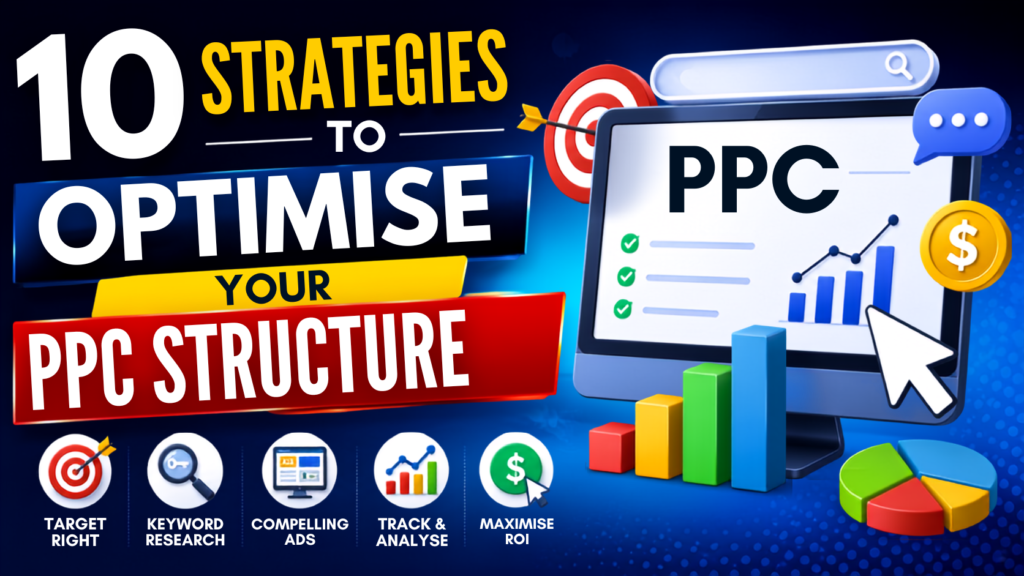
PPC structure refers to the way a paid advertising account is organised so that campaigns, targeting, keywords, advertisements, and landing pages work together around specific marketing objectives.
A simplified PPC hierarchy looks like this:
PPC Account → Campaigns → Ad Groups → Keywords & Ads → Landing Pages → Conversions
At the account level, advertisers manage the overall Google Ads environment, including campaigns, conversion tracking, billing, audiences, and other settings.Campaigns are generally used to separate major objectives, products, services, budgets, locations, or targeting requirements. For example, a digital marketing company could have separate campaigns for PPC services, SEO services, and social media marketing. Ad groups organise closely related keywords and advertisements around a particular theme. A PPC Services campaign could have an ad group focused on PPC management.Keywords help connect what people search for with relevant advertising. Ads then communicate the appropriate offer or message to those potential customers.Finally, landing pages provide the destination after someone clicks an advertisement. The page should closely match the searcher’s intent and what the ad promised.The goal is not to create the most complicated account possible. It is to create a structure that is logical, relevant, measurable, and easy to manage.
A strong PPC campaign structure provides a foundation for effective campaign management. When related keywords, ads, and landing pages are properly organised, advertisers can more easily understand performance and make targeted improvements. A good structure can help with budget allocation, because campaigns can be organised around objectives that require different levels of investment. It can also improve keyword organisation, making it easier to identify which search themes generate valuable traffic. Relevance is another important factor. When keywords, ads, and landing pages are closely connected, users are more likely to see messaging that matches what they are searching for.A well organised structure can also make reporting easier. Instead of analysing one large campaign containing unrelated products or services, marketers can examine performance according to meaningful business categories.However, more segmentation does not automatically mean better optimisation. An account containing hundreds of unnecessary campaigns and ad groups can become difficult to manage and may fragment data. A better approach is to create enough structure to maintain meaningful control while avoiding unnecessary complexity.
Every PPC campaign should have a clear reason for existing. Before creating campaigns, identify what you want each campaign to accomplish.
For example, a digital marketing agency could create campaigns around services such as PPC management, SEO services, social media marketing, and website development. An ecommerce business might organise campaigns around major product categories or business priorities.
Campaign separation can be useful when different areas require different budgets, targeting settings, locations, or strategic controls.
For instance, if a company wants to spend more aggressively on high-value PPC leads than on general awareness, separating those objectives can make budget management easier.
The important point is to avoid creating campaigns simply because a keyword or product is slightly different. Ask whether the difference actually requires separate budget management, targeting, reporting, or optimisation.
A clear campaign objective provides direction for everything underneath it and makes the overall PPC account structure easier to understand.
Ad groups should contain closely related keywords and advertisements rather than a collection of unrelated search terms.
Consider a campaign called Digital Marketing Services. It could contain ad groups such as:
The PPC Services ad group could then contain closely related terms such as “PPC management services,” “Google Ads management,” and “PPC advertising agency.”
This approach makes it easier to write relevant advertisements because the keywords share a common theme.
It also creates a clearer path between the user’s search and the content they see after clicking.
However, this does not mean every keyword needs its own ad group. Excessive fragmentation can make accounts harder to manage and can unnecessarily divide performance data. The objective is to create tightly themed but practical ad groups.
Keyword organisation should go beyond simply grouping words that look similar. Consider what the searcher is actually trying to accomplish.
Search intent can broadly include informational, commercial, transactional, local, and branded intent.
For example, “what is PPC advertising” is primarily informational. A search such as “best PPC agency” may indicate commercial research, while “hire PPC agency” suggests stronger transactional intent.
Similarly, “PPC agency in Hyderabad” includes a local component.
Understanding these differences can help advertisers decide whether keywords should share an ad group, advertisement, or landing page.
A keyword that indicates a person wants to learn about PPC may require different messaging from a keyword indicating that someone is ready to hire a PPC agency.
When building your PPC keyword structure, consider both the language used in the query and the likely stage of the customer journey.
Google Ads provides broad, phrase, and exact match options, each of which can play a role in a PPC strategy.
Broad match provides wider reach and can help advertisers discover relevant searches beyond the exact wording of the keyword. Phrase match offers a more controlled approach while still allowing variations of a search. Exact match provides greater control over the searches that can trigger a keyword, although it does not mean only one literal query will ever match.
There is no single match type that is automatically best for every campaign.
Your choice should depend on factors such as campaign objectives, conversion data, search intent, budget, and bidding strategy.
For example, an advertiser with strong conversion tracking and sufficient data may use broader matching alongside automated bidding to discover additional relevant searches. Another campaign may need tighter control because of limited budget or highly specific commercial intent.
The key is to monitor actual search behaviour rather than assuming that a particular match type will always produce the best results.
Not every search related to your keyword is necessarily valuable to your business. Negative keywords help prevent advertisements from appearing for searches that are clearly irrelevant.
Imagine a company offering professional PPC management. It may not want to attract people searching for:
If these searches repeatedly generate clicks without meaningful business value, adding appropriate negative keywords can help reduce wasted traffic.
One of the most useful habits in PPC management is regularly reviewing the Search Terms Report. This allows you to see the actual queries that triggered your ads and identify irrelevant searches.
Negative keyword management should not be a one-time activity. Search behaviour changes, campaigns expand, and new irrelevant queries can appear over time.
A regularly maintained negative keyword strategy can make your PPC campaign optimisation more efficient by directing your budget toward more relevant searches.
A strong PPC structure should create a logical connection between the search query, keyword theme, advertisement, and landing page.
Think of the journey as:
Search Query → Keyword Theme → Ad Message → Landing Page
For example, consider the keyword:
PPC agency in Hyderabad
An appropriate advertisement could communicate:
PPC Agency in Hyderabad
Generate Qualified Leads With Data-Driven PPC Campaigns
Get a Free Strategy Consultation
The advertisement directly addresses the service and location indicated by the search.
This type of alignment helps users quickly understand that the advertised service is relevant to what they searched for.
Rather than creating one generic advertisement for an entire account, develop messaging that reflects the major themes within your ad groups.
Multiple ad variations can also help you evaluate which messages connect more effectively with your target audience.
Getting the click is only one part of PPC. What happens after the click can have a major impact on campaign performance.
Sending every visitor to your homepage may not provide the most relevant experience. A person searching for PPC management should ideally arrive on a page specifically discussing PPC management rather than a generic company homepage.
A useful structure is:
Keyword Theme → Ad Group → Advertisement → Relevant Landing Page
For example:
Ad Group: PPC Services
Keywords:
PPC management services
PPC advertising agency
Google Ads management
Landing Page:
Dedicated PPC Management Services Page
The landing page should reinforce the message from the advertisement. It should have a clear headline, strong value proposition, relevant information, an obvious CTA, trust signals, and a good mobile experience.
Page speed and usability also matter. If visitors cannot quickly understand the offer or complete the desired action, paying for additional clicks will not solve the underlying problem.
Effective PPC landing pages should therefore be treated as part of the campaign structure rather than an afterthought.
Budget management becomes easier when campaigns are organised around meaningful business objectives.
For example, a company may decide that its highest-value service deserves a larger advertising budget than a lower-margin service. Keeping those objectives clearly separated can make budget allocation more practical.
Consider factors such as:
At the same time, avoid creating dozens of campaigns simply to control small budget differences.
If two campaigns have the same objective, targeting, bidding approach, and budget requirements, combining them may sometimes make more sense than maintaining separate campaigns.
The best PPC budget management approach balances control with simplicity.
Regularly compare spending against conversions and business value. A campaign receiving a large portion of the budget should be evaluated based on the outcomes it generates, not simply the number of clicks it receives.
Clicks and impressions can tell you how many people interacted with your advertising, but they do not necessarily tell you whether those interactions generated business value.
Accurate conversion tracking is therefore essential for PPC optimisation.
Depending on the business, conversions could include:
Once important actions are properly tracked, advertisers can better understand which campaigns and search themes contribute to meaningful outcomes.
This data can also support automated bidding strategies such as Smart Bidding, which uses signals and conversion-related information to adjust bids toward campaign objectives.
However, automation does not eliminate the need for good account structure. Poor conversion tracking, unclear objectives, or irrelevant traffic can limit the value of automated optimisation.
Rather than splitting campaigns unnecessarily by every device, location, or keyword variation, focus on creating meaningful campaign objectives and providing reliable conversion signals.
A PPC account should not be considered finished once the initial structure has been created.
Search behaviour changes, new products are introduced, competitors change their offers, and campaign performance evolves. Regular audits help ensure that your account remains useful and efficient.
During an audit, review:
A simple decision framework can be:
Keep → Optimise → Consolidate → Pause → Test
Strong-performing elements can be maintained. Underperforming elements can be improved or paused. Similar campaigns may be consolidated when unnecessary fragmentation exists, while new ideas can be tested in a controlled manner.
The goal is not constant restructuring. The goal is maintaining a PPC structure that remains relevant, measurable, manageable, and scalable.
Consider a fictional digital marketing agency offering several services.
Account: Digital Marketing Agency
Campaign 1: PPC Services
→ Ad Group: PPC Management
→ Keywords: PPC management, PPC management services, Google Ads management
→ Landing Page: PPC Management Services
Campaign 2: SEO Services
→ Ad Group: SEO Agency
→ Keywords: SEO agency, SEO services, SEO company
→ Landing Page: SEO Services
Campaign 3: Social Media Marketing
→ Ad Group: Social Media Services
→ Keywords: social media marketing agency, SMM services
→ Landing Page: Social Media Marketing Services
This structure creates a logical connection between the business service, keyword theme, advertisement, and landing page.
If the agency discovers that PPC services generate more qualified leads than another service, it can analyse that campaign independently and make appropriate budget or optimisation decisions.
Several structural mistakes can make PPC accounts unnecessarily difficult to manage.
Putting unrelated keywords in one ad group can make advertisements less relevant and complicate optimisation.
Creating too many campaigns can fragment data and make account management unnecessarily complex.
Ignoring negative keywords can allow irrelevant searches to consume budget.
Sending all traffic to the homepage can create a disconnect between the advertisement and the landing experience.
Creating generic ads without considering search intent can reduce relevance.
Splitting campaigns unnecessarily by device or match type can create unnecessary complexity when those differences do not require separate strategic control.
Failing to track conversions correctly makes it difficult to understand which campaigns are actually generating value.
Ignoring search terms means advertisers may miss opportunities to identify both irrelevant queries and useful new keyword ideas.
Finally, optimising only for clicks can lead to decisions that increase traffic without improving business results.
Your account may need restructuring or optimisation if you notice consistently high levels of irrelevant traffic, low conversion rates, unclear campaign objectives, large amounts of wasted spend, duplicate keywords, or difficulty understanding performance.Poor keyword to ad relevance and weak landing-page alignment can also indicate structural problems.Another warning sign is an account that has become so complicated that making a simple change requires modifying numerous campaigns and ad groups.However, do not automatically assume that structure is the only problem. Low performance can also result from the offer, audience, targeting, advertisement quality, landing page experience, conversion tracking, or bidding strategy.
A PPC audit should therefore evaluate the entire customer journey rather than restructuring campaigns based on one metric alone.
Before launching or auditing your campaigns, check that:
A good PPC campaign structure organises campaigns around clear business objectives and groups closely related keywords, advertisements, and landing pages together. The structure should provide enough control for budget, targeting, and reporting without creating unnecessary complexity. The ideal structure depends on the business, products or services, audience, budget, and campaign goals.
PPC ad groups should generally contain closely related keywords that share a common search theme or intent. This allows advertisers to create advertisements that are relevant to those searches and direct users to appropriate landing pages. Avoid combining unrelated services or products in the same ad group simply to reduce the number of ad groups.
There is no universal number that works for every account. Instead of focusing on a fixed keyword count, focus on relevance. Keywords in the same ad group should be closely related enough that they can share appropriate advertisements and a relevant landing-page experience. If keywords represent significantly different search intent, consider separating them.

Upcoming Batches Why Choose Onclick Digital Marketing Academy Onclick Digital Marketing Is Best Digital Marketing Training Institute In Hyderabad With 100% Placement Assistance 9+ Years
Privacy Policy Welcome to Onclick Digital Marketing Academy. We value your privacy and are committed to protecting the personal information you share with us. This
Terms & Conditions Welcome to Onclick Digital Marketing Academy. By accessing our website, submitting an enquiry, enrolling in any of our training programs, or using
Loading… ISO Certification We Are Providing ISO Certification For Our Students. 15000+ Students We bring the right people together to challenge established thinking Accredited &
Loading… ISO Certification We Are Providing ISO Certification For Our Students. 15000+ Students We bring the right people together to challenge established thinking Accredited &
Master Digital Marketing Learn Industry-Ready Skills. Get Certified. Launch Your Career with Practical Training. Expert Trainers Learn from Industry Experts 100% Placement Assistance Explore Courses
Whatsapp Us Call : 9346775340 Get Brochure 2026 Curriculum AI Powered Become Job Ready with AI Powered Digital Marketing Course Join Hyderabad’s most trusted digital
Whatsapp Us Call : 9985023500 Get Brochure 2026 Curriculum AI Powered Become Job Ready with AI Powered Digital Marketing Course Join Hyderabad’s most trusted digital
Whatsapp Us Call : 9985023500 Enquiry Now #1 Digital Marketing Institute in Hyderabad Launch Your Digital Marketing Career with Performance Marketing, Real-Time Projects & 100%
Whatsapp Us Call : 9985023500 #1 Digital Marketing Institute in Hyderabad Launch Your Digital Career With Real-Time Projects & 100% Placement Assistance Master 15+ in-demand
Enroll Now Master Digital Marketing with AI & Build a Future-Proof Career Learn SEO, Google Ads, Social Media & AI Tools with Real-Time Projects +